# One Today Is Worth Two Tomorrows: Insights from Benjamin Franklin's 'The Way to Wealth'
'The Way to Wealth' is a collection of adages and maxims penned by Benjamin Franklin, offering timeless wisdom on frugality, diligence, and the importance of financial responsibility. Among these nuggets of wisdom shines the aphorism, "One today is worth two tomorrows." This essay explores the concept and its ramifications, drawing on real-life examples to highlight its import.
[](https://m.media-amazon.com/images/I/71yVM4Bc45L._AC_UF1000,1000_QL80_.jpg)
*Benjamin Franklin with 'The Way to Wealth'*
## The Core Concept: One Today Is Worth Two Tomorrows
To comprehend the significance of "One today is worth two tomorrows," one must first delve into its interpretation. In essence, Franklin advocates that the present moment holds greater value than future instances. This concept is grounded in the idea that time's unpredictability demands immediate action – once gone, time cannot be regained.
When applied to financial matters, "One today is worth two tomorrows" instructs individuals to prioritize current opportunities and commitments, asserting that saving or earning in the present stands to yield more favorable outcomes than pursuing these objectives at a later time.
## Practical Implications: Timeless Lessons
The lessons encapsulated by "One today is worth two tomorrows" transcend time, remaining as relevant in today's rapidly changing world as they were in Franklin's day. The following examples elucidate this further.
### Example 1: The Compounding Power of Saving and Investing
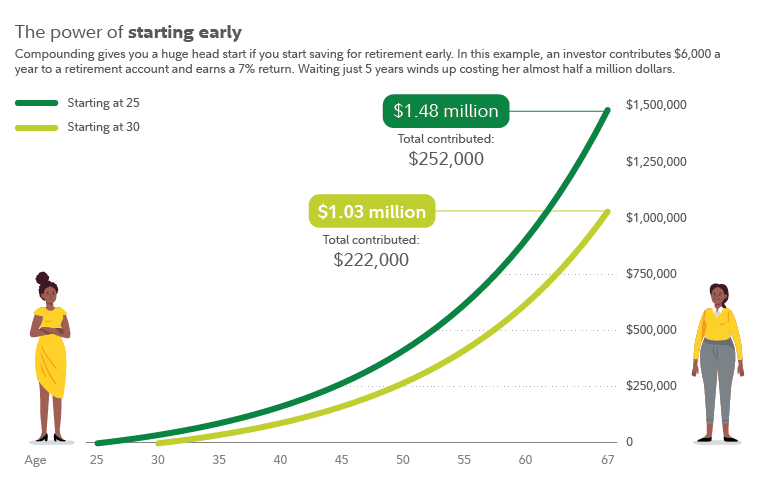
Consider the following hypothetical scenario: Two individuals begin saving at different times. The first person starts at age 25, saving an identical amount each month into a retirement vehicle offering a 6% annual return. Meanwhile, the second individual, prompted by the desire to focus on immediate pleasures, postpones saving until the age of 45 but then doubles the monthly investment.
The first saver amasses a larger retirement fund, despite a comparably modest monthly investment, due to the power of compounding returns. This phenomenon illustrates Franklin's adage: the act of putting money away now, as opposed to the future, leads to greater accumulation.
[](https://www.fidelity.com/bin-public/600_Fidelity_Com_English/images/migration/starting-early.png)
*Illustration of compounding interest*
### Example 2: Opportunity Cost and Career Advancement
Another example contextualizes the aphorism in the realms of career advancement and opportunity cost. Assume Jane has the option to pursue a certificate program in a burgeoning field or delay enrollment for two years in favor of present leisure. By opting for the former, Jane not only expedites entry into a promising occupation but likewise negates the potential for market saturation or stricter entrance qualifications two years hence.
By illustrating the economic concept of opportunity cost, this example underscores the truth that the advantages of present-focused action eclipse the allure of postponing key decisions or actions.
[](https://fastercapital.com/i/Career-paths--Opportunity-Cost-and-Career-Choices--Paving-Your-Future--Common-Career-Paths-and-Their-Opportunity-Costs.webp)
*Opportunity cost in career advancement*
## Concluding Thoughts
Franklin's "One today is worth two tomorrows" offers deep insights into the human propensity to put off essential chores and decisions. In cultivating foresight and valuing present opportunities, the adage urges people to embrace both diligence and responsibility.
To expand on the concept, consider further explorations on related subjects such as behavioral economics, impulsivity, and their impacts on personal finance. Franklin's maxims provide fertile ground for interdisciplinary study, shedding light on the psychology of saving and spending as well as the effects of compounding interest in both financial and professional domains.
Last updated: 2024-05-29
Related Books

Related Knowledges