The Law of Accelerating Returns
===============================
In his groundbreaking book "The Singularity Is Near," Ray Kurzweil introduces the concept of the Law of Accelerating Returns (LOAR). This theory posits that the pace of technological progress is not constant but instead follows an exponential growth curve. This idea is crucial for understanding the implications of technological development and its impact on society, the economy, and our understanding of the world.
[](http://static1.squarespace.com/static/58757ed7f5e231cc32494a1b/5a03763fc830253dadeb4170/5a037d138165f535a0979af9/1510356405317/moores-law-graph-gif.png?format=1500w)
*Illustration of an exponential growth curve in technology*
Core Concepts and Relevance
---------------------------
The Law of Accelerating Returns is based on the observation that the pace of technological progress is not linear but instead doubles approximately every decade. This rapid acceleration is due to the exponential increase in the number of transistors on integrated circuits, as predicted by Moore's Law. However, LOAR extends beyond Moore's Law and encompasses various technological domains, including biotechnology, nanotechnology, and artificial intelligence.
[](https://upload.wikimedia.org/wikipedia/commons/0/00/Moore%27s_Law_Transistor_Count_1970-2020.png)
*Graph illustrating Moore's Law*
The relevance of the Law of Accelerating Returns lies in its ability to help us anticipate and prepare for the implications of exponential technological growth. By understanding the accelerating pace of innovation, we can make informed decisions about the future and adapt to the rapid changes that lie ahead.
Examples and Applications
------------------------
### Artificial Intelligence
The development of artificial intelligence (AI) is a prime example of the Law of Accelerating Returns. In the early days of AI research, progress was slow, and significant breakthroughs were rare. However, as the field matured and computing power increased, the pace of innovation began to accelerate.
Today, AI has made significant strides, with applications ranging from natural language processing and computer vision to complex problem-solving and decision-making. These advancements have led to the creation of powerful tools and systems that have the potential to revolutionize various industries, from healthcare and finance to transportation and education.
[](https://i0.wp.com/sitn.hms.harvard.edu/wp-content/uploads/2017/08/Anyoha-SITN-Figure-2-AI-timeline-2.jpg)
*Timeline of key advancements in Artificial Intelligence*
### Biotechnology
Another area where the Law of Accelerating Returns is evident is in the field of biotechnology. Over the past few decades, biotechnological innovations have led to significant advancements in medicine, agriculture, and environmental science.
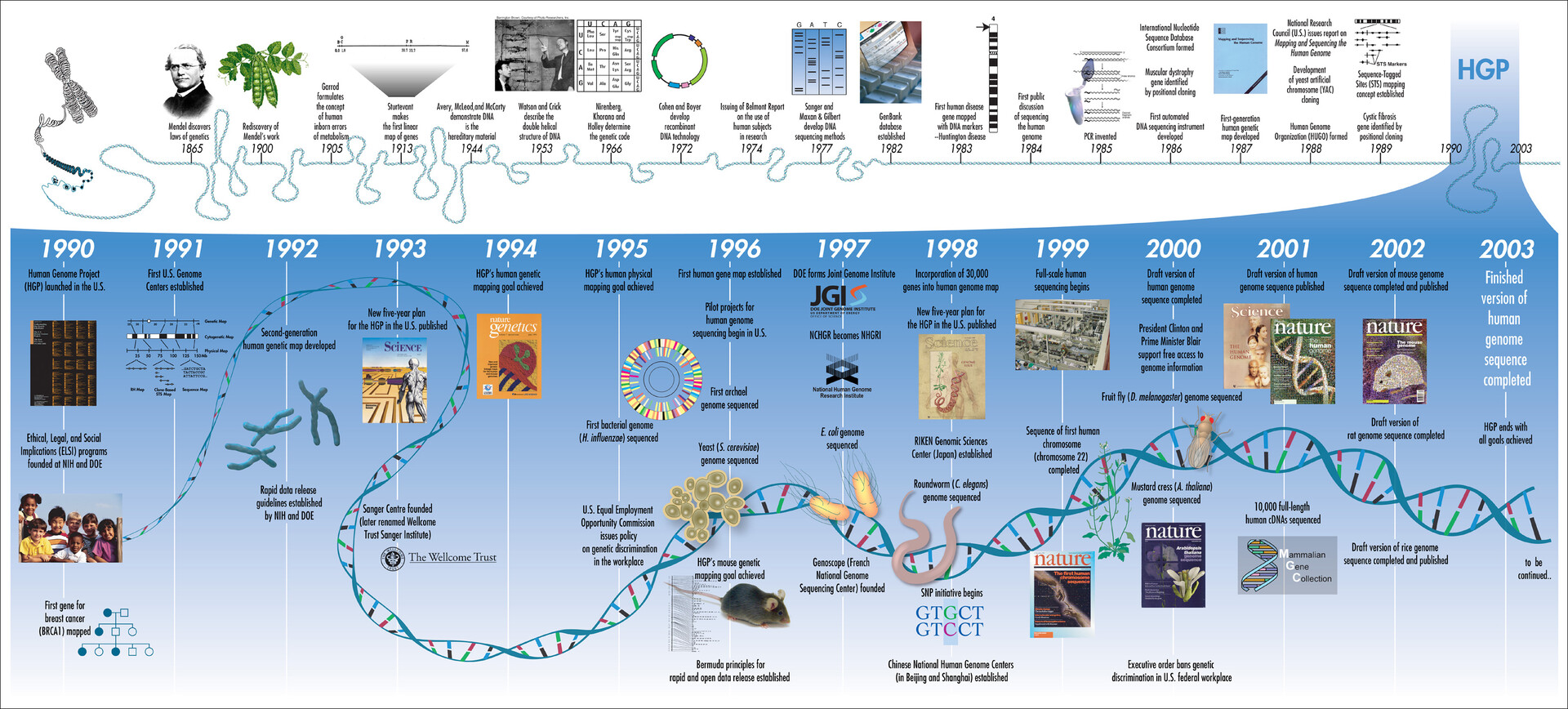
For instance, the Human Genome Project, which began in 1990, aimed to sequence the entire human genome within 15 years. However, due to rapid technological advancements, the project was completed in 2003, a full 13 years ahead of schedule. This accelerated progress has paved the way for groundbreaking research in personalized medicine, gene editing, and synthetic biology.
[](https://cdn.storymd.com/optimized/aARElDCvqz/original.jpg)
*Timeline of the Human Genome Project*
Synthetic biology, in particular, has the potential to revolutionize various industries, from pharmaceuticals and agriculture to energy and materials science. By designing and constructing new biological parts, devices, and systems, synthetic biologists can create novel solutions to some of the world's most pressing challenges, such as climate change, food security, and healthcare disparities.
### Nanotechnology
Nanotechnology, the manipulation of matter at the atomic and molecular scale, is another domain where the Law of Accelerating Returns is evident. Over the past few decades, nanotechnology has made significant strides, with applications ranging from electronics and energy to healthcare and environmental science.
One notable example of nanotechnology's potential is in the development of nanomedicine. By harnessing the unique properties of nanomaterials, researchers can create targeted drug delivery systems, diagnostic tools, and therapeutic agents that can improve patient outcomes and reduce side effects.
Furthermore, nanotechnology has the potential to revolutionize the energy sector by enabling the development of high-capacity batteries, supercapacitors, and solar cells. These innovations can help address the global energy crisis by providing clean, renewable, and efficient energy sources.
[](https://images.spiceworks.com/wp-content/uploads/2023/03/06170048/Nanotechnology-Applications.png)
*Examples of nanotechnology applications*
Key Insights and Further Exploration
------------------------------------
The Law of Accelerating Returns highlights the importance of understanding and adapting to the rapid pace of technological progress. By recognizing the exponential nature of innovation, we can anticipate and prepare for the implications of these advancements on society, the economy, and our understanding of the world.
To further explore the Law of Accelerating Returns, consider the following avenues for further study:
1. Investigate the implications of the Law of Accelerating Returns on the job market and workforce development. How can we ensure that workers are equipped with the necessary skills to thrive in a rapidly changing technological landscape?
2. Examine the ethical and societal implications of exponential technological progress. How can we ensure that the benefits of these advancements are distributed equitably and responsibly?
3. Explore the potential consequences of the Law of Accelerating Returns on geopolitical dynamics. How might the accelerating pace of innovation impact international relations, global security, and economic development?
By delving deeper into these questions and others like them, we can gain a more comprehensive understanding of the Law of Accelerating Returns and its impact on our world. This knowledge will enable us to make informed decisions and adapt to the rapid changes that lie ahead.
Last updated: 2024-05-29
Related Books

Related Knowledges