### Computational Resources: The Lifeblood of Technological Progress
Technological progress is often associated with a variety of factors, but one of the most critical and enabling components is computational resources. In his landmark book 'The Singularity Is Near', Ray Kurzweil discusses the exponential growth of computational power and its impact on the world. This article aims to provide a deep dive into the core concepts of computational resources, their relevance to technological progress, and their practical implications.
[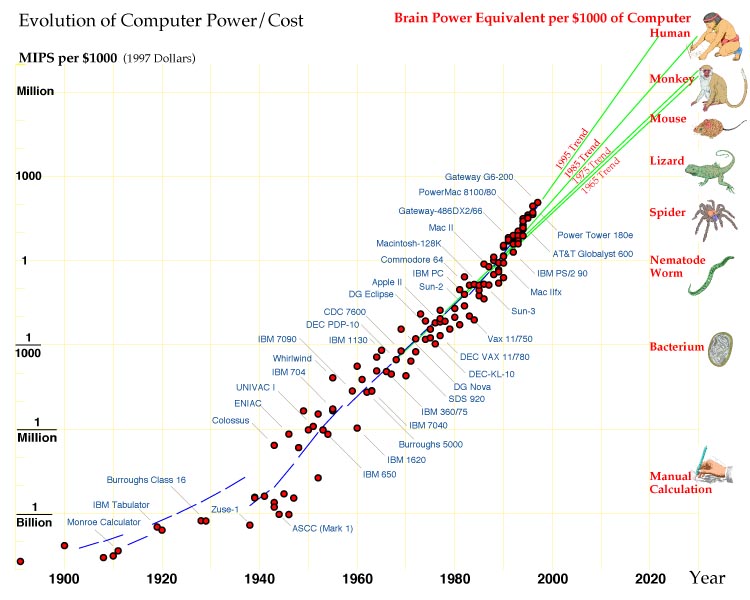](https://jetpress.org/volume1/power_075.jpg)
*Graph of computational power growth over the years*
#### Core Concepts and Relevance
At its core, computational resources refer to the capacity and speed of electronic systems that enable the processing and analysis of data. These resources consist of four primary components:
[](https://images.spiceworks.com/wp-content/uploads/2022/01/19125346/56-1.png)
*Illustration of core components of computational resources*
1. **Processing power**: The speed at which a device can perform computations.
2. **Memory**: The storage capacity of a device for data.
3. **Bandwidth**: The speed at which data can be transmitted between devices.
4. **Storage density**: The amount of data that can be stored in a given physical space.
The relevance of computational resources is best exemplified in Kurzweil's Law of Accelerating Returns. This principle posits that the pace of technological progress accelerates due to the exponential growth of computational power. As computational resources increase, so does the complexity and sophistication of technology, leading to breakthroughs in areas like artificial intelligence, nanotechnology, and biotechnology.
#### Practical Implications: Examples and Applications
Here are some examples and applications that demonstrate the practical implications of computational resources:
1. **Deep learning**: Deep learning is a subset of artificial intelligence (AI) that relies heavily on computational power. With access to powerful computational resources, deep learning algorithms can analyze large datasets and identify complex patterns. For instance, advanced facial recognition systems like Clearview AI employ deep learning techniques to identify individuals based on visual data.
[](https://www.simplilearn.com/ice9/free_resources_article_thumb/6_Incredible_Machine_Learning_Applications.jpg)
*Examples of deep learning applications*
Without the rapid increase in computational resources, it would not be possible to analyze and extract meaningful insights from vast datasets efficiently.
2. **Cryptocurrency mining**: Cryptocurrency mining is a computation-intensive process that involves solving complex mathematical equations to validate transactions. As the demand for cryptocurrencies like Bitcoin and Ethereum increases, so does the computational power required to mine them.
The computational requirements of cryptocurrency mining have led to the development of specialized hardware like ASICs (Application-Specific Integrated Circuits) and GPU (Graphics Processing Unit) farms.
[](https://www.cudominer.com/wp-content/uploads/sites/2/2019/05/AdobeStock_180524293-1.png)
*ASIC and GPU farms for cryptocurrency mining*
#### Key Insights and Further Exploration
In conclusion, computational resources are a critical enabler of technological progress. As Kurzweil posits, the explosive growth of computational power has led to exponential progress in areas like AI, biotechnology, and nanotechnology. It is worth noting, however, that this rapid increase in computational resources has its downsides: environmental impact, privacy concerns, and the risk of automation-driven unemployment, to name a few.
To further explore the topic of computational resources, consider the following:
- Read up on the environmental impact of data centers and their growing energy consumption.
- Research the role of computational resources in scientific achievements, such as the Human Genome Project, or the discovery and mapping of the Higgs Boson.
- Delve into the debate surrounding the economic and societal implications of automation and the potential for a universal basic income (UBI) as a response.
In a rapidly changing technological landscape, understanding computational resources and their practical implications is essential for anyone looking to navigate the challenges and opportunities of the 21st century.
Last updated: 2024-06-12
Related Books

Related Knowledges