# Photons and Biological Neural Interfacing: A Deep Dive into the Future of Technology
## Introduction
The concept of photons and biological neural interfacing is an intriguing intersection of physics, biology, and technology. In his groundbreaking book *The Singularity Is Near*, Ray Kurzweil establishes the relevance of this field by prognosticating the exponential convergence of these disciplines in the coming decades.
[](https://assets-global.website-files.com/62792c49f89cb381b3affec5/648c3a9ee236d9708fa6829e_ray.jpg)
*Ray Kurzweil speaking about technology and the future*
At the core of this knowledge point is the idea of using photons – the fundamental particles that constitute light – to interface with biological neurons. Photons are particularly suitable for this task due to their low-energy nature and the ease with which they can be controlled and manipulated using current technologies. Biological neural interfacing, meanwhile, alludes to the art of establishing direct communication channels between artificial devices and biological neural networks (e.g., brains).
The convergence of photons and biological neural interfacing harbors tremendous potential for addressing several unmet clinical needs. These include the development of advanced neuro-prosthetic limbs, targeted neural stimulation devices, and revolutionary therapies for neurological disorders.
[](https://media.springernature.com/m685/springer-static/image/art%3A10.1038%2Fs41587-019-0198-8/MediaObjects/41587_2019_198_Fig1_HTML.png)
*A conceptual diagram of photonic neural interfacing*
Herein, we will first introduce the underlying technological elements responsible for enabling photonic neural interfacing. Next, we will present a collection of illustrative examples, each casting light on the practical implications of this field.
## Technological Elements of Photonic Biological Neural Interfacing
Before delving into the world of photonic neural interfacing, one must acquire a solid grasp of the cornerstone technologies that support it. These can be succinctly encapsulated as follows:
- **Optogenetics**: Optogenetics represents a cutting-edge technique at the crossroads of genetics and optics. More specifically, it refers to the use of targeted genetic modifications to render neurons sensitive to specific wavelengths of light. Once engineered, these neurons can be activated or inhibited by shining the relevant light wavelengths. The most popular optogenetic actuator is the Channelrhodopsin-2 protein, a light-gated cation channel extracted from the green algae *Chlamydomonas reinhardtii*. These light-gated channels have proven instrumental in facilitating precise neural activation.
- **Waveguides**: Waveguides are specific constructs designed to guide light waves along predetermined pathways. Consequentially, they are amenable to delivering a prescribed distribution of photons to the desired locations. Polymer-based waveguides, for instance, are particularly adapted to biomedical interfacing due to their transparency, biocompatibility, and adaptability to various curvature scales. These attributes render waveguides particularly appealing for photonic neural interfaces.
[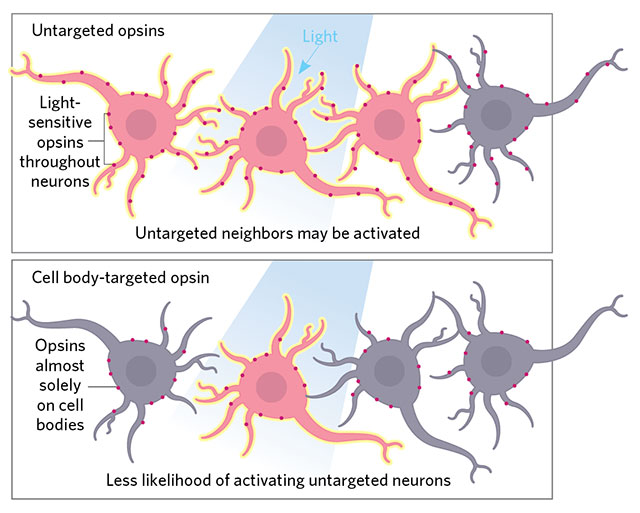](https://cdn.the-scientist.com/assets/articleNo/30019/iImg/700/uploads/ts_modus_optogenetics_640x513.jpg)
*Optogenetics in action*
Having familiarized ourselves with the background technological concepts, it is now time to explore some real-world examples.
## Biomedical Applications of Photonic Neural Interfacing: Illustrative Examples
### Restoring Vision Using Photonic Prosthetics
Visual prosthetic devices are auxiliary systems designed to restore vision to individuals suffering from retinal degenerative diseases such as retinitis pigmentosa or age-related macular degeneration.
A fascinating category of prostheses relies on photonic technology to electrically stimulate the remaining functional neurons in the retina. A stellar example of this class encompasses the Argus II retinal prosthesis, developed by Second Sight.
In essence, the Argus II device is a retinal implant that seamlessly links the damaged retina with the optic nerve by employing a photovoltaic array. This array is strategically positioned on the retinal surface, where it interfaces both with the residual neurons and the incoming waveguides.
[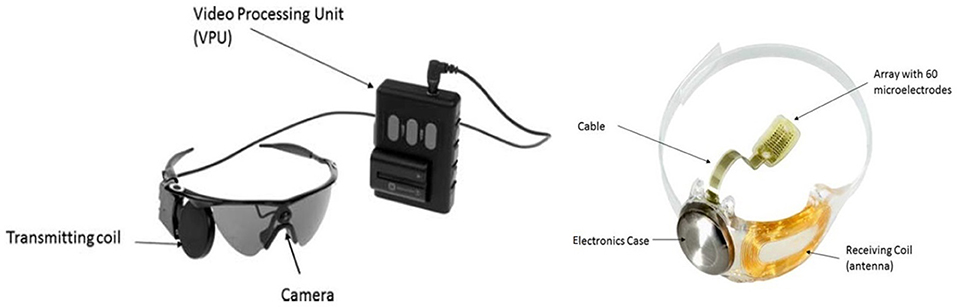](https://www.frontiersin.org/files/Articles/379353/fnins-12-00584-HTML-r1/image_m/fnins-12-00584-g001.jpg)
*Visual prosthetic device example*
The Argus II system harnesses a pair of camera-embedded glasses, which captures visual data and forwards it to an external processing unit. Upon decoding these data, the unit generates the corresponding customized light patterns and communicates them back to the implanted waveguides. The delivered photons then excite the retinal neurons, engendering the perception of visual cues by the individual.
A heartening accomplishment pertains to the success stories of implanted users, who have regained their ability to discern shapes, recognize objects, and even traverse obstacle-laden environments. Such achievements underscore the tangible impact and potential of photonic neural interfaces in restoring vision.
### Alleviating Parkinson's Disease Symptoms Through Targeted Neural Stimulation
Parkinson's disease (PD) is a progressive nervous system disorder that primarily affects movement. Its symptoms include tremors, stiffness, and uncontrolled movements, all rooted in the dopamine deficiency caused by the death of dopaminergic neurons within the substantia nigra.
A compelling potential avenue for treating PD lies in the targeted stimulation of the remaining functional dopaminergic neurons using photonic neural interfaces. This methodology offers a two-fold advantage: precise manipulation of neuronal firings and reduced invasiveness compared to the incumbent deep brain stimulation interventions.
A pioneering instance in this domain is the optogenetic approach advanced by the Grill laboratory at Stanford. Here, engineered adeno-associated viruses are harnessed to introduce light-gated channels (ChR2) in dopaminergic neurons. Once integrated, an optic fiber waveguide delivers precisely tailored laser pulses to the infected cells, thereby modulating dopamine release and alleviating the associated Parkinsonian symptoms.
[](https://www.nsf.gov/news/mmg/media/images/parkinsons1_f.jpg)
*Optogenetic stimulation for Parkinson's disease*
In a preclinical setting, Parkinsonian non-human primates subjected to laser stimulation displayed considerable motor performance enhancements, reinforcing the prospects of optogenetic neuromodulation for the treatment of Parkinson's disease.
## Conclusion and Future Directions
The convergence of photons and biological neural interfacing heralds a brave new world of clinical applications, merging the best of both worlds to address previously unmet needs and conquer formidable pathological conditions.
A wealth of opportunities abound in this captivating field, encompassing:
- The enhancement of neural-prosthetic devices,
- The optimization of targeted neural stimulation strategies,
- And the development of innovative approaches for clinical neuroscience research,
Among others.
Emboldened by the resounding achievements thus far, we stand at the precipice of a revolution that pledges to reshape the future of medicine, imbuing it with more precision, efficacy, and adaptive potential than ever before.
#### Recommended Reading and Viewing
* **Books**:
+ Kurzweil, R. (2005). *The Singularity is Near: When Humans Transcend Biology*. Penguin.
+ Deisseroth, K. (2015). *Brainwaves: The Future of Brain-Computer Interfacing*. TED Books.
* **Documentaries**:
+ Gibney, A. (Director). (2017). *Machines with Brains* [Documentary]. PBS NOVA.
()
+ Dalkara, D., Lin, J. H., & Sinclair, J. D. (2015). Optical technologies for vision restoration. Progress in Retinal and Eye Research, 46, 4-24.
()
Last updated: 2024-05-29
Related Books

Related Knowledges