# Feedback and Information Drive Evolution: Understanding the Key to Progress through David Deutsch's Perspective
_"In order to explain and predict the evolution of any information-processing system, you may need to know about its goals, its initial state, the properties of its building blocks, and the laws that govern their interactions. But you will certainly also need to know how it receives, selects and utilizes information and feedback about its performance – in other words, how it learns."_
— David Deutsch, _The Beginning of Infinity_
## Introduction
[](https://upload.wikimedia.org/wikipedia/commons/0/04/David_Deutsch.jpg)
*David Deutsch, a prominent physicist and author.*
David Deutsch, a renowned physicist and author, posits that progress and evolution are driven by the ability of systems to receive, process, and utilize information and feedback. This idea, central to Deutsch's groundbreaking work, _The Beginning of Infinity_, highlights the importance of an ongoing, iterative process of learning and adaptation. In this educational content, we aim to delve deeply into the concept of 'Feedback and Information Drive Evolution' as presented by Deutsch, elucidating the core concepts, implications, and practical applications of this fascinating idea.
## Core Concepts
At the heart of Deutsch's perspective lies the understanding that evolution and progress are deeply intertwined with the generation, processing, and utilization of information. Specifically, Deutsch emphasizes that feedback and information play pivotal roles in driving the evolution of any information-processing system. Feedback and information drive evolution through the following core concepts:
[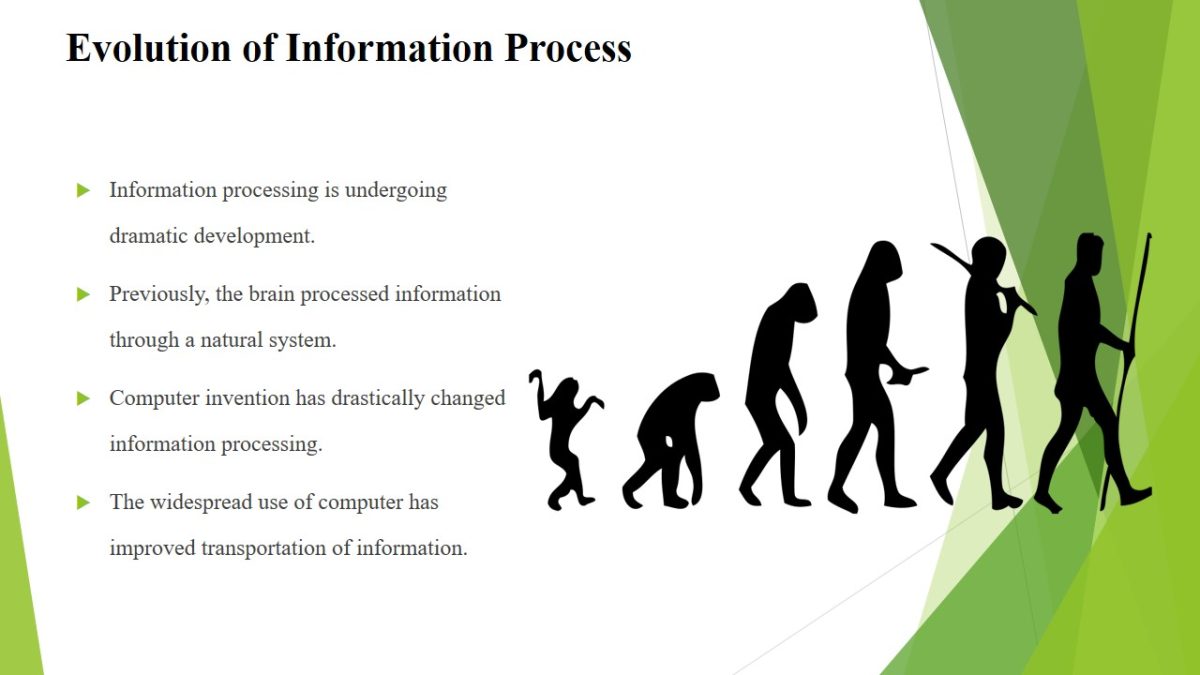](https://ivypanda.com/essays/wp-content/uploads/2022/09/information-processing-and-improving-learning-and-memory-slide2-1200x675.jpg)
*The concept of how information and feedback drive evolution.*
1. **Selectionism:** Selectionism refers to the process by which an ensemble of possibilities is iteratively reduced based on their performance or 'fitness'. In this context, the information-processing system evaluates each possibility according to a set of criteria, ultimately selecting the most suitable candidate for further development.
2. **Critical Discussion:** Critical discussion, or the ability to evaluate, critique, and refine ideas through open dialogue, allows for growth and progress within a system. By leveraging the collective wisdom of a group or even an individual's internal dialogue, critical discussion facilitates the iterative refinement of ideas.
3. **Replicator Fallacy:** The replicator fallacy stems from the misconception that the fundamental unit of evolution is the replicator – a self-reproducing entity. Instead, Deutsch argues that the fundamental units of evolution are the _interactors_ – the entities that interact with their environment and generate new information. This shift in perspective emphasizes the role of feedback and interaction in driving progress.
## Practical Implications & Examples
[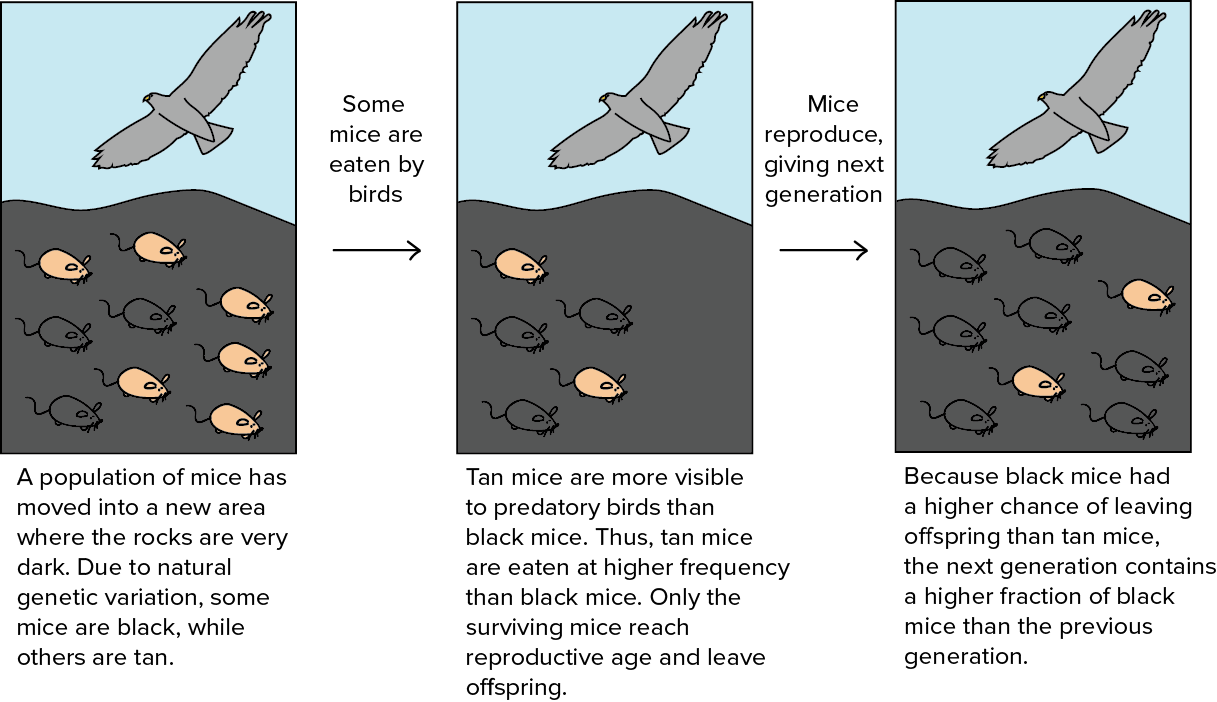](https://cdn.kastatic.org/ka-perseus-images/8f33aa4bd39c5c435af5e5dc4001d73721a25f85.png)
*An illustration of natural selection in evolutionary biology.*
To illustrate the practical implications of 'Feedback and Information Drive Evolution', we will explore several examples, shedding light on the relevance and application of these concepts in diverse domains.
### Evolutionary Biology
In evolutionary biology, the role of feedback and information can be observed in the process of natural selection. Here, the replicators are the genes, while the interactors are the individual organisms that carry and express those genes. Their interaction with the environment shapes the organism's fitness, as well as the likelihood of survival and reproduction.
Through the continuous interplay between the genotype (genetic makeup) and the phenotype (observable traits), the population evolves and adapts to changing environmental conditions. This dynamic process highlights the importance of feedback and information exchange, as the environment conveys critical information about the suitability of various genetic configurations.
### Artificial Intelligence and Machine Learning
Artificial intelligence (AI) and machine learning (ML) offer another lens through which to examine the role of feedback and information in evolution. In these domains, algorithms iteratively learn, refine, and improve their performance based on feedback and information about their previous outputs.
[](https://www.ibm.com/content/dam/connectedassets-adobe-cms/worldwide-content/cdp/cf/ul/g/3a/b8/ICLH_Diagram_Batch_01_03-DeepNeuralNetwork.component.xl.ts=1744888320157.png/content/adobe-cms/us/en/think/topics/ai-vs-machine-learning-vs-deep-learning-vs-neural-networks/jcr:content/root/table_of_contents/body-article-8/image)
*Training process of a neural network for image recognition.*
Consider, for instance, the training process of a neural network for image recognition. By providing a large dataset of labeled images, the neural network learns to discern patterns and associations between the images' visual features and their corresponding labels. Over multiple iterations, the model refines its internal weights and biases, progressively augmenting its ability to accurately classify images – a testament to the influence of feedback and information in driving the optimization process.
### The Creative Process
Beyond the realms of biology and technology, David Deutsch's ideas on the role of feedback and information in evolution can also be applied to human creativity and innovation. In this context, the creative process can be viewed as an ongoing dialogue between the individual's existing knowledge and understanding, and the external information and feedback that challenge and refine their ideas.
[](https://aylsworthartclass.wordpress.com/wp-content/uploads/2015/09/diagram1.png)
*The iterative process in artistic creation influenced by feedback.*
As an artist develops a new piece of work, they incorporate feedback from their own critical evaluation, as well as from external sources, such as mentors, peers, or patrons. In this iterative process, the artist's idea is refined and shaped, evolving in response to the information and feedback received.
## Key Insights and Further Exploration
By exploring the concept of 'Feedback and Information Drive Evolution', we have uncovered several insights that deepen our understanding of progress and evolution across diverse domains:
* Feedback and information serve as critical drivers of evolution and progress in information-processing systems.
* The fundamental units of evolution are the interactors, the entities that interact with their environment and generate new information.
* The replicator fallacy offers a different perspective on the evolutionary process, emphasizing the importance of interaction between replicators and their environment.
For college students interested in further exploring this topic, we suggest engaging with the following resources and activities:
* Engaging in critical discussions and debates on the implications of 'Feedback and Information Drive Evolution'.
* Delving into the work of other thinkers and researchers who have contributed to our understanding of the role of information and feedback in evolution, such as Richard Dawkins, Daniel Dennett, and Stuart Kauffman.
* Applying the principles of 'Feedback and Information Drive Evolution' to real-world challenges and design problems, such as developing AI and ML algorithms, or creating innovative solutions to complex societal issues.
By embracing the concepts and insights offered by David Deutsch and others, college students can cultivate a deeper appreciation for the complex, dynamic relationship between information, feedback, and evolution, paving the way for future breakthroughs that facilitate progress and innovation.
Last updated: 2025-05-08
Related Books

Related Knowledges