# Scenario Analysis: Navigating Uncertainty with Andy Grove
_"The future is not open to us; it is hidden, and we must do our best to uncover its secrets." - Pierre Teilhard de Chardin_
In today's fast-paced, ever-changing global economy, uncertainty is the only certainty. In order to successfully navigate the complex and unpredictable business landscape, it is crucial for organizations and managers to adopt a proactive approach, anticipate changes, and adapt accordingly. One such approach that has garnered significant attention in recent years is 'scenario analysis.' In his groundbreaking work, *Only the Paranoid Survive*, former Intel CEO Andrew S. Grove sheds light on the importance of strategic scenario planning as a tool for managing uncertainty and making informed, strategic business decisions. This article delves into the core concepts of scenario analysis and illustrates their practical implications through diverse examples and applications.
[](http://content.tegna-media.com/photo/2016/03/22/635941917961588841-Grove_1099981_ver1.0.jpg)
*Andrew S. Grove, former CEO of Intel*
## The Art of Scenario Analysis
Scenario analysis, a strategic planning methodology, is a systematic approach to contemplating and preparing for possible future events. It is predicated on the understanding that complexity and uncertainty define the modern business ecosystem. By constructing plausible alternative futures, organizations are better equipped to identify and navigate the potential challenges and opportunities that lie ahead. According to Grove, strategic scenario planning is a "disciplined approach to thinking about the future" that forces organizations to critically evaluate their assumptions, challenge conventional wisdom, and explore unconventional alternatives.
[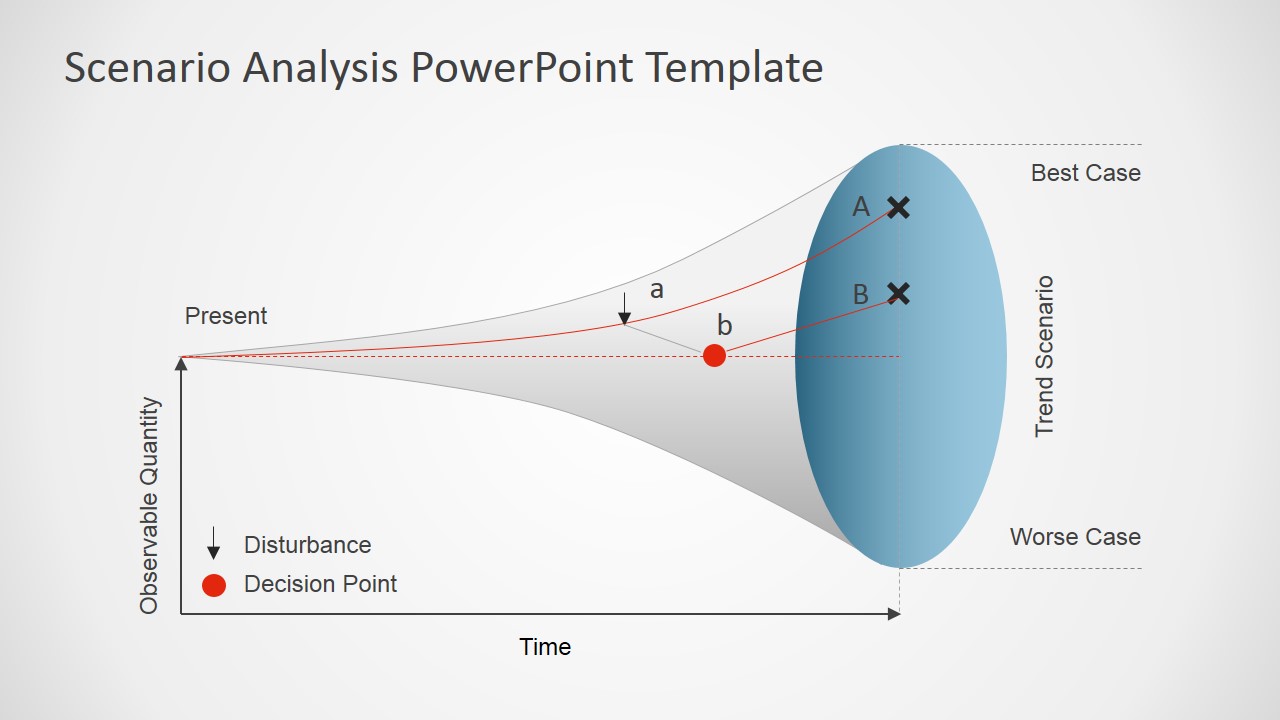](https://slidemodel.com/wp-content/uploads/6981-01-scenario-analysis-powerpointp-template-1.jpg)
*Illustration of Scenario Analysis Process*
There are three core principles that underpin effective scenario analysis:
1. **Anticipation:** In order to effectively plan for the future, organizations must first shed light on the underlying trends, driving forces, and wildcards that may impact the business environment. These factors can range from demographic shifts and technological innovations to economic fluctuations and geopolitical instabilities. By maintaining a constant, proactive vigilance over these elements, organizations can develop an anticipatory mindset that informs strategic decision-making.
2. **Plausibility:** Scenario analysis is not a crystal ball or an attempt to predict the future with certainty. Rather, it is a systematic process of constructing a series of plausible, yet distinct, alternative futures. These scenarios are not meant to be definitive or exhaustive; rather, they should be regarded as thought-provoking narratives that can help organizations explore uncertainties, challenge assumptions, and identify potential opportunities and threats.
3. **Adaptability:** The ultimate goal of scenario analysis is not to prescribe a single, definitive course of action but rather to enhance organizational adaptability. By exploring the implications of various scenarios, managers can develop a deeper understanding of their organization's strategic flexibility and resilience. This, in turn, can enable the development of more robust strategies that are better suited to respond to and thrive in a variety of future contexts.
## Paranoid Scenarios in Practice
To illustrate the practical applications of strategic scenario planning, let us consider two examples from Grove's *Only the Paranoid Survive*:
### IBM and the Personal Computer Revolution
In the late 1970s, IBM, the undisputed titan of the computer industry, faced an existential threat in the form of the burgeoning personal computer (PC) market. At the time, the dominant narrative within IBM was that the PC was a fad - a niche product with little long-term potential. Grove, however, harbored a deep sense of unease and skepticism regarding the company's strategic assumptions. In order to challenge these entrenched beliefs, Grove and his team conducted a strategic scenario analysis that explored two distinct, yet plausible, alternative futures:
- **Scenario A:** The PC remains a niche product, relegated to hobbyists and enthusiasts, with no significant impact on IBM's bottom line.
- **Scenario B:** The PC market takes off and disrupts the entire industry, relegating mainframes and minicomputers - IBM's core offerings - to obsolescence.
Upon examining the implications of these scenarios, it became abundantly clear to Grove and his team that Scenario B posed an imminent, existential threat to IBM's long-term survival. As a result, the company made the fateful decision to enter the PC market - a decision that not only transformed IBM's fortunes but also revolutionized the computer industry as a whole.
[](http://images.computerhistory.org/revonline/images/102716228p-03-01.jpg?w=600)
*IBM and the Personal Computer Revolution*
### Intel's Memory Chip Crisis
In the early 1980s, Intel found itself grappling with a severe crisis: the memory chip market, which had long been the company's bread and butter, was rapidly deteriorating. The confluence of several factors, including the rapid advancements in memory chip technology and intense competition from Japanese manufacturers, threatened Intel's very existence. In response, Grove and his team once again turned to strategic scenario analysis in order to evaluate their options. They constructed two alternative futures:
- **Scenario A:** The memory chip market recovers, and Intel's fortunes are restored.
- **Scenario B:** The memory chip market continues to languish, and Intel's core competencies become increasingly irrelevant.
Upon careful consideration, Grove and his team concluded that relying on the memory chip market's recovery was a risky and potentially disastrous strategy. Instead, they made the bold decision to abandon the memory chip market and focus on emerging opportunities in the microprocessor market. This strategic pivot not only salvaged Intel's future but also solidified its position as the undisputed leader in the microprocessor market.
[](https://i.pinimg.com/474x/e0/1a/0b/e01a0bb8a119642150bad971df9fa135.jpg)
*Intel's Shift to Microprocessors*
## Key Insights and Further Exploration
Through the examples provided above, it becomes evident that strategic scenario analysis is a powerful tool for managing uncertainty and making informed, strategic business decisions. By exploring alternative futures, organizations can enhance their adaptability, challenge assumptions, and ultimately, achieve resilience in an increasingly volatile world.
For those interested in further exploring the art and science of scenario analysis, the following resources are highly recommended:
- *Only the Paranoid Survive* by Andrew S. Grove: In this seminal work, Grove shares his firsthand experiences and insights on navigating uncertainty and the crucial role of strategic scenario planning in shaping Intel's success.
- *The Art of Strategic Planning: A Guide to Solving the Right Problems* by Joseph L. badaracco Jr.: This comprehensive guide provides a practical, step-by-step framework for conducting strategic scenario analysis and addressing the complex, unpredictable challenges that define the modern business landscape.
- *Scenario Planning: A Field Guide to the Future* by Pierre Wack, et al.: This seminal work, originally published in the *Harvard Business Review*, presents a detailed exploration of Shell's groundbreaking approach to strategic scenario planning and its role in shaping the company's strategic decision-making process.
In conclusion, strategic scenario analysis is an indispensable tool for organizations and managers operating in today's turbulent business environment. By adopting a proactive, anticipatory mindset, constantly evaluating underlying trends and driving forces, and exploring alternative futures, organizations can not only survive but thrive in the face of uncertainty. As Grove aptly instructs us, "only the paranoid survive."
Last updated: 2024-05-01
Related Books
Related Knowledges