# Exploiting New Opportunities: Grove's Strategic Inflection Points and Their Implications
Andrew S. Grove, former CEO and chairman of Intel Corporation, coined the term "strategic inflection points" (SIPs) in his influential book *Only the Paranoid Survive* (1996). Grove argues that SIPs are disruptive incidents or shifts that fundamentally alter a company's business environment, necessitating a significant reaction or adaptation from the organization. The SIP concept highlights the need for companies to stay vigilant, anticipate, and proactively exploit new opportunities arising from these disruptive forces. This article will delve into the core concepts of SIPs, present real-life examples, and discuss the practical implications of strategic inflection points and exploiting new opportunities.
[](https://upload.wikimedia.org/wikipedia/commons/5/51/Andrew_Grove.jpg)
*Andrew S. Grove introducing the concept of strategic inflection points*
## Understanding Strategic Inflection Points
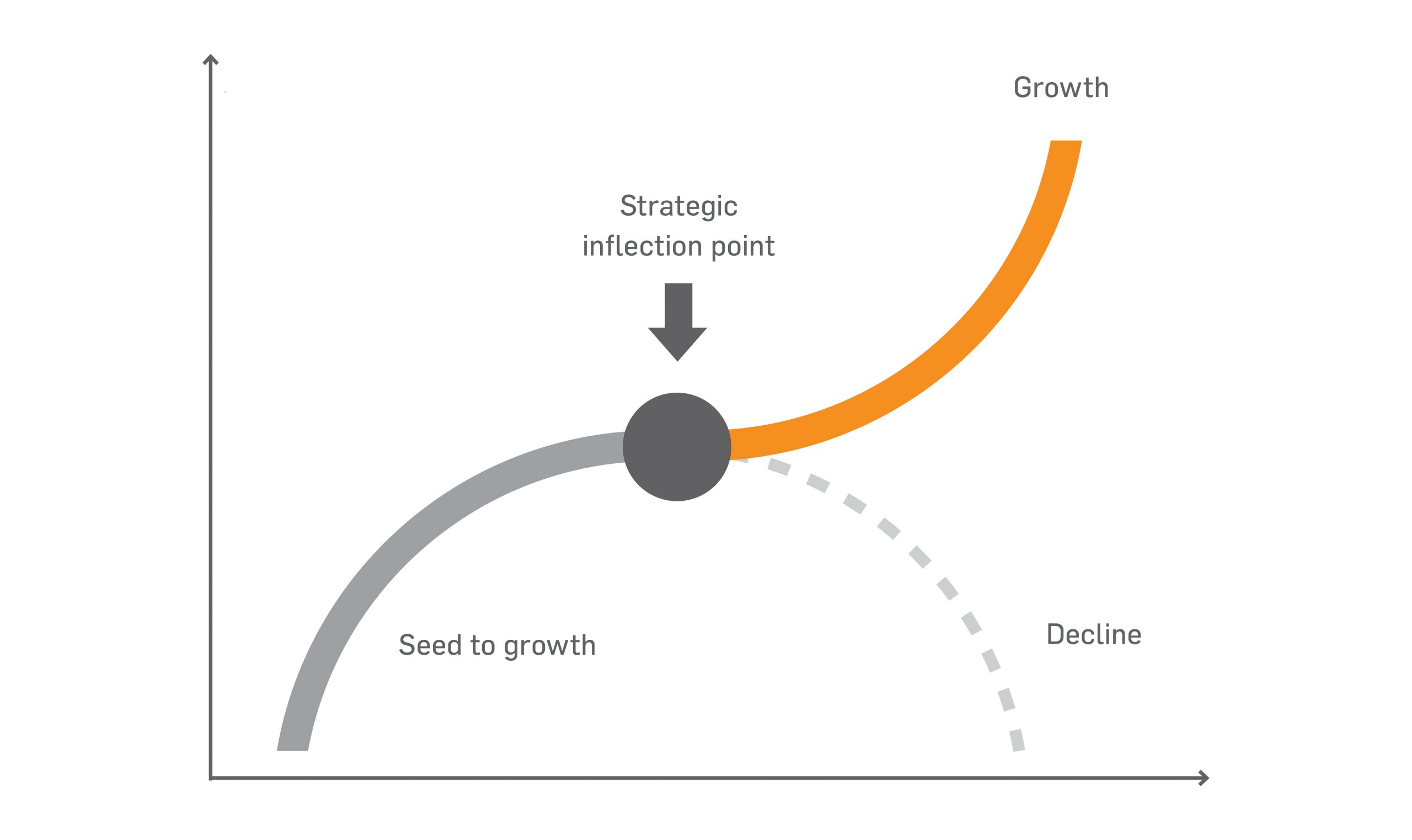
A strategic inflection point is a gradual but ultimately transformative change that impacts the trajectory of an organization. SIPs can emerge from internal factors or external forces, such as new technologies, evolving consumer preferences, regulatory changes, or economic shifts. Grove maintains that SIPs can be recognized by:
[](https://interactiveworkshops.com/wp-content/uploads/2018/06/Strategic-Inflection-Point-scaled.jpg)
*Diagram of a Strategic Inflection Point*
1. **Quantitative changes leading to qualitative differences**: Subtle quantitative shifts in a market or business environment can evolve into a paradigm shift in the future.
2. **Acceleration in the pace of change**: SIPs are characterized by the increasing speed at which change occurs, compressing the time available for a company to react.
3. **Complexity**: SIPs create a complicated and intricate environment in which companies must respond and adapt.
## Exploiting New Opportunities: Responding to Strategic Inflection Points
To successfully exploit new opportunities arising from strategic inflection points, organizations must develop a proactive and strategic approach in tackling these shifts. Here are four key considerations in seizing new opportunities:
1. **Anticipation and early recognition**: Companies should constantly monitor and analyze their business environments to promptly recognize SIPs. Early detection enables firms to respond effectively and exploit opportunities more efficiently.
2. **Adaptation**: Companies must adapt to the changing business landscape and address the disruptions caused by SIPs. This may entail altering a company's business model, product offerings, or operational processes.
3. **Resource allocation**: To capitalize on new opportunities, organizations need to allocate resources strategically. Re-deploying resources (human, financial, or technological) to promising areas can make a significant difference in seizing opportunities and gaining a competitive advantage.
4. **Continuous learning and improvement**: Organizations should promote a culture of learning and adaptation to ensure sustainable prosperity in the face of constant change.
## Real-life Examples and Applications
### The Emergence of Smartphones
The advent of smartphones is a perfect example of a strategic inflection point. Though cell phones had been growing in popularity since the late 1980s, Apple's iPhone release in 2007 marked a pivotal transformation in the mobile industry. This SIP was characterized by quantitative changes (increasing smartphone capabilities) turning into a qualitative shift (smartphones becoming all-in-one devices), accelerating change (rapid innovation), and growing complexity (app development and integration).
[](https://miro.medium.com/v2/resize:fit:872/1*XDLi0l9s7bJZhfuLCKoN_A.jpeg)
*Smartphone evolution as an example of Strategic Inflection Point*
Several companies recognized and exploited the arising opportunities. Among these winners were:
- **Apple**: Introduced the iPhone and continued to innovate, offering a game-changing touch-screen experience. Apple recognized the opportunities associated with smartphones, transformed the mobile industry, and expanded into services, such as the App Store and Apple Music.
- **Google**: Reacted by creating its Android operating system (OS), a free, flexible, and customizable OS for handset manufacturers. Google's strategic approach opened the smartphone market to a diverse set of players and leveraged Android as a platform for its lucrative digital advertising business.
- **Samsung**: Capitalizing on Android's versatility, Samsung transformed its semiconductor and consumer electronics background into a worldwide smartphone powerhouse.
### The E-commerce Revolution
The shift from traditional retail to online shopping represents a powerful strategic inflection point in the way consumer goods and services are sold. E-commerce disrupted and forever altered the retail landscape and the way consumers interact with brands.
[](https://miro.medium.com/v2/resize:fit:1400/1*KieT8db8b6O6G4Dqc4N1Ug.jpeg)
*The impact of e-commerce on retail*
E-commerce's SIP was characterized by:
- Quantitative changes (increasing online shopping convenience and speed) leading to qualitative shifts (the rise of mobile and online-only platforms)
- Acceleration in the pace of change (rapid penetration of internet access and devices)
- Complexity (multi-channel sales, logistics networks, and cross-border regulations)
E-commerce's SIP spurred the success of multiple organizations, including:
- **Amazon**: A pioneer of e-commerce, Amazon leveraged early recognition of the SIP, developing a groundbreaking online marketplace and innovating supply chain capabilities. Amazon exploited the opportunity, expanded into services (such as AWS and Alexa), and became a symbol of disruption.
- **AliExpress**: Alibaba's international B2C platform, AliExpress, seized the e-commerce opportunity by targeting global consumers looking for unique and affordable products. AliExpress leveraged user-generated content (ratings, reviews), competitive pricing, and logistics partnerships to become a key player in international e-commerce.
- **Zappos**: By focusing on customer experience (free delivery and returns, 24/7 customer service), Zappos transformed the footwear retail industry. Acquired by Amazon in 2009, Zappos remained committed to its customer-centric approach and expanded into offering a wider range of merchandise.
## Conclusion
Strategic inflection points are infrequent but critical opportunities for companies to reinvent themselves and prosper. Success in exploiting new opportunities hinges upon a corporation's capacity to anticipate, react, adapt, and continuously learn. By fostering a culture of paranoia, agility, and forward-thinking, companies can effectively exploit new opportunities and capture the market potential offered by strategic inflection points.
Further exploration of this topic can include a thorough case study analysis on disruptive innovations and corresponding organizational responses (e.g., Netflix vs. Blockbuster or Uber vs. the traditional taxi industry). Moreover, examining the role of leadership and the organizational change process in response to SIPs can provide valuable insights for students.
Last updated: 2024-06-21
Related Books

Related Knowledges