# Fast Decision Making: Crucial Insights from "Only the Paranoid Survive"
## Introduction
[](https://upload.wikimedia.org/wikipedia/commons/5/51/Andrew_Grove.jpg)
*Andrew S. Grove, former CEO of Intel*
In today's fast-paced and ever-changing world, the ability to make quick, effective decisions is vital for both individuals and organizations. Andrew S. Grove, the former CEO of Intel, emphasized the importance of fast decision making in his influential book "Only the Paranoid Survive." The book, which chronicles Grove's experience leading Intel through tumultuous periods in the technology industry, serves as a comprehensive guide to strategic decision-making under uncertainty and rapidly shifting conditions.
*Fast decision making* refers to the capability to gather, process, and act on information in a timely and accurate fashion, allowing for optimal outcomes even in high-pressure situations. In this educational content, we will delve into the core concepts of fast decision making presented in Grove's book and explore their practical implications with real-world examples and applications.
[](https://images.fastcompany.com/image/upload/f_auto,q_auto,c_fit/wp-cms/uploads/2023/03/mastering_fast_decision_making_to_accelerate_your_business_success.jpg)
*The importance of fast decision making in business*
## Fast Decision Making: Core Concepts and Relevance
Grove's treatise on fast decision making is grounded in his experiences navigating the high-stakes world of the technology industry. At Intel, rapid innovation and fierce competition necessitated swift, well-informed decision-making at all levels of the organization.
Central to Grove's argument is the idea that decision makers must continuously assess their strategic environments and adjust their approaches accordingly. This ongoing evaluation requires a commitment to data-driven analysis and an understanding that even the best-laid plans may need to be abandoned in the face of new information.
Furthermore, Grove stresses the importance of empowering employees at all levels to make decisions quickly and confidently. By fostering a culture that encourages calculated risk-taking and rapid decision making, organizations can respond nimbly to emerging trends and capitalize on opportunities as they arise.
## Practical Implications with Real-World Examples
To better understanding the practical implications of fast decision making, let's consider a few real-world examples:
### Example 1: Blockbuster vs. Netflix
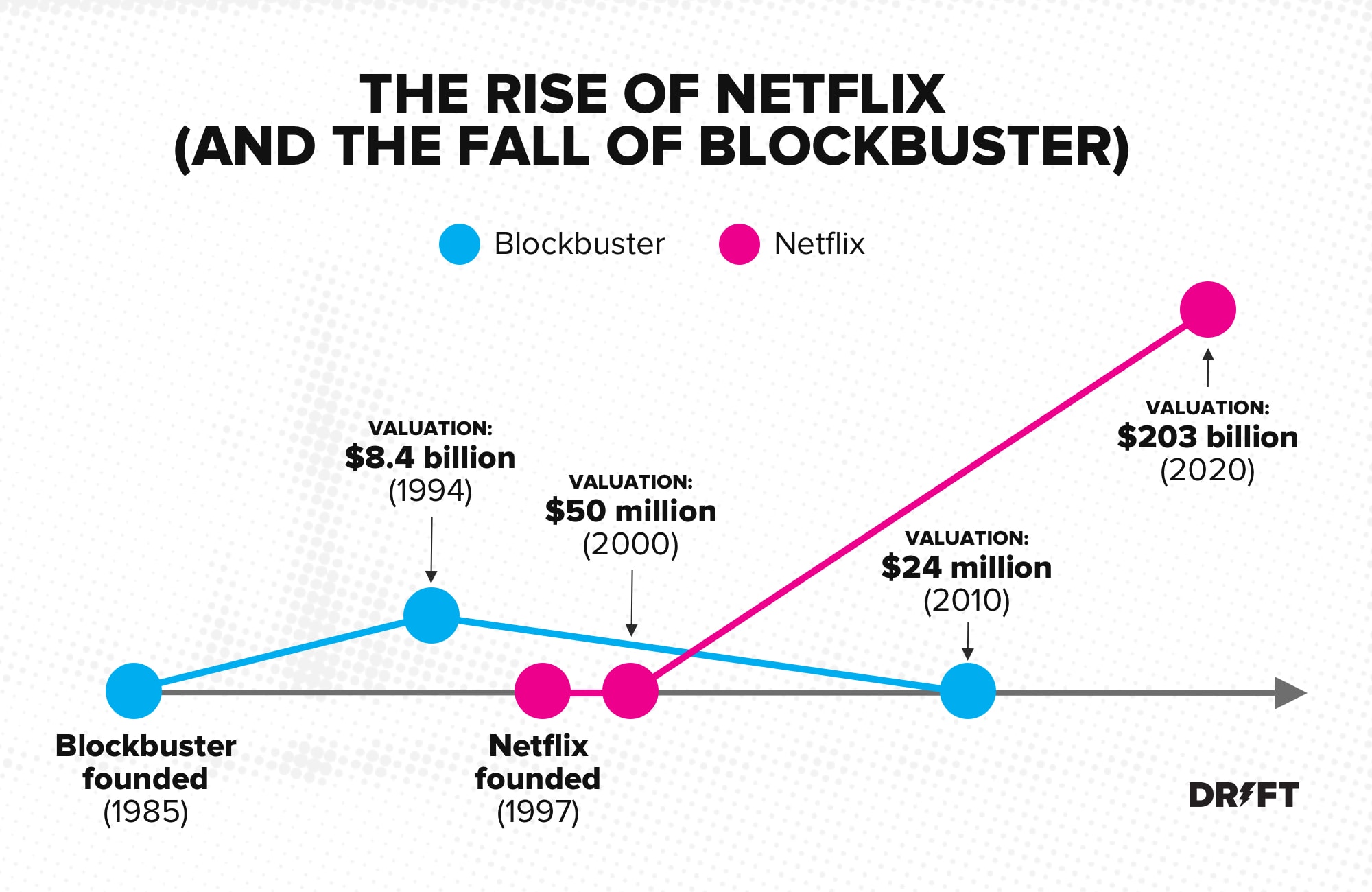
In 2000, the video rental giant Blockbuster had the opportunity to purchase Netflix, then a fledgling DVD-by-mail service, for a mere $50 million. At the time, however, Blockbuster's leadership was hesitant to abandon its brick-and-mortar business model in favor of an unproven, digitally-focused alternative. As a result, Blockbuster opted not to pursue the acquisition, a decision that would ultimately prove disastrous.
[](https://www.drift.com/wp-content/uploads/2017/07/2005-Netflix-vs-Blockbuster-%E2%80%93-Chart.jpg)
*Blockbuster and Netflix comparison*
Netflix, on the other hand, embraced the digital revolution and rapidly evolved its service model in response to changing market conditions. Today, Netflix boasts over 200 million subscribers worldwide, while Blockbuster is but a distant memory.
This example underscores the importance of remaining vigilant in the face of disruptive innovation and the need to make fast, informed decisions in response to emerging trends. By embracing new technologies and adopting flexible business models, organizations can remain competitive in the face of rapid change.
### Example 2: Apple's iOS
When Apple introduced its iOS mobile operating system in 2007, the company faced significant competition from established players in the market, such as BlackBerry and Nokia. Despite this, Apple's leadership, under the guidance of Steve Jobs, made the bold decision to focus exclusively on the consumer market, rather than attempting to court business users.
[](https://api.time.com/wp-content/uploads/2014/08/apple-iphone-steve-jobs.jpg)
*Apple iOS launch*
In making this decision, Apple leveraged its understanding of consumer preferences and its ability to innovate rapidly. The company's commitment to fast decision making and calculated risk-taking allowed it to establish a dominant position in the mobile market, ultimately relegating BlackBerry and Nokia to also-rans.
## Key Insights and Further Exploration
In "Only the Paranoid Survive," Andrew S. Grove imparts several key insights on fast decision making that are relevant for college students and professionals alike:
1. **Strategic environments are constantly shifting**: By remaining vigilant and responsive, decision makers can better adapt to changing market conditions.
2. **Data-driven analysis is crucial**: Fast decision making requires a commitment to gathering, processing, and acting on accurate information.
3. **Empower employees at all levels**: Encourage risk-taking and decision making at lower levels of the organization to foster nimbleness and adaptability.
4. **Calculated risk-taking is essential**: Fast decision making sometimes requires bold, decisive action, even in the face of uncertainty.
To further explore the topic of fast decision making, consider the following avenues for further study:
- Delve deeper into the principles of strategic decision making and organizational adaptability through additional readings, such as "Good Strategy/Bad Strategy" by Richard Rumelt or "The Lean Startup" by Eric Ries.
- Examine the role of technology in fast decision making, focusing on topics like data analytics, machine learning, and artificial intelligence.
- Analyze case studies of successful and unsuccessful decision-making scenarios in various industries, exploring common themes and pitfalls.
By embracing the principles of fast decision making and committing to continuous learning, individuals and organizations can remain resilient, competitive, and forward-thinking in the face of rapid change.
Last updated: 2024-05-29
Related Books
Related Knowledges