# Earnings Estimation: Unlocking the Core of Company's Value
## Introduction
The world of finance and investing is full of jargon and complex concepts, but at its core, it revolves around the simple idea of determining the value of a company and its stock. One of the most crucial aspects of this evaluation process is earnings estimation. In Gregory Zuckerman's book "The Man Who Solved the Market: How Jim Simons Launched the Quant Revolution," earnings estimation is presented as a fundamental concept that drives investment decisions and market dynamics.
[](https://s.yimg.com/ny/api/res/1.2/g64rEQh4gKnCl48_QA0SSg--/YXBwaWQ9aGlnaGxhbmRlcjt3PTY0MDtoPTI4Nw--/https://media.zenfs.com/en/us.finance.gurufocus/882846333825f28be71b2c64f1dd7d6c)
*Understanding Earnings Estimation*
Earnings estimation is the process of predicting a company's future earnings or profits. Financial analysts, investors, and portfolio managers use earnings estimates to evaluate a company's performance, assess its potential growth, and make informed investment decisions. Armed with accurate and reliable earnings estimates, these professionals can predict how much a company is likely to earn in the future and determine whether the company's current stock price reflects its earnings potential.
In this educational content, we will delve into the core concepts and relevance of earnings estimation, discuss practical examples and applications, and conclude with key insights and suggestions for further exploration.
## Core Concepts and Relevance
At its core, earnings estimation is about understanding a company's financial health. By estimating a company's future earnings, investors can assess the company's growth prospects, market position, and competitive advantages. This information, in turn, helps investors to determine the company's intrinsic value and make informed decisions about buying, selling, or holding its stock.
Earnings estimation has three primary objectives:
1. **Predicting Future Earnings:** Financial analysts and investors use earnings estimates to predict a company's future earnings per share (EPS)—the portion of a company's profit allocated to each outstanding share of common stock. A company's EPS serves as a key indicator of its financial performance, as well as an essential input in valuation models such as the price-to-earnings (P/E) ratio.
2. **Valuing a Company:** Earnings estimates are critical in determining a company's intrinsic value—a forward-looking assessment of a company's worth based on its expected future earnings. Intrinsic value is a fundamental concept in investment analysis, enabling investors to make informed decisions about whether a company's stock is undervalued, overvalued, or fairly valued.
3. **Assessing Market Expectations:** Earnings estimates can also reveal market expectations and sentiment regarding a company's future performance. When a company's actual earnings surpass or fall short of consensus estimates, it sends a strong signal about its prospects and can significantly impact its stock price.
## Practical Implications and Examples
To illustrate the practical implications and relevance of earnings estimation, let's consider two examples:
### Example 1: Earnings Surprise and Stock Price Reaction
Imagine a hypothetical company, XYZ Inc., that has a strong track record of consistent earnings growth and a reputation for accurate earnings guidance. Market analysts and investors closely follow XYZ's quarterly earnings reports and have high expectations for its upcoming earnings release.
On the day of the earnings announcement, XYZ reports earnings per share (EPS) of $1.20, beating the consensus analyst estimate of $1.15. This earnings surprise—when a company's reported earnings exceed or fall short of the consensus estimate—triggers a positive reaction in the stock market, as investors revise their expectations for XYZ's future earnings and potential growth. As a result, XYZ's stock price surges by 5% on the day of the earnings announcement.
[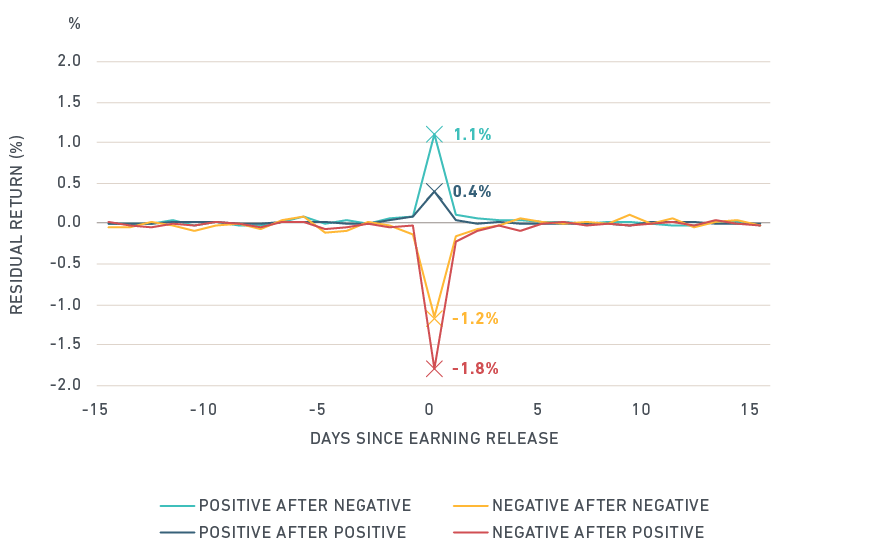](https://www.msci.com/documents/1296102/12358585/Corporate-Earning-Surprise-2019-Exhibit02.png/26d23b41-3cf2-e62b-b4dd-fabece10b625?t=1549012465596)
*Earnings Surprise Impact on Stock Price*
In this example, the earnings estimate serves as a crucial benchmark, shaping market expectations and influencing the stock price. By accurately predicting XYZ's earnings, analysts and investors can evaluate the company's performance and make informed decisions about its stock.
### Example 2: Earnings Estimate Revision and Market Sentiment
Now consider a different scenario where a company, ABC Corp., has been facing headwinds in its industry, leading to declining sales and profitability. Despite these challenges, ABC Corp's management remains optimistic about its long-term growth prospects and maintains its earnings guidance.
As the quarter progresses, however, it becomes clear that ABC Corp will miss its earnings guidance. Financial analysts and investors begin revising their earnings estimates downward, reflecting the deteriorating market sentiment and the company's weakened financial position.
In response to these negative revisions, ABC Corp's stock price starts to decline, as investors reassess their expectations for the company's future earnings and growth potential. The downward revision in earnings estimates serves as a powerful signal for the market, highlighting the company's struggles and increasing the perceived risk associated with its stock.
[](http://thereformedbroker.com/wp-content/uploads/2013/07/err-1.png)
*Analyzing Earnings Estimate Revisions*
In this second example, the earnings estimate revisions serve as a leading indicator for the market, reflecting changing market conditions and influencing the stock price. By carefully monitoring earnings estimates, investors can gauge market sentiment, evaluate a company's performance, and make informed investment decisions.
## Conclusion
Earnings estimation is a powerful tool for investors and financial analysts, providing critical insights into a company's financial health, growth prospects, and market position. Through accurate earnings predictions and thoughtful analysis, investors can make informed decisions about whether a company's stock is undervalued, overvalued, or fairly valued.
The examples discussed in this educational content demonstrate the practical implications and applications of earnings estimation. By predicting a company's future earnings and evaluating market expectations, investors can assess a company's intrinsic value and make informed investment decisions.
For further exploration, consider the following areas:
- **Advanced Valuation Techniques:** Dive deeper into the world of valuation by studying advanced techniques such as discounted cash flow (DCF) analysis, residual income models, and economic value-added (EVA) metrics.
- **Behavioral Finance:** Explore the role of cognitive biases and emotional factors in earnings estimation and investment decision-making.
- **Big Data and Machine Learning:** Investigate the applications of big data and machine learning algorithms in earnings estimation, including predictive analytics, natural language processing, and sentiment analysis.
- **Alternative Data Sources:** Examine the use of alternative data sources such as satellite imagery, social media, and web traffic to enhance earnings estimation accuracy.
By mastering earnings estimation and understanding its practical implications, college students can become more informed and effective investors, positioned to make wise decisions in the dynamic world of finance and investing.
Last updated: 2024-06-27
Related Books

Related Knowledges