# Dark Pools: Understanding the Secretive World of Wall Street's High-Frequency Trading
## Introduction
In the past decade, high-frequency trading (HFT) has emerged as a dominant force in the global financial ecosystem. Among the many components of this complex landscape, "dark pools" stand out as a particularly intriguing and mysterious aspect. In *The Man Who Solved the Market: How Jim Simons Launched the Quant Revolution*, Gregory Zuckerman sheds light on these elusive entities as he examines the growth and implications of HFT. This article delves into the core concepts and relevance of dark pools, illustrating their practical implications through diverse examples and applications.
[](https://news.mit.edu/sites/default/files/download/201402/d20140131162520-0.jpg)
*Graphic representation of dark pools in financial markets*
At their core, dark pools represent private exchanges for trading securities, operated by financial institutions, alternative trading systems, or specialized dark pool operators such as Liquidnet or IEX. Unlike traditional public exchanges like the New York Stock Exchange or Nasdaq, dark pools are designed to enable large institutional investors to anonymously execute large orders without significantly impacting the market price. As a result, dark pools play a critical role in maintaining the efficiency and stability of financial markets, although they remain shrouded in mystery due to their secretive nature.
## Examples and Implications of Dark Pools
### 1. Dark Pools and Hidden Liquidity
Imagine a large pension fund managing billions of dollars, aiming to sell a substantial block of shares in a multinational corporation. Executing such a large order entirely in the public market could lead to adverse price impacts, triggering a decline in the stock's value and potentially revealing the pension fund's intentions to other market participants.
To maintain the confidentiality of their trading activities and minimize market impact, the pension fund can utilize a dark pool to split the large order into smaller trades. In this environment, the pension fund can achieve a more favorable execution price compared to public exchanges. At the same time, the dark pool's anonymity ensures that competing investors remain unaware of the pension fund's trading behavior, reducing the risk of predatory trading and market manipulation.
### 2. Dark Pools in Flash Crashes
Dark pools have been at the center of several of the most dramatic and disruptive events in modern financial markets. One such episode is the infamous Flash Crash of May 6, 2010, when a confluence of factors, including high-frequency trading activities, led to the temporary suspension of trading across multiple U.S. equities and options markets, resulting in a rapid and unforeseen decline in stock values.
[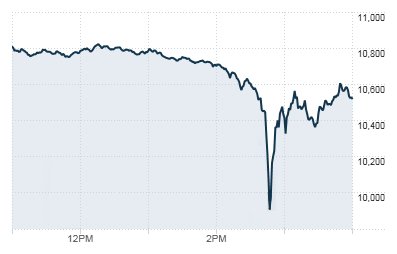](https://upload.wikimedia.org/wikipedia/commons/b/bb/Flashcrash-2010.png)
*Example of a Flash Crash in stock market*
Dark pools' secretive nature remains a source of concern and investigation for regulators and industry observers, as several studies suggest that opaque trading environments might exacerbate or even trigger abrupt price swings and other adverse market events.
### 3. Dark Pools and the Erosion of Public Markets
Despite the benefits offered by dark pools in terms of reduced market impact and increased anonymity, an increasing reliance on these private exchanges may erode the core tenets and advantages of public markets, including transparency and price discovery. Over the past decade, the growth of dark pools and other opaque trading platforms has raised concerns that the public markets' traditional role in the efficient allocation of capital might be compromised.
### 4. Dark Pools, Algorithms, and Regulation
Regulators worldwide have imposed multiple restrictions and guidelines to improve the transparency and accountability of dark pool activities. In response, dark pool operators have increasingly implemented sophisticated algorithms to classify and segment incoming orders based on user profiles and risk appetites. For instance, these algorithms can identify incoming orders from high-frequency trading firms, preventing them from taking advantage of regular investors or exhibiting predatory trading behavior.
[](https://www.investopedia.com/thmb/PK-9Nsx8V9uDDYgSLMs_ImzMfMY=/1500x0/filters:no_upscale%28%29:max_bytes%28150000%29:strip_icc%28%29/Dark-Pool-Final-8183d3d246ee4ae181389f8ad456d9c9.jpg)
*Impact of algorithms on dark pool trading*
## Conclusion
Dark pools represent a key knowledge point in understanding the role and implications of high-frequency trading and its impact on today's financial landscape. As evidenced by the examples above, these secretive trading venues offer advantages to institutional investors, such as reduced market impact, customized trade execution, and heightened confidentiality. However, the potential drawbacks, including the erosion of public markets, the exacerbation of flash crashes, and concerns around predatory trading practices, necessitate ongoing regulation, scrutiny, and supervision.
In conclusion, exploring the topic of dark pools reveals a fascinating and yet contentious aspect of the financial ecosystem, warranting further investigation. For students interested in pursuing topics related to dark pools, the following areas should be considered:
- Analyzing regulatory frameworks and their impact on dark pools in different countries
- Investigating the role of algorithms and artificial intelligence in dark pool operations and supervision
- Examining the potential for blockchain technology and smart contracts to address the inherent opacity of dark pools
- Contrasting the advantages and drawbacks of decentralized finance (DeFi) platforms to traditional dark pools
- Assessing the evolution and transformation of dark pools in the context of increasingly stringent regulations and heightened public scrutiny
Last updated: 2024-04-18
Related Books
Related Knowledges