# Understanding the Creation of the Nasdaq Index: Cornerstones and Consequences
## Introduction
The Nasdaq Composite Index, or the Nasdaq for short, is a stock market index that consists of more than 3,000 common equities listed on the Nasdaq Stock Market. As one of the premier benchmarks for the technology sector and other global growth companies, it is a crucial indicator of the overall health of the world's economy.
[](https://www.investopedia.com/thmb/1fVGhL6zGrDVn0qD38xwMZZgzwU=/1500x0/filters:no_upscale%28%29:max_bytes%28150000%29:strip_icc%28%29/20181011nasdaq-5bfd7a8746e0fb0083fd3005)
*Nasdaq Composite Index Chart*
This article delves into the core concepts, the creation process, and the far-reaching ramifications of the Nasdaq Index. Moreover, it provides real-life examples and illustrates its practical implications, helping college students understand its significance better.
## The Core Concepts and Relevance
Established in 1971, the Nasdaq Stock Market was the world's first electronic stock market. This digital format offered numerous advantages over the traditional stock exchanges, which relied on physical trading floors. In contrast, the Nasdaq utilized an innovative computer system called the Computer Assisted Execution System (CAES).
The CAES enabled securities transactions to occur between brokers and dealers through a computerized telecommunications network. The birth of this novel system did away with the need for a physical trading floor and allowed investors from all over the country, or even the world, to participate in real-time trade executions without physical constraints.
[](https://www.strike.money/wp-content/uploads/2023/06/Which-Stock-Markets-use-Electronic-Trading-1024x650.jpg)
*Nasdaq Stock Market Electronic Trading*
However, the Nasdaq Stock Market's rapid growth led to the necessity of a comprehensive index that would accurately and fairly represent the market's pulse. Thus, the Nasdaq Composite Index was introduced on February 5, 1971, serving as a yardstick for gauging the collective performance of all domestic and international securities listed on The NASDAQ Stock Market.
### The Methodology Behind the Index
The Nasdaq Index creation process might appear straightforward at first glance, but its calculation methodology requires a deeper understanding of its unique aspects. Some of these differentiators include:
1. **Market capitalization weightage**: Unlike the Dow Jones Industrial Average (DJIA), which is price-weighted, or the S&P 500, which is market-capitalization-weighted but float-adjusted, the Nasdaq Composite Index is a market-capitalization-weighted index that includes all the common stocks listed on the Nasdaq Stock Market.
[](https://images.squarespace-cdn.com/content/v1/5be3a740506fbe475c27d1e0/1574747797503-O2PE4Y6B0BYL1SCMQIZ6/Weightage.png)
*Market Capitalization Weightage*
2. **Calculation**: The index value is calculated by taking the total market capitalization of all the companies listed on the Nasdaq index and dividing it by a specific divisor, which is a value that changes periodically to account for adjustments like stock splits and changes in the components of the index.
3. **Rebalancing**: The Nasdaq Composite Index does not follow a predefined schedule for rebalancing or changing its components. As a result, the index is adjusted whenever a company no longer meets the listing requirements.
### Practical Implications and Examples
The Nasdaq Composite Index holds immense significance for various stakeholders in numerous ways, as illustrated by the following examples.
#### 1. Trading and investing
The Nasdaq Composite Index is a valuable tool for traders and investors to assess the overall health of the technology and growth sectors. By analyzing this index, they can identify market trends, make informed investment decisions, and execute trading strategies.
For instance, if the Nasdaq Composite Index experiences a sharp drop over a few days, it could signal that technology stocks are facing headwinds, such as regulatory changes or macroeconomic uncertainties. As a result, traders and investors might be inclined to sell their positions in technology companies, or conversely, they might find the drop an attractive entry point to buy those stocks at a perceived discount.
#### 2. Economic indicators
The Nasdaq Composite Index serves as a valuable leading economic indicator due to its strong representation of growth companies. Thus, it often acts as a forecaster of economic trends and can signal turning points in the business cycle.
For example, during the dotcom bubble of the late 1990s, the Nasdaq Composite Index reached unprecedented heights, fueled by speculative investments in internet-based businesses. However, after the bubble burst, the index plummeted, indicating a shift in economic sentiment and the onset of recessionary conditions.
## Key Insights and Further Exploration
The Nasdaq Composite Index is an indispensable instrument for college students, traders, investors, policymakers, and economists alike. As demonstrated, it plays a pivotal role in guiding essential decisions in various industries and sectors.
To further explore the nuances of the Nasdaq Index, students can consider delving deeper into the following aspects:
1. **Historical analysis**: Conduct a historical analysis of the Nasdaq Composite Index from its inception to the present day and observe the major inflection points, their causes, and their consequences on the broader market and economy.
2. **Impact of individual companies**: Investigate the influence of individual companies or specific sectors on the Nasdaq Composite Index and discern how their performance affects the overall index. Analyze the key drivers and detractors for specific time periods.
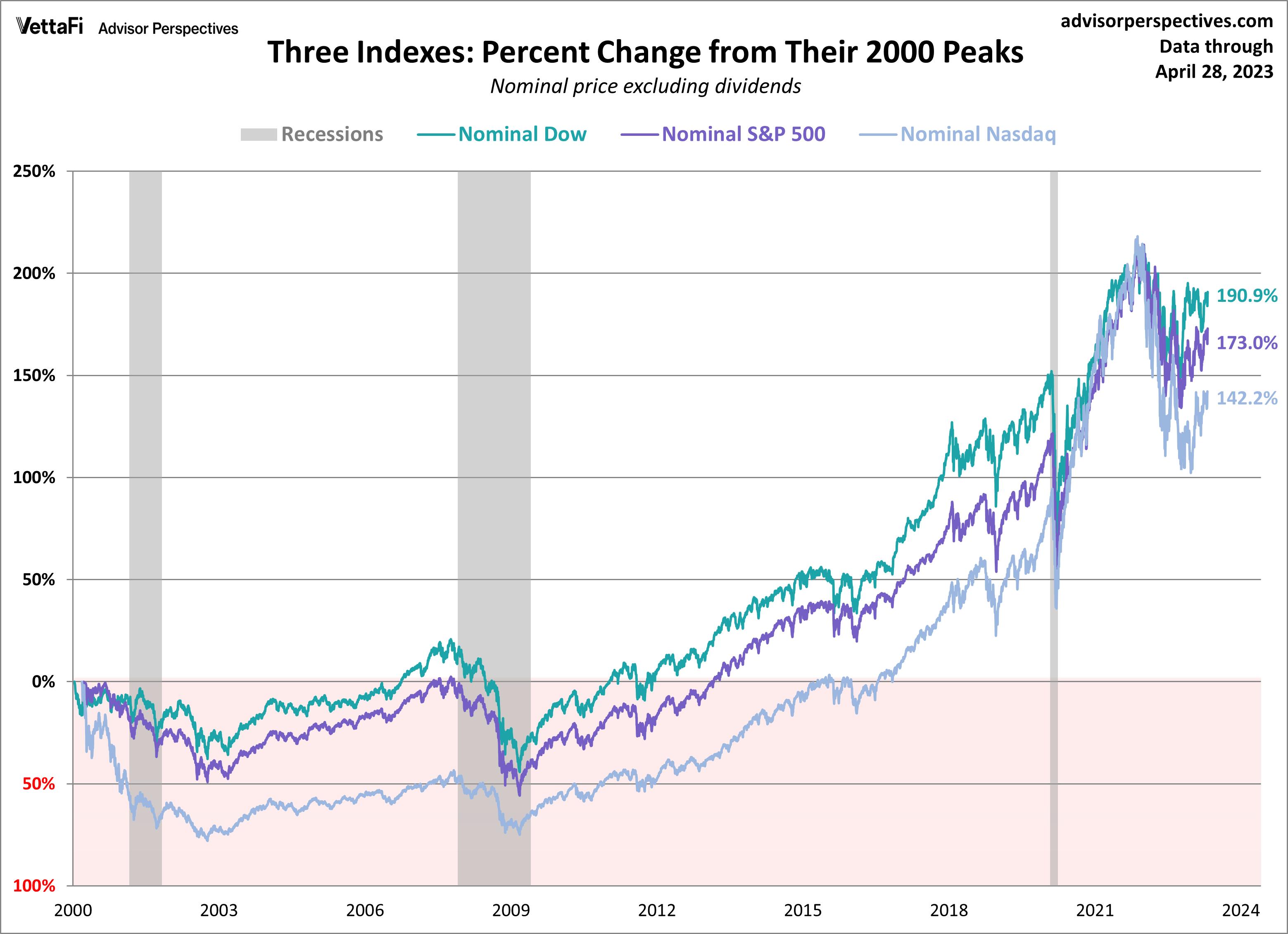
3. **Comparison with other indices**: Compare and contrast the Nasdaq Composite Index with other prominent indices, such as the Dow Jones Industrial Average and the S&P 500. Assess the correlations, divergences, and implications.
[](https://www.etftrends.com/wp-content/uploads/2023/05/SPX-Dow-Nasdaq-since-2000-nominal.png)
*Nasdaq vs. Dow Jones and S&P 500*
4. **Methodology comparisons**: Study the differences between the Nasdaq Index computation methodology and its counterparts. Understand the rationale for these differences and the implications for investors.
5. **Factor investing**: Explore factor investing, such as value, momentum, and quality, and analyze the representation of these factors within the Nasdaq Composite Index and their impact on index performance.
In conclusion, the Nasdaq Composite Index serves as a powerful statistical tool for understanding the workings of the technology and growth sectors and their influence on the broader market and economy. Through a comprehensive and nuanced understanding of its creation, college students can enhance their appreciation of this vital index and apply these insights in real-world scenarios and investment strategies.
Last updated: 2024-06-27
Related Books

Related Knowledges