### Long-Term Capital Management (LTCM): A Study in Risk and Reward

*Logo of Long-Term Capital Management \(LTCM\)*
#### Introduction
Long-Term Capital Management (LTCM) was a hedge fund established in 1994 by a group of highly accomplished financial professionals, including two Nobel laureates in economics. The firm aimed to capitalize on minute price differences between securities in various markets, exploiting inefficiencies through the use of complex mathematical models. The story of LTCM offers a compelling lesson in the limitations of quantitative models, the dangers of excessive leverage, and the potential for systemic risk in the financial system.
#### Core Concepts and Relevance
At its core, LTCM's strategy relied on the assumption that the distribution of price movements in financial markets follows a normal distribution (also known as a Gaussian distribution or bell curve). This assumption allowed the fund's managers to calculate the probability of specific price movements and to construct trading strategies based on those probabilities.
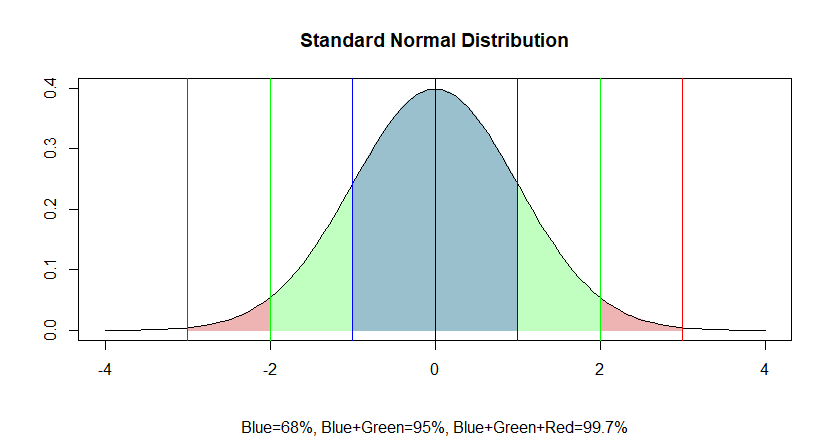
*Illustration of a Gaussian distribution in finance*
However, as LTCM's operations expanded, the firm began to take on increasingly risky positions, using large amounts of leverage to amplify returns. This strategy proved successful for a time, with LTCM generating impressive returns for its investors. However, the fund's heavy reliance on leverage ultimately proved to be its downfall.
In 1998, a series of financial crises and market dislocations led to a sharp increase in volatility across multiple asset classes. As a result, LTCM's models began to break down, and the fund found itself unable to meet margin calls from its creditors. This situation led to a broader crisis of confidence in the financial system, as investors feared that the collapse of LTCM could trigger a chain reaction of defaults and insolvencies.
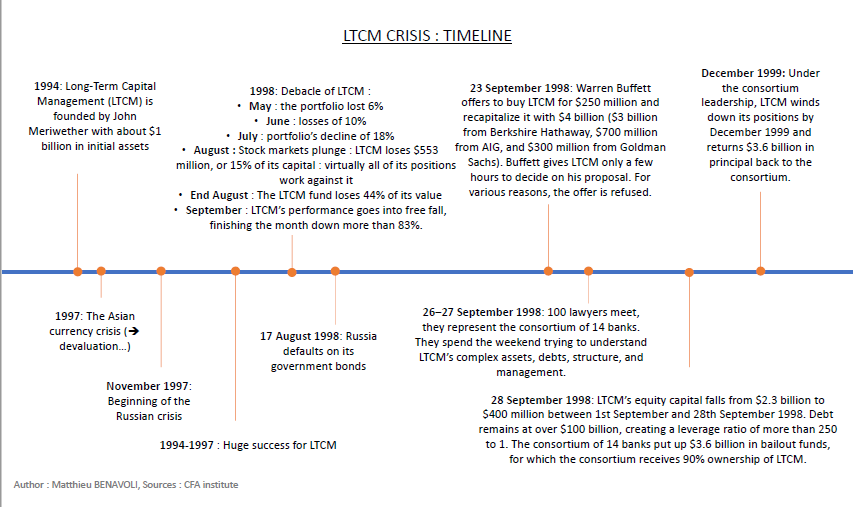
*1998 financial crises leading to LTCM's difficulties*
#### Practical Implications and Examples
1. **The Limits of Quantitative Models**
LTCM's experience highlights the dangers of relying too heavily on quantitative models in financial decision-making. While these models can be powerful tools for analyzing and predicting market behavior, they are based on simplifying assumptions that may not always hold true in practice. In particular, the assumption of a normal distribution of price movements can lead to underestimation of the likelihood of extreme events (often referred to as "black swans").
1. **The Risks of Leverage**
The use of leverage can significantly increase returns in favorable market conditions, but it also magnifies losses during downturns. LTCM's heavy reliance on leverage left the fund vulnerable to even small adverse price movements, ultimately leading to its downfall. This example underscores the importance of prudent risk management and the judicious use of leverage in investment strategies.
1. **Systemic Risk and Regulatory Responses**
The near-collapse of LTCM raised concerns about the potential for individual firms to pose systemic risks to the broader financial system. In response, regulators have implemented measures aimed at increasing transparency, reducing leverage, and promoting financial stability. For example, the Dodd-Frank Wall Street Reform and Consumer Protection Act, enacted in the United States in 2010, introduced new regulations designed to mitigate the risks associated with complex financial instruments and large, interconnected financial institutions.

*Illustration of the Dodd-Frank Wall Street Reform Act*
#### Conclusion
The story of Long-Term Capital Management serves as a powerful reminder of the risks and rewards associated with sophisticated financial strategies. By examining the core concepts and practical implications of LTCM's approach, students can gain valuable insights into the complexities of financial markets and the importance of effective risk management.
For further exploration, students might consider the following questions:
- How have financial regulations evolved in response to the lessons of LTCM and other financial crises?
- What role do incentives and human behavior play in the success or failure of quantitative trading strategies?
- How can financial institutions balance the pursuit of profit with the need to manage risk and maintain financial stability?
By delving deeper into these and other related questions, students can develop a more nuanced understanding of the challenges and opportunities presented by long-term capital management.
Last updated: 2024-03-20
Related Books

Related Knowledges