### Soft Dollars: Understanding the Concept and its Relevance
In the world of finance, the term "soft dollars" has been a topic of interest for many. While it may initially appear as a complex term, it essentially refers to a practice where a brokerage firm is compensated for the services they provide through means other than direct cash payments. These services may encompass research, market intelligence, and other benefits that enable a firm to make informed trading decisions.
To explore the details and importance of soft dollars, this article delves into its core concepts, real-life illustrations, and potential applications to provide a comprehensive understanding of the topic for college students.
[](https://images.squarespace-cdn.com/content/v1/6328fc3ce815af1808e8a939/7b1be283-2e8d-438f-a0c0-1920416f19de/Infographic+-+Website+WHITE.jpg)
*An infographic explaining the concept of soft dollars in the financial industry.*
#### The Core Concepts of Soft Dollars
At its foundation, soft dollars form an integral part of the brokerage industry as it exists today. It is a common practice where investment managers engage brokerages to carry out trades for their clients. However, as money managers require research and other services to make informed decisions, they pay the brokerages through soft dollars instead of direct cash payments.
This form of payment system allows money managers to access knowledge and resources that they would otherwise have to purchase on their own. It provides essential value for these firms in the following ways:
1. Accessibility to premium research products and services.
2. Improved networking and communication channels between brokerages and managers.
3. Enhanced ability to analyze information, leading to more informed decision-making.
While soft dollars can be a valuable tool for money managers and brokerages, it's essential to ensure that the arrangement remains ethical and transparent to all parties involved, especially regulatory authorities.
[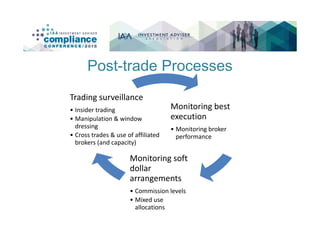](https://image.slidesharecdn.com/iaa-conference-life-cycle-trade-ppt-march2015-230207033805-ff975782/85/iaaconferencelifecycletradepptmarch2015pdf-8-320.jpg)
*Flowchart illustrating the flow of benefits and services in a soft-dollar arrangement.*
#### Relevance of Soft Dollars
Soft dollars are crucial in the financial world due to their impact on market efficiency and competition. By analyzing the benefits of soft dollars, one can understand its significance and relevance:
1. **Market efficiency**: Soft dollars allow money managers to gain access to research, analysis, and other valuable information, which may lead to more efficient markets. This knowledge helps market participants make well-informed decisions, resulting in increased liquidity and decreased price volatility.
2. **Competition**: The soft-dollar arrangement fosters healthy competition in the financial industry by allowing smaller managers to compete effectively with larger and more established firms. By compensating brokerages for necessary services with research and other benefits, smaller firms get equal opportunities to succeed, enhancing market dynamism.
3. **Transparency**: Soft dollars promote transparency as brokerage firms provide a detailed breakdown of research and other services offered, allowing money managers to evaluate whether the costs have been fairly allocated.
[](https://pbs.twimg.com/media/F13SNKiXgAAOY6k.jpg)
*Diagram showing the impact of soft dollars on market efficiency and competition.*
#### Practical Implications: Real-life Illustrations
To better comprehend the concept and relevance of soft dollars in actual practice, consider a few real-life scenarios:
**Scenario 1: Investment Manager A**
Investment Manager A employs the services of Broker X to carry out trades for their clients. In return, Manager A compensates Broker X for its brokerage services using soft dollars. This compensation includes access to research and market intelligence. The research provided helps Manager A to refine and improve its investment strategies and market predictions. As a result, Manager A can offer enhanced returns to its end investors. In this case, both Manager A and Broker X benefit from the soft-dollar arrangement.
**Scenario 2: Small Investment Firm B**
Small Investment Firm B manages a limited portfolio of assets but seeks to offer its clients a range of services similar to those offered by their larger competitors. Firm B employs Broker Y, which provides research services tailored to Firm B's specific needs. Firm B benefits from the shared knowledge, gaining insights into market trends and new investment opportunities. As a result, Firm B can effectively compete in the market despite its smaller size.
[](https://www.wallstreetmojo.com/wp-content/uploads/2022/09/Picture61.jpg)
*Illustration of a real-life scenario involving soft dollars in investment management.*
##### Conclusion: Key Insights and Further Exploration
After diving into the core concepts and relevance of soft dollars, it's evident that this practice plays a vital role in today's financial market. Soft dollars help facilitate access to valuable resources, contribute to market efficiency, and foster competition. Furthermore, the real-life scenarios illuminate its functionality and benefits.
To further explore the topic of soft dollars, consider the following avenues:
1. Reading more extensively on the topic, including additional books and academic publications. One recommended resource is *The Man Who Solved the Market* by Gregory Zuckerman, which delves into the intricacies of the practice.
2. Engaging in group discussions or debates focusing on the ethics of soft dollars, enabling a deeper understanding of the implications of soft-dollar arrangements on market practices, transparency, and regulatory oversight.
3. Conducting research on the historical impact and evolution of soft dollars over time, highlighting the changing landscape and its effects on financial market participants.
Remember, the world of finance is intricate and ever-evolving; delving into the depths of various concepts, such as soft dollars, will not only broaden your understanding but also help you appreciate the industry's complexities and opportunities.
Reference:
Zuckerman, G. (2019). The Man Who Solved the Market: How Jim Simons Launched the Quant Revolution. Portfolio Penguin.
Last updated: 2024-04-20
Related Books

Related Knowledges