# Predictive Algorithms: Unveiling the Core of Jim Simons' Revolutionary Investment Strategy
## Introduction
[](https://media.licdn.com/dms/image/D4E12AQF6926PQ7Ht8g/article-cover_image-shrink_720_1280/0/1684915089572?e=2147483647&v=beta&t=Vuq4T_Z3FReR0ILP1dyd1OmFG8oKUF2xl7t2ihJ9Cpc)
*The Quantum Revolution in Finance*
Predictive algorithms are a cornerstone of the quantitative analysis (or 'quant') revolution that has transformed the financial industry in recent decades. The use of these sophisticated mathematical models, which identify patterns and trends in large datasets to make predictions about future events, has helped investors like Jim Simons and his firm Renaissance Technologies (RenTech) achieve unparalleled returns. The insights presented in Gregory Zuckerman's book "The Man Who Solved the Market" provide us with a fascinating look into the world of predictive algorithms and their practical implications in finance.
[](https://assets.bwbx.io/images/users/iqjWHBFdfxIU/iCJdDuA07brw/v1/-1x-1.jpg)
*Jim Simons Renaissance Technologies*
At its core, predictive algorithms involve creating statistical models that can identify historical patterns in data and use these patterns to make predictions about future outcomes. When applied to financial markets, this means analyzing historical price, volume, and other relevant data to predict future price movements. Predictive algorithms can provide insights into the complex and dynamic nature of financial markets, enabling investors to make more informed decisions.
[](https://www.investopedia.com/thmb/l5OhfOZdZM1iT9S_WTVs-Tw0Q6Q=/1500x0/filters:no_upscale%28%29:max_bytes%28150000%29:strip_icc%28%29/predictive-analytics.asp-final-fc908743618a4f9093dfdd1fa6e9815a.png)
*Predictive Algorithms in Finance*
## Predictive Algorithms and Real-World Applications
### RenTech's Medallion Fund: A Case Study
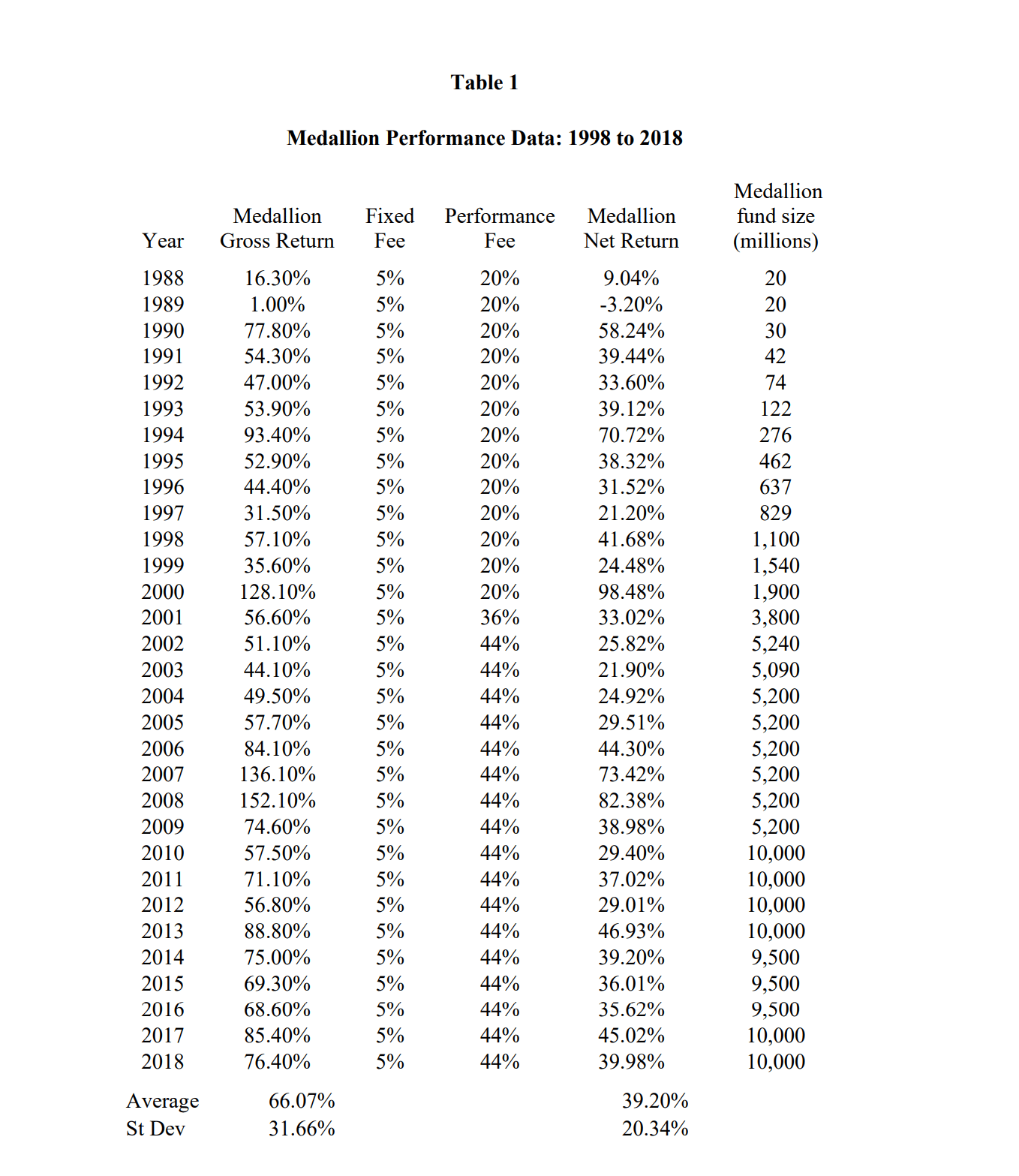
Jim Simons and his team at RenTech developed one of the most successful quantitative investment strategies in history, underpinned by predictive algorithms. The Medallion Fund, RenTech's flagship fund, has delivered an astonishing average annual return of 66% from 1988 to 2018. Although the specifics of RenTech's algorithms remain a closely guarded secret, Zuckerman's book sheds light on the general principles that have driven the firm's success.
[](https://www.cornell-capital.com/wp-content/uploads/2021/04/Table1-1.png)
*Medallion Fund Performance Chart*
RenTech's predictive algorithms are based on identifying patterns across a wide range of financial instruments and markets. These models analyze petabytes of historical data in a matter of seconds, enabling the firm to quickly adapt to changing market conditions. By employing predictive algorithms, RenTech can capitalize on short-term market inefficiencies that other investors often overlook.
### Predictive Algorithms in Derivatives Pricing: The Black-Scholes-Merton Model
Another prominent example of predictive algorithms in finance is the Black-Scholes-Merton (BSM) model, which is widely used to price options. Developed in the early 1970s by three pioneering mathematicians—Fischer Black, Myron Scholes, and Robert Merton—the BSM model uses predictive algorithms to estimate the theoretical price of a European call or put option.
[](https://personalpages.bradley.edu/~arr/bsm/images/bsg1.gif)
*Black-Scholes-Merton Model*
The BSM model accounts for key factors, such as the underlying asset's price, strike price, risk-free rate of interest, time to expiration, and volatility. By inputting these values into the model, investors can derive a theoretical pricing estimate for the option. This has become an indispensable tool for financial professionals, allowing them to assess the fair value of options and manage risk more effectively.
## Expanding on Predictive Algorithms: Further Exploration and Summary
Incorporating predictive algorithms into quantitative investment strategies and risk management tools has undoubtedly revolutionized the financial industry. By leveraging these mathematical models, investors and financial professionals can better understand the complexities of financial markets, identify emerging trends, and make more informed decisions.
For those interested in further exploring the topic of predictive algorithms, consider the following resources and avenues:
- **Textbooks and Academic Resources**: Delve deeper into the mathematical foundations and applications of predictive algorithms with texts like "Advanced Quantitative Trading" by Ernie Chan or "Machine Trading: Deploying Computer Algorithms to Conquer the Markets" by Ernest P. Chan.
- **Online Courses**: Platforms such as Coursera, edX, and Udacity offer comprehensive courses on machine learning, data analysis, and quantitative finance, providing students with a solid foundation in predictive algorithms and their applications.
- **Case Studies and Real-World Applications**: Explore real-world applications of predictive algorithms in the financial industry by studying success stories like RenTech and the evolution of popular models such as the Black-Scholes-Merton model.
- **Research Papers and Articles**: Keep up-to-date with the latest advancements and breakthroughs in predictive algorithms and their applications in finance by reviewing research papers and articles from reputable sources such as SSRN, arXiv, and The Journal of Finance.
Understanding predictive algorithms is crucial for success in today's data-driven financial landscape. By embracing these mathematical models, students can unlock the secrets of market inefficiencies and develop powerful investment strategies that capitalize on short-term market fluctuations.
Last updated: 2024-06-27
Related Books
Related Knowledges