# Crisis as Opportunity: Navigating Market Turmoil with the Dao of Capital
*Crisis as Opportunity* is a central theme in Mark Spitznagel's *The Dao of Capital: Austrian Investing in a Distorted World*. Spitznagel argues that understanding and embracing crisis as an opportunity for gain distinguishes successful, long-term investors. The concept is rooted in the Austrian School of Economics and Eastern philosophies such as Taoism. To fully grasp this idea, we'll delve into the core concepts, practical implications, and examples of *Crisis as Opportunity*.
## Core Concepts
### The Dao of Capital
[](https://image.spreadshirtmedia.com/image-server/v1/products/T1459A842PA3861PT28D1039325236W6765H10000/views/1,width=550,height=550,appearanceId=842,backgroundColor=F2F2F2/ying-yang-tao-symbol-taoism-t-harmony-balance-sticker.jpg)
*Tao symbol representing the natural path, harmony, and balance*
The Dao (also Tao) is a central concept in Chinese philosophy representing the natural path, harmony, and balance. According to Spitznagel, the Dao of Capital emphasizes harnessing the market's natural tendencies instead of fighting them. By embracing the market's inherent crises, investors can create wealth by capitalizing on undervalued assets and positions amidst turmoil.
### Systemic Risk
Systemic risk refers to the potential collapse of an entire financial system due to interconnectedness between financial institutions, markets, and governments. Systemic risk significantly increases during crises, making them seemingly unpredictable yet inevitable in the Dao of Capital.
[](https://www.investopedia.com/thmb/lFb2PzthYdUB9LIJ-tftSe8J43A=/1500x0/filters:no_upscale%28%29:max_bytes%28150000%29:strip_icc%28%29/systematicrisk.asp-final-f38c64261b2945e89722e5e0163cbfc0.png)
*Illustration of Systemic Risk in Financial Markets*
### Austrian School of Economics
The Austrian School emphasizes the role of individual choice, spontaneous order, and market prices in determining resource allocation. In contrast to Keynesian economics, the Austrian School favors free markets and minimal government intervention. The Dao of Capital incorporates these principles in its framework, promoting individual responsibility and proactively managing risk by the investor.
[](https://m.media-amazon.com/images/I/41n3jd0sUgL._AC_UF1000,1000_QL80_.jpg)
*Key concepts of the Austrian School of Economics*
## Relevance
The 2008 Financial Crisis exemplified the significance of Crisis as Opportunity. Investors who remained calm and proactively managed their risk during the mayhem reaped significant profits as markets rebounded. Adopting an Austrian perspective allows investors to assess the environment and identify undervalued assets and opportunities that align with their investment objectives.
[](https://static01.nyt.com/images/2021/03/17/business/00fed-crisis/00fed-crisis-videoSixteenByNineJumbo1600.jpg)
*2008 Financial Crisis market rebound illustration*
## Practical Implications and Examples
### Black Swan Events and Risk Management
Black Swan events are rare, unpredictable, and severe occurrences with substantial consequences for financial markets. Investors employ various risk management strategies to mitigate the impact of Black Swans. For instance, purchasing out-of-the-money put options, following a Barbell Portfolio approach, and maintaining cash reserves can help navigate unforeseen circumstances.
#### # Put Options
A put option is a financial derivative that grants its holder the right to sell an underlying asset at a predetermined price. By purchasing put options on a portfolio, investors create a safety net against market downturns at a relatively low cost. In a crisis, these put options would rise in value, offsetting the losses in the investor's portfolio.
#### # Barbell Portfolio
The Barbell Portfolio strategy suggests balancing risky and safe assets in a lopsided manner, resembling a barbell shape. The risky side consists of long-term, highly speculative investments, while the conservative side involves low-risk, low-return assets. This setup provides an investor the opportunity to capitalize on both crises and bull markets, while protecting the investor from potential downsides.
[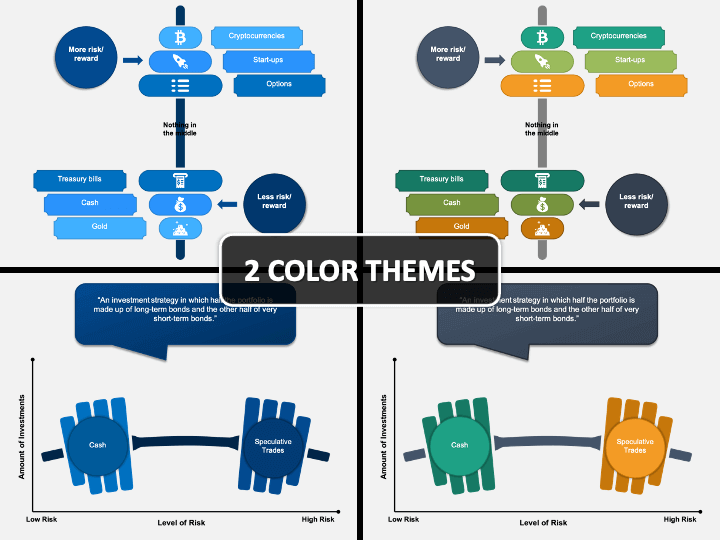](https://cdn.sketchbubble.com/pub/media/catalog/product/optimized1/f/4/f4f685bac8647729ae5539a0c5ededf71f8a367349c078b78d498bc41bc66e91/barbell-strategy-base-slide.png)
*Barbell Portfolio strategy example*
#### # Cash Reserves
Maintaining cash reserves can serve as a defensive strategy during market downturns. During crises, assets are typically undervalued, providing investors with unique purchasing opportunities. Consequently, cash-rich investors are better positioned to seize the opportunities that arise during a crisis.
### Overlooked Investment Opportunities
Investors often overlook the potential of undervalued or "out-of-favor" assets during crises. Crisis as Opportunity invites investors to think differently and capitalize on such oversights. Moreover, misguided government policies and panicky market players tend to create these opportunities.
#### # Post-Crisis Recovery
Governments often respond to crises by injecting liquidity into the economy. Stimulus packages, lower interest rates, and quantitative easing aim to stabilize financial markets. These measures, in turn, can result in a rapid post-crisis recovery, making it an attractive opportunity for investors.
#### # Short Squeezes and Underestimated Assets
Short squeezes occur when investors heavily short a security are forced to buy back their positions due to substantial price increases. Consequently, this drives the security's price even higher. The Dao of Capital encourages investors to explore assets with strong fundamentals yet lacking popularity among investors. By identifying such undervalued assets, investors can benefit from market irrationality during crises.
## Conclusion
Understanding Crisis as Opportunity equips investors with a powerful perspective on managing risk and maximizing returns. Navigating unpredictable markets demands adaptability, discipline, and proactive risk management. Embracing the tenets of the Dao of Capital allows investors to transcend conventional investment strategies and capture the wealth-building potential inherent in turmoil.
Further exploration of Crisis as Opportunity may include researching the origins and principles of the Austrian School of Economics, the role of market efficiency and behavioral finance, and the use of derivatives such as options and futures in risk management. By investigating these topics, students and investors can augment their investment acumen, making them more resilient in the face of uncertainty and crisis.
Last updated: 2024-04-21
Related Books

Related Knowledges