# The Contentment Key: Finding Inner Happiness through Ben Franklin's Wisdom
[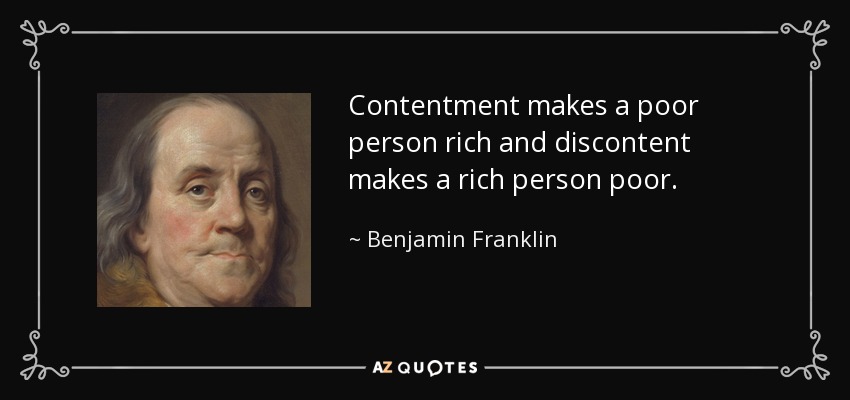](https://www.azquotes.com/picture-quotes/quote-contentment-makes-a-poor-person-rich-and-discontent-makes-a-rich-person-poor-benjamin-franklin-136-87-98.jpg)
*Benjamin Franklin and a quote on contentment*
_"...there is, perhaps, no simpler and wiser maxim in the world than that of Poor Richard, 'Contentment makes poor men rich; Discontent makes rich men poor.' "_
— Samuel Johnson, Letter to John Newton (1778)
## Introduction
In the modern world, college students are constantly seeking the keys to happiness and success, both in their personal lives and professional careers. Benjamin Franklin's _Poor Richard's Almanack_ offers invaluable insights into these age-old pursuits, and his concept of 'Contentment' stands out as a critical and transformative concept. In the context of our materialistic and consumer-driven society, contentment can serve as a powerful alternative to the never-ending chase for more.
[](https://news.utexas.edu/wp-content/uploads/2020/03/iStock-11915892982-copy-scaled.jpg)
*Illustration of contentment vs. materialism*
The core principle of contentment, as proposed by Franklin, implies recognizing and appreciating the value of what one already has and experiencing satisfaction and fulfillment in one's life without relying on external factors. It isn't about settling for mediocrity or forgoing ambitions; rather, it entails cultivating a mindset of gratitude and appreciating the simple joys in life.
This piece delves deep into the contentment key, discerning its core concepts, applications, and practical implications as presented in Franklin's _Poor Richard's Almanack_. By exploring a number of examples and applications, the content aims to illuminate the topic's significance and relevance to contemporary college students.
## Contentment as a Foundation of Happiness
[](https://lookaside.instagram.com/seo/google_widget/crawler/?media_id=3332862627455082810)
*Graphic on the foundation of happiness*
_"Virtue and contentment make a full Christian; more than wealth, more than fame, more than beauty or power. He that hath these hath enough, and hath more than enough, and lacketh nothing._
— Poor Richard (1752)
Contentment lies at the foundation of happiness, and cultivating it requires self-awareness. Acknowledging one's desires help us put our ambitions in perspective and build our resilience against external factors affecting our lives. Franklin's concept of contentment, entwined with frugality and self-sufficiency, leads us to redefine our relationship with possessions and desires.
In practice, contentment allows us to recognize the difference between what we want and what we need, enabling us to prioritize our values and invest our time and resources accordingly. This approach ultimately leads to greater life satisfaction and harmony.
## Contentment and the Pursuit of Wealth
_"Most people dispose of their time in the same way that they would spend their money if they had twice as much as they have._
— Poor Richard (1734)
A crucial takeaway from Franklin's work encourages college students to consider the function of wealth in their lives and reflect on the role they assign to it. The unchecked pursuit of wealth risks derailing our contentment and displacing values essential for well-being.
Through his parables, witticisms, and proverbs, Franklin raises an essential question: Should wealth be an end in itself, or can it serve a vehicle to our long-term happiness and self-actualization? The contentment key empowers students to reassess their relationship with wealth and consume, spend, and invest in a responsible and meaningful manner.
### Example 1: Practicing Gratitude to Overcome Discontent
_"Contentment consisteth not in adding more fuel, but in taking away some fire: it is not in having many things, but in having few; not in being high, but in being low; not in being in several places, but having one home in peace._
— Seneca, Moral Letters (c. 65 AD)
With the pervasive influence of social media and advertising, it is all too easy for college students to feel inadequate or envious of their peers' possessions, accomplishments, and experiences. By encouraging the practice of gratitude, Franklin inspires students to focus on the present moment and appreciate the opportunities they're granted in their lives.
[](https://media.istockphoto.com/id/1386788795/vector/a-person-writing-a-gratitude-journal.jpg?s=612x612&w=0&k=20&c=CkZspHitagCyrDuNOrQiHdcMbbBA8Tt7WnHW7zQnfwQ=)
*Gratitude journaling illustration*
Consistent gratitude journaling can help address these negative emotions and shift the focus toward the positive aspects of one's life. Through daily reflection, students can adopt more positive thinking patterns, become more self-aware, and build their psychological resources. Ultimately, this strengthens an individual's capacity to manage adversity, enhances resilience, and cultivate a mindset of contentment even amidst life's challenges.
### Example 2: Balancing Ambition and Contentment
[](https://www.shutterstock.com/image-illustration/ambition-contentment-balance-metaphor-showing-260nw-2310182531.jpg)
*Balancing ambition and contentment*
_Ambition aims at something beyond oneself; contentment asks nothing beyond the present moment. Mature ambition seeks less to add to one's stock than to distribute it; contentment accepts the gifts of fate with a calm and tranquil mind._
— William James, Principles of Psychology (1890)
Balancing the pursuit of ambitious goals and the alignment of values with contentment is crucial for long-term happiness. Franklin demonstrates that contentment doesn't mean bypassing one's aspirations; instead, it involves cultivating a stable foundation for embarking on one's goals.
For college students, this can translate into setting realistic, SMART goals, that resonate with one's values and identity. Incorporating the contentment key enables a thoughtful, deliberate, and sustainable approach to goal-setting, and builds one's capacity to handle adversity or ambiguity.
Moreover, it encourages a shift from a fixed mindset to a growth mindset. This way, students can view challenges and failures as opportunities for learning and growth, translating into long-term success in their chosen paths.
## Conclusion
Benjamin Franklin's 'Contentment' remains as relevant in today's fast-paced and materialistic society as it was in his time. From reevaluating the pursuit of wealth and success to finding balance in one's ambitions, the contentment key opens doors of opportunities for college students.
Further exploration into contentment can take various forms:
- Diving into pertinent psychological literature, such as Martin Seligman's work on positive psychology and well-being or Shawn Achor's research on happiness;
- Engage in discussions with peers and mentors on building a life of purpose and resilience;
- Reflecting on the implications of a contentment-based mindset in classrooms, career development, and leadership contexts.
[](https://m.media-amazon.com/images/I/614bzlDv2qL._AC_UF1000,1000_QL80_.jpg)
*Positive psychology and well-being books*
Ultimately, the contentment key is a practical and accessible concept that can enable students to live more fulfilling lives. By embracing the wisdom of Poor Richard, students can navigate the complex landscape of higher education and beyond, grounded in gratitude, self-awareness, and inner peace.
Last updated: 2024-05-30
Related Books

Related Knowledges