# Charlie's Checklist: A Comprehensive Guide to Decision Making and Mental Models
_"In this world, we have to choose. We can have money or we can have freedom. We can't have both. I choose freedom" - Charles T. Munger_
[](https://static01.nyt.com/images/2023/11/30/multimedia/29munger-jvcl-print/29munger-jvcl-articleLarge.jpg?quality=75&auto=webp&disable=upscale)
*Charles T. Munger*
## Introduction
"Charlie's Checklist" is a concept introduced by Charles T. Munger, a renowned businessman, investor, and vice chairman of Berkshire Hathaway. Munger's checklist comprises of a collection of mental models, which serve as a tool to enable rational and effective decision-making. This idea is detailed in Munger's seminal work, "Poor Charlie's Almanack," serving as a cornerstone for budding investors and entrepreneurs.
In essence, Charlie's Checklist is an amalgamation of various disciplines, including psychology, mathematics, physics, and biology, geared towards enhancing one's understanding of the world and various phenomena. In this guide, we aim to expound upon the core concepts, practical implications, and key insights of Charlie's Checklist, thereby enabling a deeper comprehension of the idea.
## Core Concepts
The core concepts of Charlie's Checklist revolve around mental models, which refer to simplified and interconnected representations of the world that help an individual understand, predict, and decide upon a given scenario. Munger emphasizes the importance of becoming familiar with a broad array of mental models from different disciplines, thereby equipping oneself with various lenses to examine and dissect real-world problems.
[](https://miro.medium.com/v2/resize:fit:1400/1*6UNuHUlTMZCVm5y7xcfKUw.png)
*The importance of mental models in decision-making*
Moreover, Charlie's Checklist underscores the following aspects:
1. **Circle of Competence:** An individual should employ mental models within their circle of competence, referring to the areas in which they possess a deep understanding and expertise.
2. **Latticework of Mental Models:** Individuals should construct a latticework of mental models, as interconnected frameworks enable a more nuanced analysis and decision-making process.
3. **Inversion:** To make better decisions, consider the opposite - inverting the problem to reveal potential pitfalls and uncover possible solutions.
4. **Multi-Disciplinary Approach:** Mental models from a multitude of disciplines should be harnessed to expand one's knowledge base and enhance their decision-making capabilities.
[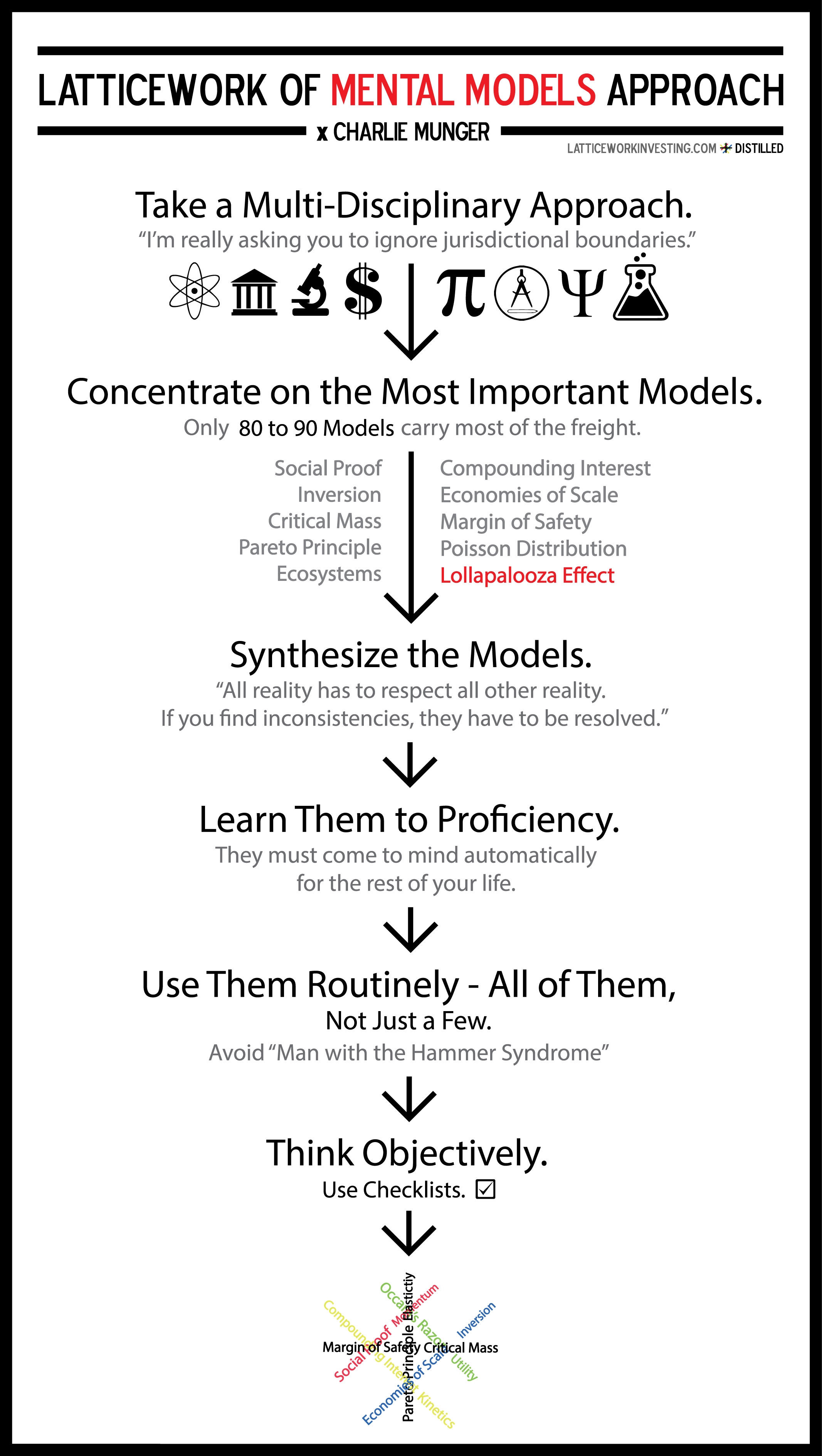](http://latticeworkinvesting.com/wp-content/uploads/2015/11/Latticework-of-Mental-Models-Approach12.jpg)
*Latticework of Mental Models*
## Practical Implications
Charlie's Checklist carries profound practical implications for various aspects of life, including investing, entrepreneurship, and personal decision-making. In this section, we shall discuss several examples and applications of Charlie's Checklist.
### Scenario 1: Investing
Imagine an investor, Jane, seeks to evaluate a potential investment opportunity - a fintech company, PayNGo. Jane can employ the mental models outlined in Charlie's Checklist to analyze the investment.
1. **Economic Moats (Competitive Advantage):** Jane can employ the mental model of economic moats, which pertains to a company's ability to maintain competitive advantages over its competitors. In the case of PayNGo, Jane can assess the company's network effects, brand recognition, and cost advantages to discern its competitive position in the market.
2. **Circle of Competence:** Jane should assess her familiarity with the fintech industry and the underlying technology that powers PayNGo. If she lacks the necessary knowledge, Jane can either seek intervention from experts or avoid the investment altogether.
3. **Latticework of Mental Models:** Jane can construct a latticework of mental models to analyze the opportunity. For instance, she can incorporate the mental model of risk and reward, probability, and inversion to evaluate potential outcomes and downsides associated with investing in PayNGo.
[![PDF\] EVALUATING THE INVESTMENT DECISION-MAKING PROCESS FOR ...](https://d3i71xaburhd42.cloudfront.net/f129744edd7f4751f5afb372ea548e14a8b228c0/5-Figure1-1.png)](https://d3i71xaburhd42.cloudfront.net/f129744edd7f4751f5afb372ea548e14a8b228c0/5-Figure1-1.png)
*Practical application of Charlie's Checklist in investing*
### Scenario 2: Personal Decision-Making
Suppose you, a college student, are deciding between pursuing a career in finance or pursuing a graduate degree in mathematics. You can leverage the concepts from Charlie's Checklist to inform your decision.
1. **Inversion:** Begin by inverting the problem: instead of focusing on the potential advantages, assess the disadvantages of each path. You can examine the potential pitfalls associated with each decision that may not be immediately evident.
2. **Mental Models:** You can incorporate various mental models in the decision-making process. For instance, the mental model of opportunity cost, expected value, or utility can help you gauge the potential benefits and drawbacks, thereby facilitating an informed decision.
3. **Circle of Competence:** Consider your strengths, skills, and interests. If you have a strong background in mathematics and enjoy solving complex problems, pursuing a graduate degree may be more in line with your circle of competence.
[](https://corporate-assets.lucid.co/chart/5eaf9c22-de8b-4c68-8770-6fffce781591.png)
*Decision-making and mental models*
## Key Insights and Further Exploration
In summary, Charlie's Checklist provides a comprehensive framework to analyze and make decisions based on interconnected mental models. The key insights derived from Charlie's Checklist include the following:
* Familiarity with a broad array of mental models from various disciplines enables an effective, nuanced, and informed approach to decision-making.
* Constructing a latticework of mental models can unlock deeper comprehension of complex scenarios.
* The application of mental models from within your circle of competence can help mitigate errors in decision-making.
For further exploration of the topic, consider reading works by prominent thinkers such as Charlie Munger, Nassim Taleb, and Howard Marks. Additionally, you can engage in the following activities:
1. Identify real-life scenarios or case studies and apply mental models from the latticework.
2. Construct your latticework of mental models and consistently refine it based on experience and new learnings.
3. Periodically reflect on past decisions to ascertain potential errors or biases in the decision-making process.
Charlie's Checklist, consequently, can act as a versatile tool in the arsenal of a college student, aiding them in the realms of investing, entrepreneurship, and personal decision-making. The core concepts and principles detailed herein can serve as a foundation for informed, rational, and effective decision-making, equipping students for a lifetime of learning and growth.
Last updated: 2024-05-31
Related Books

Related Knowledges