# The Inversion Principle: Understanding and Applying a Powerful Mental Model
## Introduction
The Inversion Principle is a potent mental model that can help us make better decisions, solve complex problems, and improve our thinking process. First introduced by the renowned investor and philosopher Charlie Munger, it involves examining a situation or problem from an opposite angle to gain a fresh perspective. This principle is one of the core components of Munger's "Latticework of Mental Models" approach to learning and decision-making, emphasizing the importance of having a well-rounded knowledge base and the ability to apply different models creatively.
[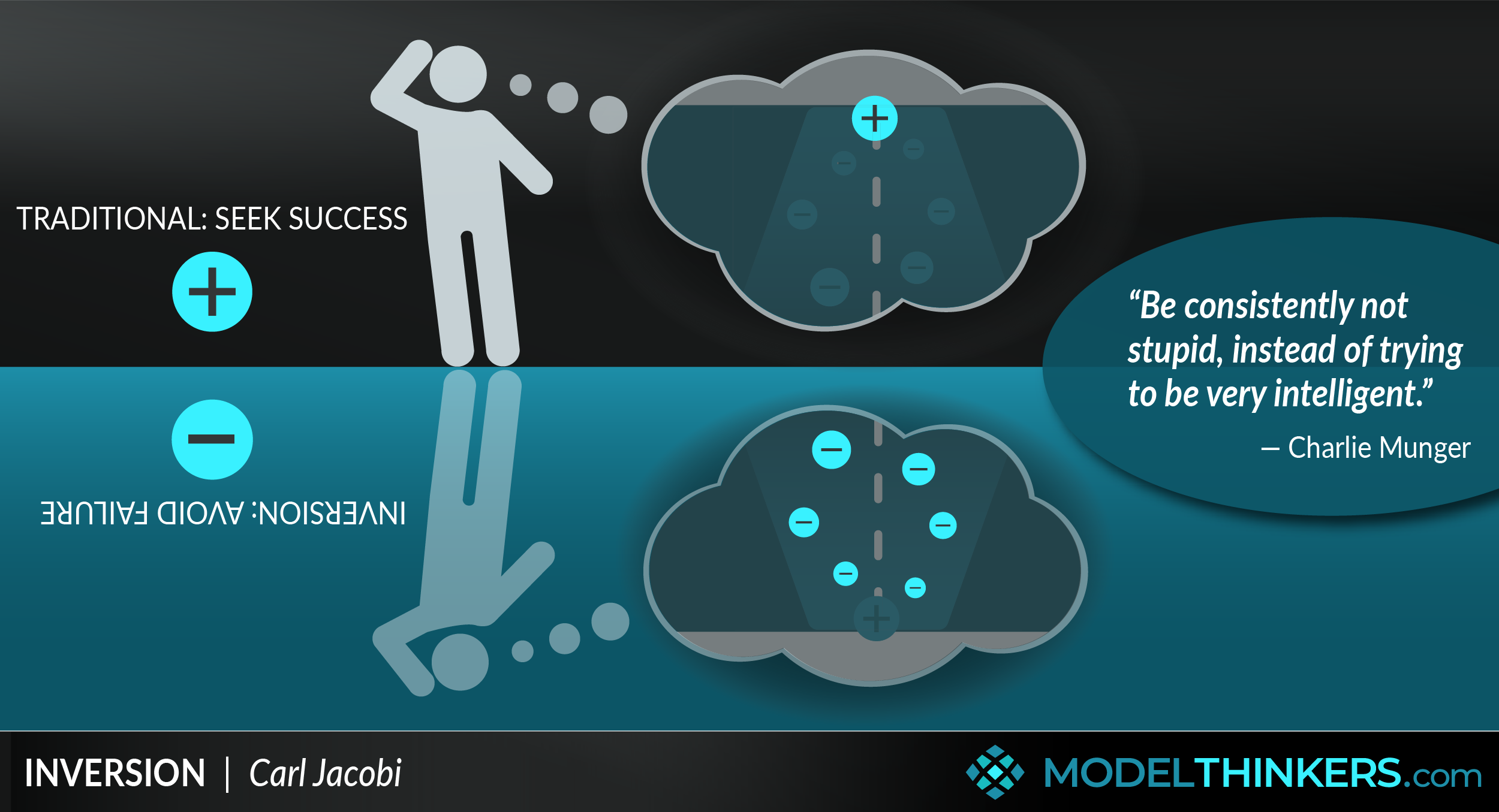](https://modelthinkers.com/storage/app/public/model_image/PmfdVIJbc5afJgweDPgBoS7DmCg1VKGvAlAKO8ML.png)
*Charlie Munger introducing the Inversion Principle*
In essence, the Inversion Principle encourages us to flip our thinking upside down and consider the opposite side of an idea, belief, or decision. By doing so, we can identify potential pitfalls, uncover alternative solutions, and make more informed choices.
## Understanding the Inversion Principle
At its core, the Inversion Principle consists of two key concepts: invert, always invert, and the idea of focusing on the opposite.
[](https://www.designorate.com/wp-content/uploads/2015/03/design-thinking-reverse.jpg)
*Illustration of inverted thinking concept*
### Invert, Always Invert
Inverting a problem or situation means turning it on its head and looking at it from the opposite perspective. For example, if you want to determine the factors that make a successful business, invert your thinking and consider the factors that would lead to failure.
Inversion allows us to:
1. Identify the common causes of failure and avoid them.
2. Recognize underlying assumptions and challenge them.
3. Explore alternative possibilities that might otherwise be overlooked.
4. Develop a deep understanding of the problem or situation.
### Focus on the Opposite
The second aspect of the Inversion Principle involves focusing on the opposite of what you seek. For instance, if you aim to become wealthy, consider the actions and habits that will prevent you from achieving wealth. By understanding the opposites, you can create a roadmap to success.
## Practical Examples of the Inversion Principle
Let's explore some practical examples to illustrate the power of the Inversion Principle.
### 1. Building a Successful Marriage
Imagine you and your partner want to build a successful and fulfilling marriage. Using the Inversion Principle, you would first consider the factors that contribute to a failed marriage. By examining the common causes of divorce (e.g., poor communication, infidelity, financial issues, lack of trust), you can work on actively avoiding these pitfalls.
Additionally, focusing on the opposites of specific goals or values can help you create a healthy and thriving relationship. For example, if you prioritize trust in your marriage, actively work on being transparent and open with your partner to strengthen this bond.
### 2. Achieving a Balanced Diet
The Inversion Principle can also help you maintain a balanced diet and avoid unhealthy eating habits. Rather than focusing on what to consume, think about the foods you should avoid. Here are some steps to follow:
1. Make a list of unhealthy foods (e.g., processed snacks, sugary drinks, fast food) that you should limit or eliminate.
2. Identify the triggers that lead you to consume these unhealthy foods (e.g., stress, boredom, social situations) and develop alternative responses.
3. Establish a routine of consuming nutrient-dense foods (e.g., fruits, vegetables, lean proteins) that support your health goals.
[](https://m.media-amazon.com/images/I/61w27cm96HL._AC_UF1000,1000_QL80_.jpg)
*Steps to avoid unhealthy eating habits using the Inversion Principle*
By focusing on the opposites (healthy vs. unhealthy), you create a clear path toward a balanced diet.
## Conclusion
The Inversion Principle is a powerful mental model that can help you make better decisions, solve complex problems, and improve your thinking process by considering the opposite side of an idea, belief, or decision. By incorporating this principle into your learning and decision-making process, you can build a strong mental framework capable of addressing various challenges and scenarios.
To explore the Inversion Principle further, consider the following suggestions:
1. Read Poor Charlie's Almanack to gain a deeper understanding of Charlie Munger's "Latticework of Mental Models" approach.
2. Practice applying the Inversion Principle to various scenarios, both personal and professional, to build your familiarity with this mental model.
3. Engage in discussions with fellow students or peers about different mental models and their applications to develop a well-rounded knowledge base and the ability to apply different models creatively.
Last updated: 2024-05-31
Related Books

Related Knowledges