Mental Models: The Building Blocks of Better Thinking
=====================================================
Mental models are, simply put, the tools that our brain uses to understand the world. They are the frameworks and concepts that we use to make sense of the complex, chaotic, and ever-changing world around us. By using mental models, we can better understand how things work, make predictions about the future, and make better decisions.
Mental models are not a new concept. In fact, they have been studied and written about for centuries. However, it was Charles T. Munger, the vice chairman of Berkshire Hathaway and long-time business partner of Warren Buffett, who brought the concept of mental models to the forefront of modern thinking. In his book, "Poor Charlie's Almanack," Munger explains the importance of mental models and how they can be used to improve our thinking and decision-making.
Relevance of Mental Models
--------------------------
Mental models are relevant to college students because they provide a framework for understanding and analyzing the world. By learning and applying mental models, students can improve their critical thinking skills, make better decisions, and solve complex problems. Furthermore, mental models can help students to better understand and apply the concepts they learn in their courses.
Examples of Mental Models
--------------------------
There are many different mental models, and each one provides a different perspective on the world. Here are a few examples of mental models:
### The Circle of Competence
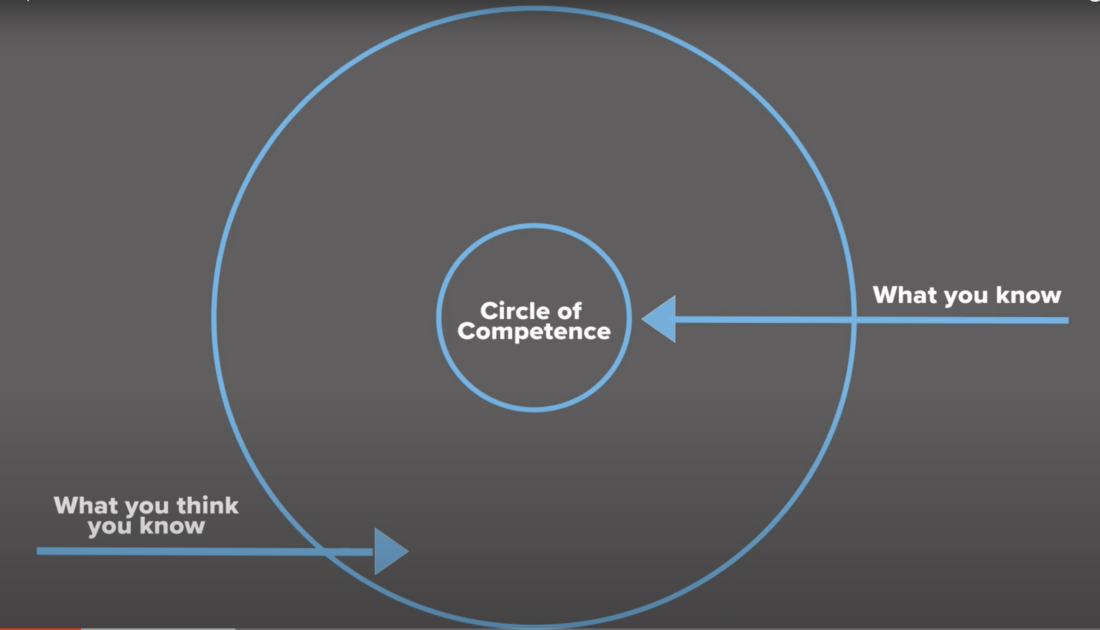
The circle of competence is a mental model that helps us to understand our own strengths and weaknesses. By understanding what we are good at and what we are not, we can focus our efforts on the things that we are best suited to do. This mental model is particularly relevant for college students, as it can help them to choose a major and a career that is well-suited to their abilities and interests.
[](https://ibkrcampus.com/wp-content/uploads/2023/07/Screenshot-2023-07-24-at-12.46.43-PM-1100x630.png)
*The Circle of Competence explained*
For example, if a student is good at math and science, they might choose to major in engineering or physics. On the other hand, if a student is not good at math, they might choose to major in a field that is more writing-intensive, such as English or journalism.
### The Law of Diminishing Returns
The law of diminishing returns is a mental model that helps us to understand the relationship between inputs and outputs. According to this mental model, there is a point at which adding more of an input will not result in a proportional increase in the output. This mental model is particularly relevant for college students, as it can help them to understand the trade-offs between studying and other activities.
[](https://upload.wikimedia.org/wikipedia/commons/2/26/Diminishing_Returns_Graph.svg)
*Illustration of the Law of Diminishing Returns*
For example, if a student spends all of their time studying, they will eventually reach a point of diminishing returns. At this point, adding more study time will not result in a significant increase in their grades. However, if the student takes a break and engages in other activities, such as exercise or socializing, they will be able to study more effectively when they return to their studies.
### The Inverse Rule of Accuracy
The inverse rule of accuracy is a mental model that helps us to understand the relationship between the complexity of a problem and the accuracy of our solutions. According to this mental model, the more complex a problem is, the less accurate our solutions will be. This mental model is particularly relevant for college students, as it can help them to understand the limitations of their knowledge and expertise.
[](https://www.imagesco.com/nuclear-science/geiger-counter/img/experiment-4-square.jpg)
*Understanding the Inverse Rule of Accuracy*
For example, if a student is asked to solve a simple math problem, such as 2 + 2, they can be confident that their solution is accurate. However, if the student is asked to solve a complex problem, such as a differential equation, they should be aware that their solution may not be 100% accurate.
Conclusion
----------
In conclusion, mental models are the building blocks of better thinking. By learning and applying mental models, college students can improve their critical thinking skills, make better decisions, and solve complex problems. Furthermore, mental models can help students to better understand and apply the concepts they learn in their courses.
To further explore the topic of mental models, I would recommend reading "Poor Charlie's Almanack" by Charles T. Munger, as well as "Thinking, Fast and Slow" by Daniel Kahneman. These books provide a comprehensive overview of mental models and their applications, and they are written in a clear and engaging style that is accessible to college students.
By learning and applying mental models, college students can become better thinkers, decision-makers, and problem-solvers. So, I encourage you to start building your own mental models today!
Last updated: 2024-05-31
Related Books

Related Knowledges