# Consolidation of Learning: The Power of Understanding and Integration
## Introduction
[](https://pbs.twimg.com/media/CiUEel_U4AAATt1.jpg)
*Learning as an ongoing journey*
In the vast expanse of knowledge, learning is an ongoing journey that extends far beyond the confines of a classroom. The consolidation of learning is a crucial aspect of this journey, which involves understanding, integrating, and applying new information and skills to reinforce long-term retention. Charles T. Munger, the vice-chairman of Berkshire Hathaway and a renowned businessman and philanthropist, emphasizes the importance of consolidation of learning in his book, *Poor Charlie's Almanack*. This concept is relevant not only for academic success but also for personal and professional growth.
## Core Concepts and Relevance
Consolidation of learning is the process of strengthening neural connections in the brain by systematically reviewing, practicing, and applying new information. This process helps learners to:
[](https://img.chemie.de/Portal/News/659e6e303d1de_hdwoGkfWZ.png?tr=w-1792,h-896,cm-extract,x-0,y-77:n-news_teaser)
*Core concepts of consolidation of learning*
1. Retain information for the long term
2. Make connections between different concepts
3. Apply knowledge in various contexts
4. Develop a deeper understanding of complex topics
The relevance of consolidation of learning is evident in various aspects of life. In the academic world, it enables students to perform better in exams and build a strong foundation for future studies. In professional settings, it facilitates problem-solving, decision-making, and innovation. Moreover, consolidation of learning contributes to personal development by fostering curiosity, creativity, and adaptability.
## Practical Implications and Examples
### Spaced Repetition
Spaced repetition is a powerful technique for consolidating learning, which involves reviewing information at gradually increasing intervals. This method leverages the brain's natural forgetting curve and enhances long-term retention.
[](https://i0.wp.com/getrapl.com/wp-content/uploads/2023/01/Colorful-Linear-Business-Process-Graph-_11zon-1-1.png?ssl=1)
*Spaced repetition method*
Example: A student learning a new language can use spaced repetition by reviewing vocabulary flashcards daily for the first week, then every three days for the second week, and finally, once a week for the following weeks.
### Interleaving
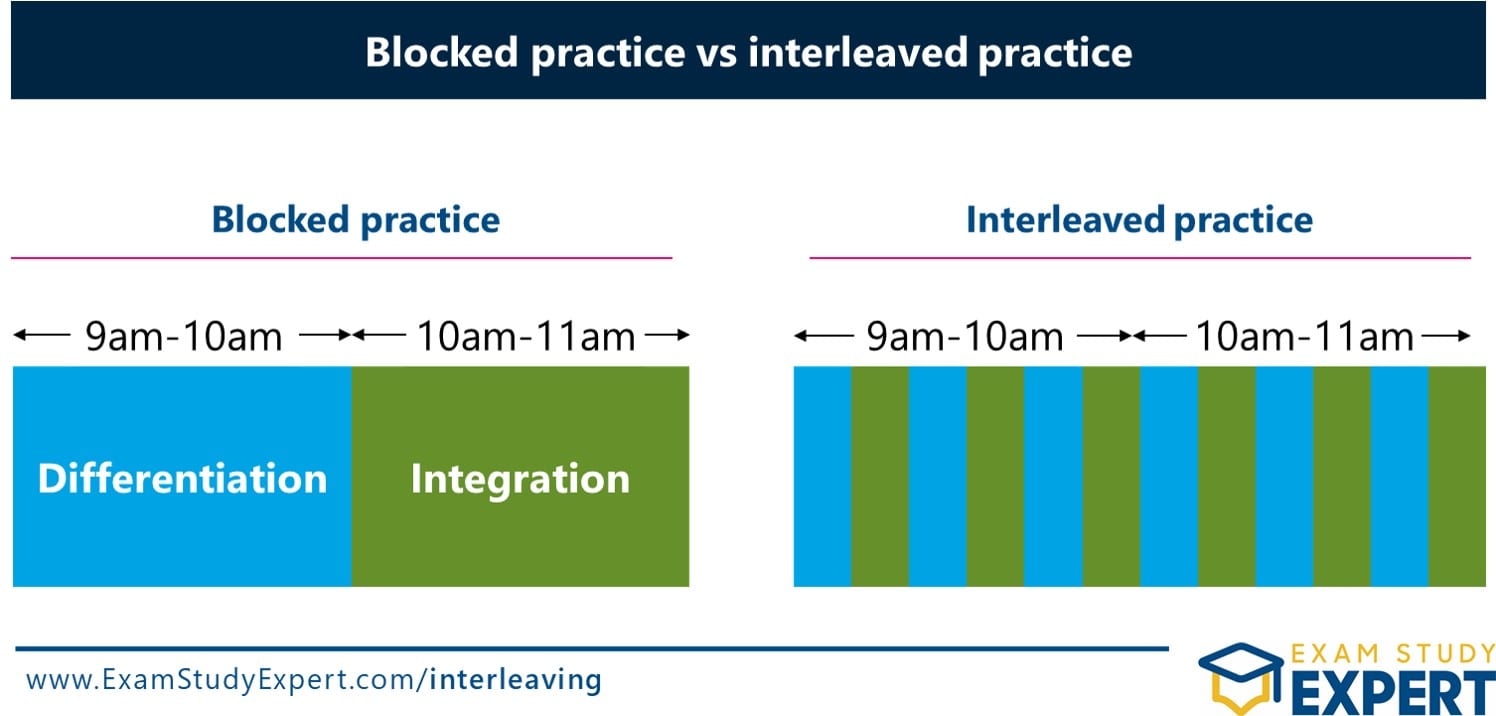
Interleaving is a learning strategy that involves alternating between different subjects or topics. This approach encourages learners to differentiate between concepts and make connections between them.
[](https://assets-global.website-files.com/5b69a01ba2e409501de055d1/618402fa146f31a4cf47e8df_What-Is-Interleaving.jpg)
*Interleaving study method*
Example: A mathematics student studying calculus can alternate between solving calculus problems, practicing algebraic equations, and reviewing geometry theorems.
### Elaborative Interrogation
Elaborative interrogation is a technique that involves generating explanations for why an explicitly stated fact or concept is true. This process deepens understanding and promotes the integration of new information with existing knowledge.
[](https://theunconsciouscurriculum.com/wp-content/uploads/2017/04/1475507246298.jpeg?w=590)
*Elaborative interrogation technique*
Example: A history student learning about the American Civil War can ask themselves why the Emancipation Proclamation was issued and how it impacted the course of the war.
### Real-World Applications
Consolidation of learning is not limited to academic subjects. It can be applied to various aspects of life, such as personal finance, health, and relationships.
[](https://media.springernature.com/lw685/springer-static/image/art%3A10.1007%2Fs11263-022-01666-w/MediaObjects/11263_2022_1666_Fig1_HTML.png)
*Real-world applications of consolidation of learning*
Example: A person interested in improving their financial literacy can use consolidation of learning techniques to understand complex financial concepts. They can use spaced repetition to review financial terms, interleave different financial topics, and practice elaborative interrogation by asking themselves why certain financial principles work.
## Conclusion
Consolidation of learning is a powerful tool for enhancing long-term retention, fostering deep understanding, and facilitating the application of knowledge. By incorporating techniques such as spaced repetition, interleaving, and elaborative interrogation, learners can optimize their study habits and improve their academic and professional performance. Furthermore, the principles of consolidation of learning can be applied to various aspects of life, empowering individuals to make informed decisions, solve complex problems, and adapt to an ever-changing world.
For further exploration, students can delve into the science of learning, investigate various learning strategies, and experiment with different techniques to discover what works best for them. By continuously refining their learning process, students can unlock their full potential and become lifelong learners.
Last updated: 2024-05-31
Related Books

Related Knowledges