# 'Big Brother as Deity' in 1984: Deconstructing the Cult of Omnipotence
[](https://m.media-amazon.com/images/I/71rpa1-kyvL.jpg)
*George Orwell's 1984 book cover*
George Orwell's dystopian novel, 1984, has long served as a cautionary tale about the dangers of totalitarianism, surveillance, and the manipulation of reality. At the heart of this bleak world is 'Big Brother,' the supreme leader of the superstate Oceania. Orwell's portrayal of Big Brother as a deity goes beyond a simple political symbol; it represents the insidious nature of total control and the power of fear to subvert human autonomy. In this comprehensive analysis, we will dissect the various aspects of Big Brother as a deity, supported by thought-provoking examples and applications.
## The Deification of Big Brother
At its core, Big Brother as a deity signifies a carefully crafted personality cult that manipulates and harnesses the deepest human fears, desires, and needs. Within Oceania, the ruling Party employs this ingenious form of propaganda to maintain power and obedience.
### 1. The Omnipresent Deity
One of the central aspects of Big Brother as a deity is the notion of omnipresence. Through the ever-watchful telescreens, Big Brother is constantly monitoring the every move and thought of Oceanian citizens. In this regard, the ceaseless surveillance creates the impression of an all-seeing entity, one that is intimately aware of every transgression or secret thought.
[](https://s22908.pcdn.co/wp-content/uploads/2017/06/are-we-living-in-1984.jpg)
*Big Brother omnipresence concept*
**Example**: In 1984, Winston Smith constantly grapples with the reality of perpetual surveillance, both in his personal space and even in his most private moments. This omnipresent fear cripples Winston's autonomy and further entrenches the power of the Party.
### 2. The Omnipotent Deity
In addition to omnipresence, the myth of Big Brother as a deity is further solidified through the belief in his omnipotence. By presenting an image of unyielding power and control, the Party seeks to instill the message that resistance is futile.
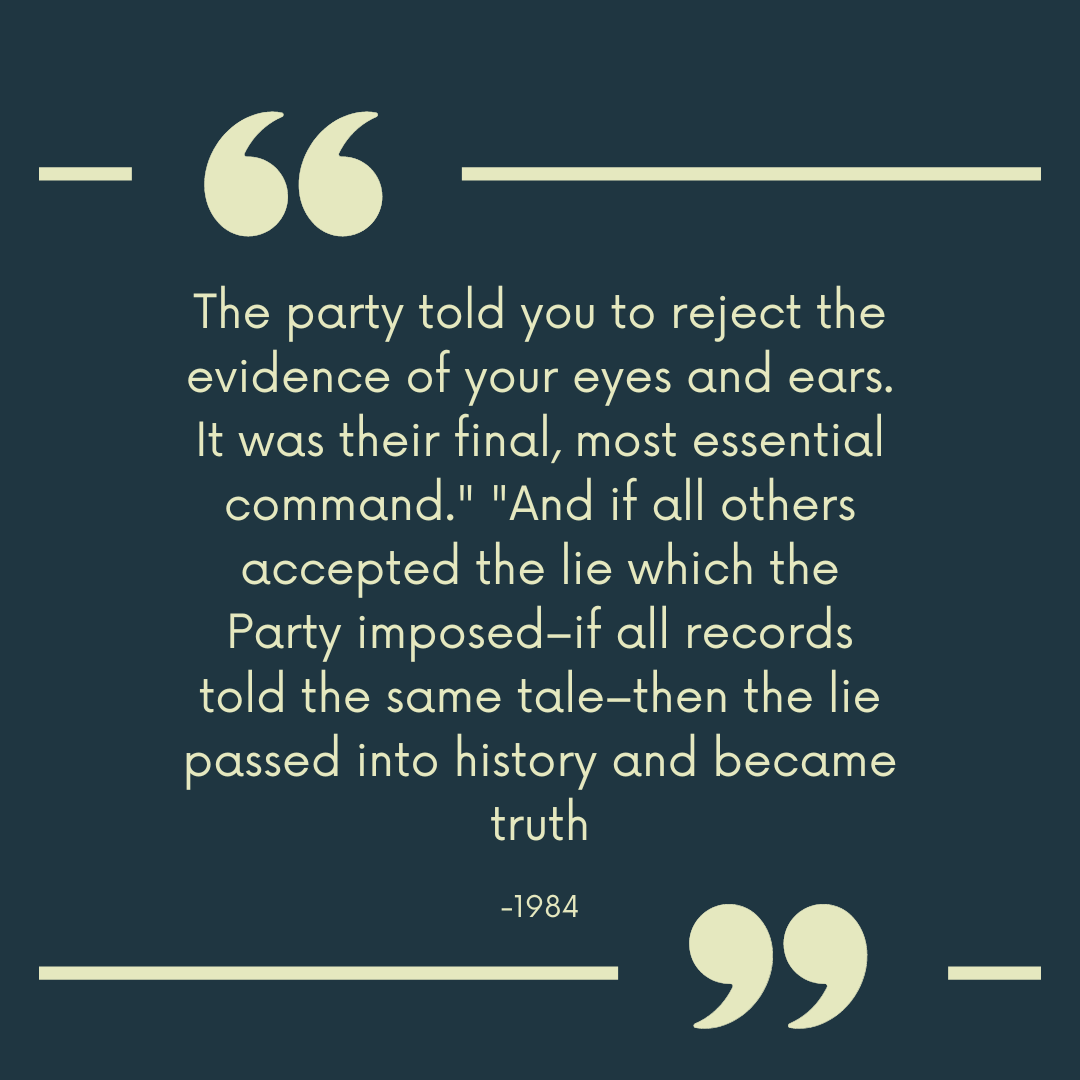
**Example**: This facet of Big Brother's deification is evident through the Party's manipulation of historical records. Official documents are constantly rewritten, creating an illusion of a flawless past and an unassailable present. This crafted narrative fosters the myth that the Party and Big Brother are infallible and possess complete authority and mastery over the past, the present, and the future.
[](https://edlatimore.com/assets/images/posts/party-told-you-to-reject.png?_cchid=d619850b1849264239ddc9502891218b)
*Manipulation of historical records*
### 3. Big Brother as a Fear-Inspiring Deity
Underpinning the deification of Big Brother is the pervasive presence of fear. This emotion, deliberately fostered and maintained by the Party, guarantees compliance from the Oceanian population. In essence, Big Brother as a deity symbolizes the destructive nature of fear that inhibits human freedom and critical thinking.
**Example**: A harrowing instance of this fear-based control can be seen in the Two Minutes Hate. Throughout this daily ritual, Oceanians are subjected to a frenzy of collective hatred, orchestrated against the Party's enemies. This propagandistic exercise not only reinforces the fear-driven narrative but also encourages self-incrimination and betrayal among the populace.
[](https://i.ytimg.com/vi/XvGmOZ5T6_Y/hq720.jpg?sqp=-oaymwEhCK4FEIIDSFryq4qpAxMIARUAAAAAGAElAADIQj0AgKJD&rs=AOn4CLCYTtSft-IF08-M0a3AZic_r5x8fw)
*Two Minutes Hate scene*
### 4. The Self-Perpetuating Deity
Finally, the circulation of certain slogans in Oceania illustrates the self-perpetuating nature of Big Brother as a deity. These slogans, which are drilled into the Oceanian consciousness through ceaseless propaganda, serve the dual function of propagating the myth of Big Brother and ensuring the subjugation of society.
**Example**: The slogan, 'Big Brother is watching you,' exemplifies this phenomenon. On a basic level, the phrase instills fear and engenders obedience. Yet, its underlining message also serves as a tool in deepening the illusion that surrendering one's autonomy to Big Brother ensures protection and order, thus further perpetuating the power and influence of the omnipresent deity.
## Cultivating Critical Thinking: Further Exploration
For students seeking to further explore the topic of Big Brother as a deity within the context of 1984, the following avenues may prove insightful:
1. Investigating historical instances of deification of political leaders, and analyzing how such examples compare and contrast with Orwell's portrayal of Big Brother as a deity.
2. Delving deeper into the nature of fear in dystopian societies and the role of fear in molding and maintaining totalitarian regimes.
3. Examining the concept of surveillance and the impact of constant monitoring on human behavior, identity, and freedom.
4. Comparing and contrasting the functions and manifestations of deities in religious contexts and political contexts, and assessing the similarities and differences with Orwell's construction of the Big Brother deity.
In elucidating the knowledge point 'Big Brother as deity,' we have scrutinized the mechanisms and effects of this construct within 1984, offering compelling examples and applications. By understanding the intricate nature of this phenomenon, readers can deepen their appreciation of the novel, cultivate their critical thinking skills, and remain ever vigilant of the erosive influence of power and control on the fundamentals of human autonomy and dignity.
Last updated: 2025-01-12
Related Books
Related Knowledges