# Proles in 1984: An In-depth Look at the Lower Class in a Dystopian Society
*Proles*, short for *proletariat*, refers to the lowest social class in the dystopian society of George Orwell's novel 1984. The proles make up the overwhelming majority of the population, yet they are oppressed and exploited by the ruling class, the Inner Party. This essay will delve into the concept of proles in 1984, their relevance, and practical implications.
[](http://2.bp.blogspot.com/_9XzDGnDAGDc/TK69PdEUWuI/AAAAAAAAAPY/EfBehE7o9eA/s400/1984-social-classes.gif)
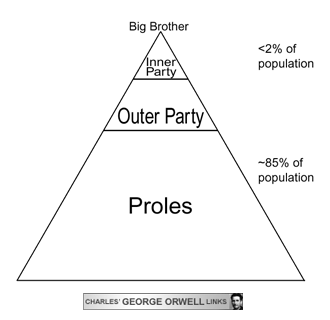
*Society structure in 1984*
## Core Concepts and Relevance
In Orwell's 1984, the society is divided into three social classes: the Inner Party, the Outer Party, and the Proles. The Inner Party consists of the ruling elite, who control and manipulate the society through an all-encompassing surveillance system, propaganda, and manipulation of language. The Outer Party serves as the middle class, who are responsible for implementing the policies and ideologies of the Inner Party. The Proles, on the other hand, are the masses who are exploited and kept in a state of ignorance and poverty.
The Proles are significant in 1984 because they represent a potential threat to the ruling class. Although they are kept in a state of ignorance and poverty, they outnumber the ruling class. This fact makes the Proles a potential source of rebellion, which the ruling class seeks to suppress and control.
## Practical Implications: Examples and Applications
The Proles' ignorance and poverty make them easy targets for exploitation and manipulation. The ruling class uses various tactics to keep the Proles in a state of subjugation:
1. **Pervasive Surveillance:** The ruling class uses surveillance to monitor and control the Proles' behavior. For instance, telescreens are installed in every home, workplace, and public space, enabling the ruling class to monitor and control the Proles' activities.
2. **Propaganda:** The ruling class uses propaganda to shape the Proles' beliefs and values. For instance, the Party controls the media and uses it to disseminate propaganda that reinforces the Party's ideology.
3. **Mind Control:** The ruling class uses mind control to manipulate the Proles' thoughts and feelings. For instance, the Party uses techniques like doublethink and newspeak to confuse and control the Proles' minds.
[](https://i.ytimg.com/vi/KgX8PWYNW6c/maxresdefault.jpg)
*Methods of control in 1984*
These tactics allow the ruling class to maintain its power and control over the Proles, but they also have practical implications for the Proles:
1. **Lack of Autonomy:** The Proles have no autonomy or control over their lives. They are controlled and manipulated by the ruling class, leaving them with no agency or freedom.
2. **Exploitation:** The Proles are exploited for their labor, which benefits the ruling class. They are paid low wages, forced to work long hours, and denied access to education and healthcare.
3. **Poverty:** The Proles live in extreme poverty, with limited access to food, shelter, and other basic necessities. They are forced to live in squalid conditions, making them vulnerable to disease and other health risks.
The examples above illustrate the impact of the ruling class's tactics on the Proles. They also highlight the practical implications of the Proles' subjugation: the absence of autonomy, exploitation, and poverty.
[](https://openthedoorto1984.wordpress.com/wp-content/uploads/2015/10/bundesarchiv_bild_146-1994-041-07_dresden_zerstc3b6rtes_stadtzentrum.jpg?w=640)
*Living conditions of the Proles in 1984*
## Further Exploration
The concept of Proles in 1984 offers a rich area for further exploration. Students can delve deeper into the topic by:
1. Analyzing the portrayal of the Proles in the novel and its implications for the society.
2. Comparing and contrasting the Proles in 1984 with other dystopian societies, such as Brave New World or The Handmaid's Tale.
3. Examining the historical and social context of 1984 and its impact on the portrayal of the Proles.
4. Exploring the relevance of the Proles in contemporary society and the implications for social justice and equality.
## Conclusion
In conclusion, the Proles in 1984 are a significant concept that highlights the impact of oppression and exploitation. They represent the masses who are kept in a state of ignorance and poverty, making them vulnerable to exploitation and manipulation. The practical implications of the Proles' subjugation are significant, as they have limited autonomy, are exploited for their labor, and live in extreme poverty. The concept of Proles in 1984 offers a rich area for further exploration, as it highlights the importance of social justice and equality. By analyzing the portrayal of the Proles, comparing and contrasting it with other dystopian societies, examining the historical and social context, and exploring its relevance in contemporary society, students can deepen their understanding of the concept of Proles and its implications for social justice and equality.
Last updated: 2024-12-04
Related Books

Related Knowledges