Party-Think: Understanding the Psychological Manipulation in 1984
=================================================================
[](https://m.media-amazon.com/images/I/71XtTiYQdKL._UF1000,1000_QL80_.jpg)
*Orwell's 1984 dystopian world illustration*
In George Orwell's dystopian novel 1984, the concept of "Party-think" is a pervasive force that shapes the way the citizens of Oceania perceive reality. At its core, Party-think refers to the strict control and manipulation of information, language, and thought by the ruling party, the Inner Party, in order to maintain power and suppress individual freedom. In this educational content, we will explore the intricacies of Party-think, its implications, and how it serves as a tool for psychological manipulation.
Understanding Party-Think
---------------------------
Party-think is manifested in several ways throughout the novel, but its most striking form is the manipulation of language, or Newspeak. Newspeak is a deliberately limited and controlling language, designed to reduce the range of thought. By controlling language, the Party seeks to eliminate any words or phrases that might challenge its authority or encourage individual thinking.
[](https://sva.design/image/project/uploads/upload-84-Screen_Shot_2017-04-24_at_7.00.03_PM.jpg)
*Newspeak concept illustration*
The Party also implements a pervasive surveillance system, known as telescreens, which monitor the actions and expressions of citizens. This constant supervision instills a sense of fear and self-censorship, further limiting the individual's capacity for independent thought.
[](https://miro.medium.com/v2/resize:fit:1024/1*quqfpv_D74jUg6X1Wojczw.jpeg)
*Telescreens surveillance in 1984*
Relevance and Applications of Party-Think
----------------------------------------
The concept of Party-think offers valuable insights into the ways in which power structures can manipulate language, information, and thought to control populations. By examining the psychological tactics used in Orwell's dystopia, we can better understand and identify similar manipulations in real-world contexts.
### 1. Propaganda and Media Manipulation
One prominent example of Party-think in contemporary society is the use of propaganda and media manipulation. Governments and other powerful entities can influence public opinion by carefully selecting and framing the information presented in news outlets and social media platforms. By controlling the narrative and limiting access to alternative viewpoints, these entities can shape public discourse and stifle dissent.
[](https://newseumed.org/sites/default/files/styles/600height/public/2018-10/Propaganda%20Tip%201.jpg?itok=WkwQtR50)
*Propaganda and media manipulation*
### 2. Groupthink and Conformity
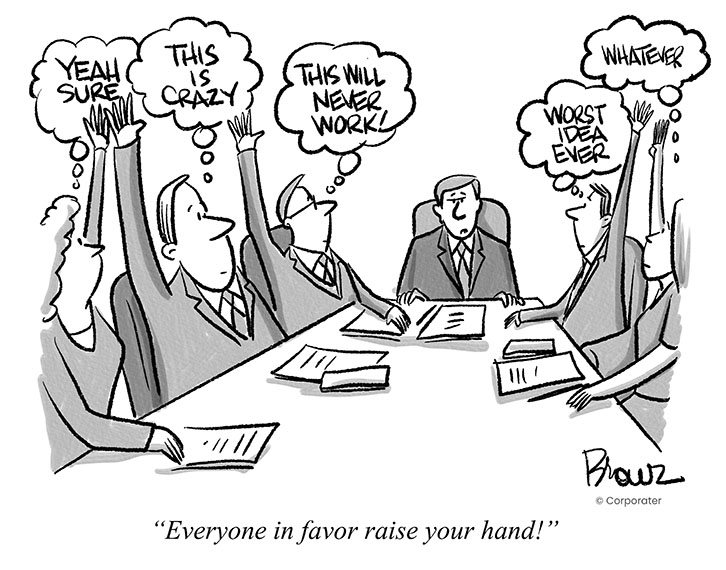
Another application of Party-think can be seen in instances of groupthink and conformity. Groupthink occurs when a group of individuals, often motivated by shared values or goals, unquestioningly accepts and promotes a particular viewpoint or course of action. This phenomenon can generate an echo chamber effect, where alternative viewpoints are dismissed or suppressed.
[](https://corporater.com/wp-content/uploads/2021/03/Resource-Library-Avoiding-Groupthink-1.jpg)
*Groupthink concept illustration*
In such situations, individuals may abandon their critical thinking skills and embrace the prevailing narrative, even if it contradicts their personal beliefs or values. Groupthink can be particularly dangerous when it supplants evidence-based decision-making, as it can lead to poor outcomes, misguided policies, and the suppression of dissenting voices.
Exploring Party-Think Further
---------------------------
To further explore the concept of Party-think, consider examining the following areas:
1. **Critical Discourse Analysis (CDA):** CDA is a multidisciplinary approach that examines language and power relations in social contexts. Applying CDA to political speeches, news articles, or social media discussions can reveal the ways in which language is used to shape public opinion and influence decision-making.
2. **Censorship and Information Control:** Investigate historical and contemporary examples of censorship and information control, such as governmental surveillance programs, book banning, internet filtering, and propaganda campaigns. Analyze the psychological impact of these measures on individuals and society, and consider the implications for democratic principles and values.
3. **Critical Thinking and Media Literacy:** Encourage the development of critical thinking and media literacy skills among students and the broader public. Teach individuals to identify biases, question sources, and analyze arguments in order to promote independent thinking and resist the manipulation of language and information.
In conclusion, Party-think is a powerful and insidious tool of psychological manipulation, as demonstrated in George Orwell's 1984. By understanding the ways in which language, information, and thought can be controlled and distorted, we can better recognize and resist similar manipulations in our own society. By fostering critical thinking, media literacy, and a commitment to evidence-based decision-making, we can strive to maintain our individual autonomy and protect the democratic values of openness, diversity, and freedom of expression.
Last updated: 2024-12-04
Related Books
Related Knowledges