# Enterprise Multiples: A Comprehensive Guide from The Intelligent Investor
## Introduction
Enterprise multiples are critical valuation tools for investors to estimate the worth of a company. Also known as business 'multiples' or 'valuation ratios,' these indicators represent the relative price of a company's stock concerning fundamental factors. These factors may include earnings, cash flows, sales, or book value. Enterprise multiples prove particularly useful when comparing companies within the same industry or sector.
_The Intelligent Investor_ by Benjamin Graham introduces various enterprise multiples and teaches investors how to use them to estimate a company's intrinsic value. This article delves deeper into the knowledge point of enterprise multiples, offering a comprehensive guide for college students and aspiring investors.
## Types of Enterprise Multiples
### Price-to-Earnings (P/E) Ratio
One of the most common enterprise multiples is the price-to-earnings (P/E) ratio. The P/E ratio is calculated by dividing the current stock price by the earnings per share (EPS).
P/E ratio = Market Value per Share / Earnings Per Share (EPS)
This ratio indicates how much an investor pays for each dollar of a company's earnings. For example, a P/E ratio of 20 implies that an investor is willing to pay $20 for every dollar of the company's earnings.
[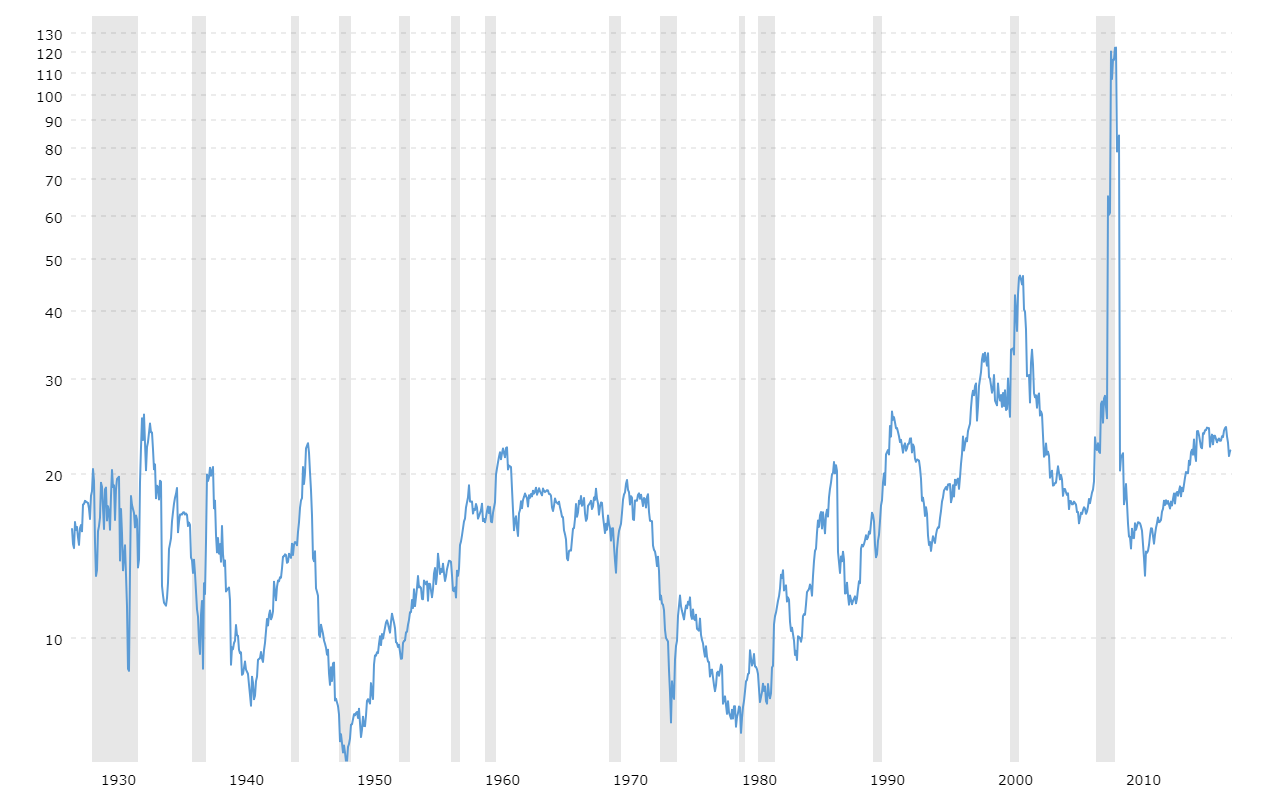](https://www.macrotrends.net/assets/images/large/sp-500-pe-ratio-price-to-earnings-chart.png)
*Price to Earnings \(P/E\) Ratio*
### Price-to-Sales (P/S) Ratio
Another popular enterprise multiple is the price-to-sales (P/S) ratio. The P/S ratio calculates the market value of a company in relation to its revenue or sales. It is particularly helpful in valuing companies with negative earnings or those undergoing restructuring.
P/S ratio = Market Value per Share / Sales Per Share (SPS)
Investors can apply the P/S ratio to identify undervalued companies and growth opportunities.
[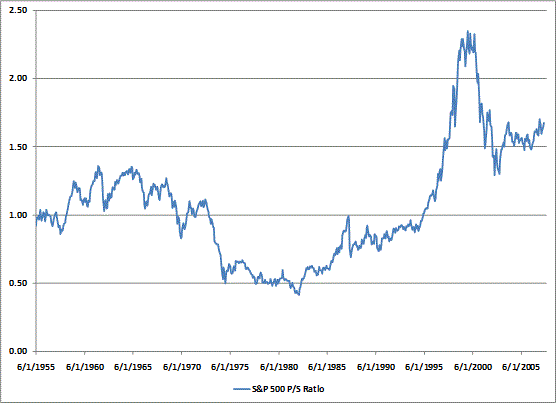](https://www.hussmanfunds.com/wp-content/uploads/research/rsi171018c.gif)
*Price to Sales \(P/S\) Ratio*
### Price-to-Book (P/B) Ratio
The price-to-book (P/B) ratio compares a company's market capitalization to its net assets' book value. This ratio is especially useful for comparing companies in capital-intensive industries.
P/B ratio = Market Value per Share / Book Value per Share (BVPS)
A lower P/B ratio may signify a potential investment opportunity, as it may suggest that the company's stock is undervalued relative to its net asset value.
[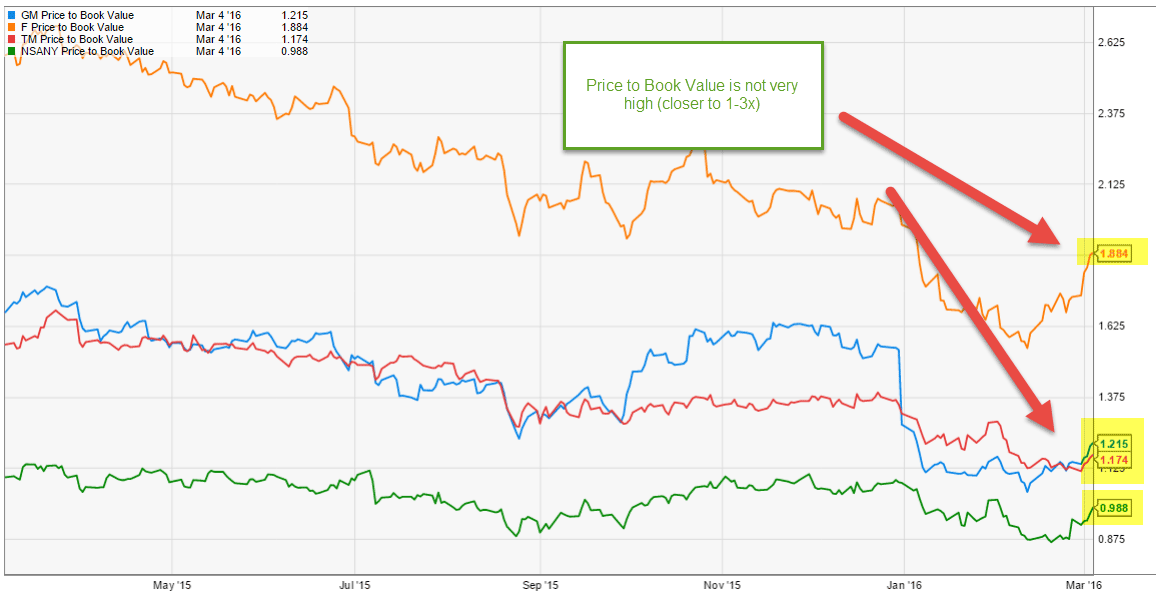](https://www.wallstreetmojo.com/wp-content/uploads/2016/03/Automobile-comapnies-Price-to-Book-Ratio.png)
*Price to Book \(P/B\) Ratio*
## Practical Applications
### Identifying Overvalued and Undervalued Stocks
Enterprise multiples can help an investor discern if a company's stock is overvalued or undervalued. For example, if the current P/E ratio of a company is above its historical average or that of its competitors, this may indicate that the stock is overvalued. Conversely, an undervalued stock might have a lower P/E ratio than its peers or its historical average.
### Comparing Companies in the Same Sector
Investors can use enterprise multiples to compare similar companies within the same sector. For instance, a growth-oriented investor might compare the P/E ratios of various technology companies to identity the most attractively valued stock.
### Assessing Industry Trends
Comparing average enterprise multiples for an entire industry can offer insights into broader market trends. For example, a particularly high average P/E ratio may suggest that investors are optimistic about the sector's future growth prospects.
## Example: Enterprise Multiples in Action
Let's consider two hypothetical technology companies, XYZ Corp. and ABC Inc., with the following financials:
- XYZ Corp.
- Market Value per Share: $150
- EPS: $10
- SPS: $200
- BVPS: $50
- ABC Inc.
- Market Value per Share: $120
- EPS: $8
- SPS: $180
- BVPS: $60
| Enterprise Multiple | XYZ Corp. | ABC Inc. |
| --- | --- | --- |
| P/E Ratio | 15 | 15 |
| P/S Ratio | 0.75 | 0.67 |
| P/B Ratio | 3.0 | 2.0 |
Using enterprise multiples, we can compare XYZ Corp and ABC Inc. According to the P/E ratio, both companies are equally valued. However, XYZ Corp. has a lower P/S ratio (0.75) than ABC Inc. (0.67), suggesting that XYZ Corp. may be undervalued compared to ABC Inc. based on sales. Furthermore, XYZ Corp. has a higher P/B ratio (3.0) than ABC Inc. (2.0), indicating that ABC Inc. may be undervalued regarding book value.
## Conclusion
Understanding enterprise multiples is essential for investors seeking to estimate a company's intrinsic value and identify investment opportunities. By contrasting various multiples, investors can make informed decisions about potential investments and market trends.
Further exploration of enterprise multiples may include analyzing additional case studies, assessing a company's historical multiples, or combining multiple ratios for a more comprehensive assessment. Additionally, investors should consider incorporating other factors, such as qualitative aspects and macroeconomic indicators, to make well-rounded investment decisions.
Last updated: 2024-06-12
Related Books

Related Knowledges