### Investor vs Speculator: Core Concepts and Relevance
[](https://upload.wikimedia.org/wikipedia/commons/2/2a/Benjamin_Graham_%281894-1976%29_portrait_on_23_March_1950.jpg)
*Benjamin Graham, author of 'The Intelligent Investor'*
In the realm of finance and investing, it is crucial to distinguish between an investor and a speculator. This distinction, first introduced by Benjamin Graham in his seminal book 'The Intelligent Investor,' has significant implications for one's investment strategy, portfolio management, and overall financial success.
An investor, as defined by Graham, is an individual who takes a conservative and long-term approach to acquiring securities. Investors employ a fundamentals-driven strategy, meticulously evaluating businesses' intrinsic values, management quality, and earning potential before investing in them. They focus on reducing risk, generating consistent returns, and safeguarding their hard-earned capital.
Speculators, on the other hand, are market participants who actively trade securities, primarily seeking short-term profits. By buying and selling securities quickly, speculators aim to capitalize on price fluctuations regardless of their intrinsic value or underlying fundamentals.
The investor-speculator distinction carries profound real-life implications. Understanding one's inclination towards either category helps shape a suitable investment philosophy, minimize unsystematic risk, and enhance financial decision-making. In the following sections, we delve into various examples and applications that demonstrate practical differences and key insights between the two.
#### Practical Implications of Investor vs Speculator
##### Example 1: Growth vs. Value Stocks
[](https://eor7ztmv4pb.exactdn.com/wp-content/uploads/2021/01/b278p1.jpg)
*Growth vs Value Stocks*
A practical example of the investor-speculator distinction becomes evident when comparing growth stocks and value stocks. An investor, focusing on earnings, cash flow, and intrinsic values, may prefer purchasing stocks of established and financially healthy companies at reasonable valuations. They display a proclivity towards value stocks that offer long-term wealth creation opportunities.
In contrast, speculative investors may be indifferent to valuation disparities, overlooking fundamental analysis and intrinsic values. Instead, they seek companies with considerable growth potential and swifter price appreciation. Consequently, they may be more willing to invest in growth stocks that tend to be overvalued yet promise substantial returns in a shorter time frame.
##### Example 2: Day Trading vs. Long-Term Positions
[](https://g.foolcdn.com/image/?url=https%3A%2F%2Fm.foolcdn.com%2Fmedia%2Fdubs%2Fimages%2Fday-trading-vs-investing-infographic.width-600.png&op=resize&w=400&h=400)
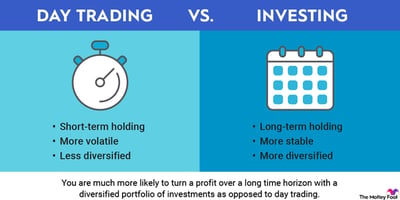
*Day Trading vs Long-Term Investing*
Another illustration of the contrast between investors and speculators can be found in their approach towards the tenure of their investments.
Speculators are more likely to engage in day trading or maintaining short-term positions. As a result, speculators often concentrate on technical analysis, focusing on price action, chart patterns, and market sentiment. Speculators tend to exit their positions quickly, aiming to exploit fleeting market inefficiencies or capitalize on temporary price discrepancies.
Conversely, investors emphasize long-term positions, averaging down whenever possible. Displaying patience, investors remain unruffled by short-term volatility, focusing instead on the company's prospective financial performance and value creation capacity.
##### Example 3: Fundamentals vs. Trends
Speculators and investors also differ in their reliance on market trends and sentiment versus fundamentals. Speculators might be swayed by market hype and popular trends, rather than focusing on a company's revenue or earnings, and become susceptible to cognitive biases such as herd behavior, recency bias, and loss aversion.
Investors, however, prioritize fundamentals over market trends when making an investment decision. Investors objectively assess the prospect of a security's intrinsic value while considering market trends and other qualitative and quantitative factors.
Moreover, investors tend to maintain diversified portfolios, reducing risk exposure and ensuring exposure across various segments and industries. Simultaneously, speculators might maintain narrow and concentrated portfolios, seeking to maximize short-term returns and minimize diversification - a classic difference between investors and speculators.
[](https://media.licdn.com/dms/image/D4D12AQE9mowcEPPWBA/article-cover_image-shrink_600_2000/0/1680085846332?e=2147483647&v=beta&t=sMRkTNYVfkTtEcTzxSlNIMB_sMs8QcWKKL6ckQ_zRKY)
*Investment Portfolios: Diversified vs Concentrated*
#### Summarizing Key Insights and Further Exploration
The investor-speculator dichotomy, introduced and detailed in Benjamin Graham's iconic work, shapes a solid foundation for a successful and sustainable investment philosophy.
Differentiating between the two permits us to understand that investors and speculators have distinct goals and risk tolerances. Striving for consistency, investors maintain long-term positions in undervalued securities while leaning towards value stocks and quality businesses. Simultaneously, speculators exhibit greater interest in short-term market fluctuations, day trading, and technical analysis.
For college students, understanding this dichotomy at a deeper level is crucial. Students could further delve into these two concepts through exploration of different value-investing strategies, modern portfolio theory (MPT), and the role of cognitive biases in finance. Additionally, analyzing and comparing the performance of value and growth stocks, examining case studies of market bubbles and crashes, and evaluating the impact of investor behavior on markets could validate and strengthen comprehension of these essential financial concepts.
Last updated: 2024-04-04
Related Books
Related Knowledges