# Investment Margin of Safety: A Comprehensive Exploration from The Intelligent Investor
## Introduction
[](https://upload.wikimedia.org/wikipedia/commons/2/2a/Benjamin_Graham_%281894-1976%29_portrait_on_23_March_1950.jpg)
*Benjamin Graham, the father of value investing.*
Investment Margin of Safety is a fundamental concept introduced by Benjamin Graham, the father of value investing and the author of *The Intelligent Investor*. This concept focuses on purchasing stocks at a considerable discount from their intrinsic value, providing a "margin of safety." Graham emphasizes that investors should strive to minimize their downside risk, and the investment margin of safety serves as a crucial tool to do so. By understanding the intrinsic value of a security and investing in it at a significant discount, investors reduce the likelihood of incurring losses while providing the potential for substantial returns over time.
## Core Concepts
[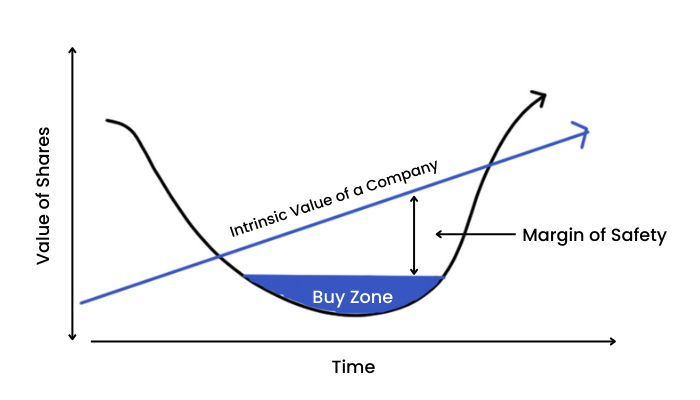](https://d24uab5gycr2uz.cloudfront.net/uploads/other_pic/WfwtYlZNmd.png)
*Diagram of Margin of Safety Concept*
In essence, the Margin of Safety represents the gap between the price an investor pays for a stock and its underlying intrinsic value. Graham proposed a systematic approach for valuing stocks to determine the intrinsic value, which involves:
1. Calculating a conservative estimate of a company's future earnings, known as earnings power value (EPV). This estimate considers the company's historical earnings and expected future growth rates.
2. Applying a reasonable discount rate or a multiple to the EPV to account for potential fluctuations and uncertainties.
The product of these calculations is the intrinsic value of a stock, and it is critical to invest in the security when its current market price is well below this value.
## Relevance
The principle of the investment margin of safety remains relevant in modern finance for multiple reasons, such as:
1. Counterbalancing Uncertainty: The financial markets are inherently volatile, and forecasts are inherently uncertain. By adhering to the margin of safety principle, investors minimize their exposure to adverse market movements and reduce the likelihood of purchasing overvalued stocks that might later decline in price.
2. Disciplined Approach: Applying the margin of safety principle fosters a disciplined and rational investment philosophy. By focusing on acquiring undervalued securities, investors can avoid engaging in speculative behavior driven by market sentiments.
3. Catalyzing Long-Term Wealth Creation: The margin of safety principle enables long-term wealth creation by minimizing losses and facilitating the compounding of returns over the years.
## Practical Applications
[](https://www.investopedia.com/thmb/ofTg04WDo94GEs1a11Y0uRO-htY=/1500x0/filters:no_upscale%28%29:max_bytes%28150000%29:strip_icc%28%29/intrinsicvalue-11e4051f0881435d91c0df4f68e9395e.jpg)
*Stock Valuation Example*
### Example 1: The Case of Altria Group (MO)
Altria Group, a multinational tobacco company, is a blue-chip stock with a robust history of consistent earnings and dividend growth. Assuming a conservative growth rate, and applying the formula for EPV, we can estimate its intrinsic value.
Suppose the EPV of MO equates to $100 per share, reflecting conservative financial projections for the company. However, the current market value ranges around $45. By investing in MO at the current price, investors gain a margin of safety of more than 50%. This substantial margin serves as a protective buffer against prospective potential downsides.
### Example 2: IBM's Gap Between Intrinsic Value and Market Price
IBM is another example where the margin of safety approach can be implemented. Assume the EPV for IBM is $200, while the current market price remains around $120 per share. In this case, an investment in IBM at the prevailing market price would present an approximate 40% margin of safety.
## Key Insights and Future Explorations
1. Incorporating a margin of safety in investment decisions reduces downside risks while offering potential gains.
2. Applying the margin of safety principle necessitates rigorous analysis and objective projections, providing investors with an avenue to improve their analytical skills.
3. Valuation and price discount metrics should constantly be reassessed and updated. This continuous monitoring enhances the probability of capturing favorable opportunities in the ever-changing financial markets.
4. Adopting the margin of safety principle fosters a disciplined and rational investment process, thereby contributing to the long-term success of investors.
[](https://i0.wp.com/newspaceeconomy.ca/wp-content/uploads/2024/04/img_9048-1.jpg?fit=1767%2C2000&ssl=1)
*Future Exploration in Investment Strategies*
For further exploration of the topic, students can consider the following avenues:
1. Examining the impact of interest rate fluctuations on margin of safety calculations.
2. Investigating the significance of the margin of safety principle across various market conditions (bull, bear, or neutral markets).
3. Analyzing sector-specific variations in margin of safety levels, and evaluating their implications on sector rotation strategies.
4. Comparing alternative valuation models and techniques (e.g., Discounted Cash Flow, Dividend Discount, etc.) in the context of the margin of safety principle.
5. Evaluating the relationship between the investor's risk tolerance and the required margin of safety.
Last updated: 2024-06-12
Related Books

Related Knowledges