# Understanding the Mr. Market Analogy: A Ben Graham Classic
[](https://upload.wikimedia.org/wikipedia/commons/2/2a/Benjamin_Graham_%281894-1976%29_portrait_on_23_March_1950.jpg)
*Benjamin Graham, author of 'The Intelligent Investor'.*
*This essay aims to present a comprehensive analysis of the 'Mr. Market' analogy, a fundamental concept introduced in Benjamin Graham's classic investment book, *The Intelligent Investor*, Rev. Ed. This essay will introduce the analogy, explain its relevance, provide diverse examples and applications, and conclude with key insights and avenues for further exploration.*
## Introduction to Mr. Market
First published in 1949, *The Intelligent Investor* lays out the cornerstone of value investing, a strategy centered on buying stocks when they are underpriced and selling when they are overpriced. Graham's 'Mr. Market' analogy, a key concept in the book, helps investors differentiate between speculation and investing.
'Mr. Market' is a hypothetical business partner who approaches investors daily, offering to buy their shares at a certain price or sell his for another. This partner isn't financially sophisticated, and his prices fluctuate depending on his ever-changing emotions. Sometimes, he is optimistic, leading to high share values; other times, pessimism dominates, making his prices seemingly attractive.
[](https://w3wealth.com/wp-content/uploads/2020/04/1140-bull-and-bear-in-coronavirus-masks-watch-stock-prices-1024x588.jpg)
*Illustration of Mr. Market's mood swings impacting stock prices.*
By visualizing the stock market through the 'Mr. Market' analogy, Graham teaches that markets aren't rational but driven by human emotions. Investors can capitalize on the market without relying on these fluctuations, ensuring long-term profitability by focusing on company fundamentals.
## Applying the Analogy
In the stock market, many people are overwhelmed by the chaotic price movements of shares, induced by fear and greed. 'Mr. Market' embodies these sentiments and behavior, as shares' values tend to deviate from their company's underlying, inherent worth.
Consider a company with a stock worth $100 per share based on financial standings. However, 'Mr. Market' is worried about the overall economy, causing his panic — and a resulting price drop to $80. Does this change truly imply a $20 loss on the company's intrinsic value?
Investors inspired by 'Mr. Market's' irrational pessimism might sell their shares and leave the company, missing out on future growth and value generation. Though risk-averse behavior, it isn't necessarily the path toward prosperity or intelligent investing.
Let's flip this scenario upside down. Assume that 'Mr. Market' is euphoric because the overall economy is booming. As an irrational character, 'Mr. Market' might increase the stock price disproportionately. When examining the company, an investor notices that share prices rose from $100 to $150. The company's inherent value didn't increase by $50, but optimistic 'Mr. Market' overvalued the shares. Again, investors can ignore such exaggerations and focus on acquiring shares based on their fundamental analysis of company value.
## Broader Applications
Beyond its use in examining single-company stocks, the 'Mr. Market' analogy also offers insights into other market phenomena:
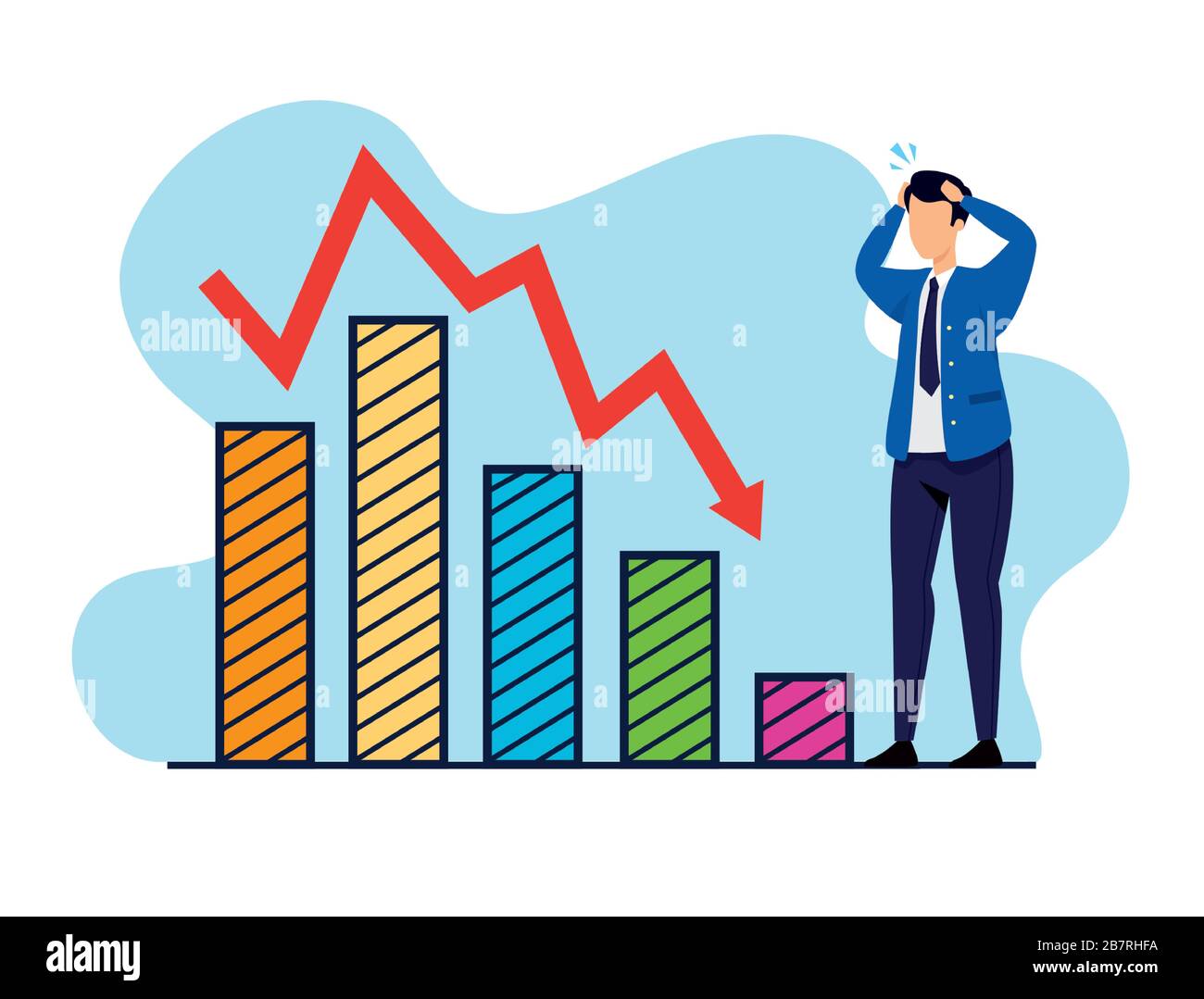
**Market Crashes:** When 'Mr. Market' goes from euphoric to depressed in seconds, it can hint towards an upcoming market crash. Recognizing these irrational shifts generates a rational investor aware of, but not subservient to, panicked markets on a macroeconomic level.
[](https://c8.alamy.com/comp/2B7RHFA/stock-market-crash-with-businessman-and-infographics-2B7RHFA.jpg)
*Examples of market crashes influenced by Mr. Market's behavior.*
**The Greater Fool Theory:** This theory is essentially an irrational 'Mr. Market' partner who can't see beyond the irrationality of higher share prices. A foolish investor (greater fool) may irrationally buy overpriced stocks, expecting a resale so they too can profit. By comparing such a mindset to 'Mr. Market,' one better understands why this thinking is bound for failure.
**Behavioral Economics:** Behavioral economics analyzes the irrational and predictable irrationality of human thinking. With 'Mr. Market, investors learn to recognize impulsive behavior, enhancing financial decision-making and staying prudent during tumultuous times.
[](https://www.investopedia.com/thmb/0EnMItE_Sj6MPK6-MlQwxkMwezM=/1500x0/filters:no_upscale%28%29:max_bytes%28150000%29:strip_icc%28%29/behavioraleconomics.asp-final-10e6085b26754eea8b50bc54882a1b8a.png)
*Behavioral economics and financial decision-making visual.*
**Financial Education:** 'Mr. Market' allows financial educators to impress upon students the volatility and instability of the market. The objective is to cultivate long-term, value-driven mindsets amongst students, so they can navigate eventful markets with savvy and wisdom.
## Conclusion
The 'Mr. Market' analogy conveys the Benjamin Graham value investing wisdom and has immense practical implications. Recognizing the fickle emotions of Mr. Market — and thus the stock market — empowers investors to act rationally and objectively.
Investors should avoid the chaos of 'Mr. Market' and instead, seek undervalued shares of quality companies that deliver consistent long-term returns. By grounding their financial decision-making in rational analysis and a clear understanding of the underlying drivers of value, the Intelligent Investor can turn the irrationality of 'Mr. Market' to their advantage.
Key Insights:
* The stock market's daily fluctuations don't solely indicate price changes of a company's inherent worth.
* 'Mr. Market' embodies stock market instability due to individual and collective irrationality, susceptible to human emotions.
* Value investors ought to ignore market noise and capitalize on price distortions that don't match the financial health of quality companies.
Further Exploration:
* Contrarianism — Approaches borrowing from 'Mr. Market' principles for long-term benefits
* Technical analysis vs. fundamental analysis — The influence of 'Mr. Market' on short-term/long-term views
* Market Efficiency Hypothesis — The role of 'Mr. Market' and EMH interconnectedness, anomalies, and consequences
* Cognitive biases in investing decisions — A behavioral finance and 'Mr. Market' standpoint
Investors seeking enduring wealth creation must adopt the mindset of the intelligent investor portrayed in *The Intelligent Investor*, navigating the vagaries and surprises in the stock market through the lessons of Benjamin Graham's 'Mr. Market' analogy.
Last updated: 2024-04-06
Related Books
Related Knowledges