# The Enigma of Capital: Unlocking the Hidden World of Property Rights
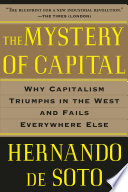
*The Mystery of Capital* by Hernando De Soto delves into the intricate relationship between capitalism and property rights, specifically highlighting what he refers to as the 'enigma of capital.' The central argument of the book lies in the idea that while developing countries have an abundance of resources and labor, they lack the necessary institutional framework that allows for the transformation of these assets into capital. This ‘enigma of capital’ serves as a significant barrier for economic growth and development in many countries around the world.
[](https://upload.wikimedia.org/wikipedia/commons/7/71/IMF_advanced_economies_and_UN_least_developed_countries.svg)
*Map highlighting developing countries around the world.*
## Introduction
The enigma of capital refers to the inability of many developing countries to utilize their resources, labor, and entrepreneurial potential effectively. Despite the wealth of assets present in these regions, the lack of formal property rights severely restricts their transformation into capital. This, in turn, hampers economic growth and development.
[](https://study.com/cimages/videopreview/fnwxgc7quh.jpg)
*Illustration of formal vs. informal property rights.*
Hernando De Soto, in his book *The Mystery of Capital*, elucidates the importance of property rights as the foundation of the capitalist system. According to De Soto, property rights provide a clear definition of ownership and enable individuals to leverage their assets to secure credit, invest in businesses, and access the broader financial system. This, in turn, fuels economic growth and development.
The enigma of capital stems from the inability of many countries to establish transparent, accessible, and efficient systems for property registration, leading to what De Soto refers to as 'dead capital.' Dead capital signifies the unproductive and underutilized assets that could potentially fuel economic development if integrated into the formal economy.
## Practical Implications
### Example 1: Peru's Informal Sector
In his book, Hernando De Soto delves into the specific case of Peru, illustrating the challenges faced by the country's informal sector. Although Peru boasts significant reserves of natural resources and a vast labor force, its economic progress has been hampered by the enigma of capital.
An overwhelming majority of Peruvians lack clear, legally recognized property rights, meaning they cannot use their assets as collateral for loans or as a form of capital for investment. As a result, small businesses and entrepreneurs struggle to access the financial resources necessary to expand their operations or innovate. Consequently, the informal sector remains stagnant, and economic growth is hindered.
De Soto's research team has estimated that if the legal and administrative barriers preventing the formalization of property rights in Peru were removed, the country's gross domestic product (GDP) could potentially triple. This represents the vast potential of dead capital and the transformative power of formal property rights.
[](https://media.springernature.com/full/springer-static/cover-hires/book/978-1-137-54523-7)
*Chart showing potential GDP growth from formalizing property rights in Peru.*
### Example 2: Housing in Cairo
Another prominent example illustrating the enigma of capital can be observed in Cairo, Egypt. Informal housing, often built without proper permits or legal titles, constitutes a significant portion of the city's residential landscape. Approximately 60% of Cairo's housing stock is considered informal, sheltering an estimated 65% of the city's population.
Despite the prevalence of informal housing, residents often cannot access essential services like electricity, water, and sanitation. Additionally, without legal property titles, these homeowners cannot leverage their assets for credit or investment, effectively locking them out of the formal financial system. Moreover, the constant threat of forced eviction looms over these communities, exacerbating their vulnerability.
[](https://assets.website-files.com/5d253237e31f051057dc0a2b/5fa598a62683653c64a1d576_Picture1.jpg)
*Informal housing in Cairo.*
Addressing the enigma of capital in Cairo involves the formalization of property rights for these informal housing units. By providing secure and legally recognized property titles, homeowners can access the financial resources required for upgrading their homes, accessing essential services, and investing in their businesses. This, in turn, will fuel economic growth and development for the city and its residents.
## Conclusion
The enigma of capital, as presented by Hernando De Soto, highlights the importance of property rights as the foundation of a capitalist economy. By establishing transparent, accessible, and efficient systems for property registration, countries can unlock the vast potential of dead capital, fueling economic growth, and development.
To further explore the topic, consider the following avenues:
1. Research the relationship between property rights and financial inclusion. Investigate how formalizing property rights can facilitate access to credit and investment opportunities for individuals and businesses in developing countries.
2. Examine the role of government policies and regulations in promoting or hindering the formalization of property rights. Explore case studies of countries that have successfully addressed the enigma of capital and those that continue to struggle with the issue.
3. Investigate the potential consequences of ignoring the enigma of capital. Consider the social, economic, and political implications of failing to address the issue of dead capital.
By delving into these topics, students can develop a deeper understanding of the complexity of the enigma of capital and its far-reaching implications for economic growth and development.
Last updated: 2024-05-06
Related Books
Related Knowledges