# Legal Formalities: A Key to Unlocking Capital
[](https://upload.wikimedia.org/wikipedia/commons/thumb/d/db/Hernando_de_Soto_%28cropped%29.jpg/800px-Hernando_de_Soto_%28cropped%29.jpg)
*Hernando De Soto, author of \*The Mystery of Capital\**
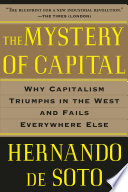
In his groundbreaking work, *The Mystery of Capital: Why Capitalism Triumphs in the West and Fails Everywhere Else*, Hernando De Soto delves into the significance of legal formalities and their role in facilitating the transformation of assets into capital. To set the stage for understanding this crucial concept, it is vital to grasp the distinction between assets and capital. According to De Soto, assets refer to resources controlled by individuals or organizations, while capital denotes assets that have been augmented by the legal process, enabling them to function as collateral for credit and contribute to economic growth.
[![infographic\] Raising capital to grow: debt and equity | GCV](https://blog.growthfunders.com/hubfs/Imported_Blog_Media/Raising-Capital-Debt-Vs-Equity-Infographic.jpg)](https://blog.growthfunders.com/hubfs/Imported_Blog_Media/Raising-Capital-Debt-Vs-Equity-Infographic.jpg)
*Examples of assets and capital*
## Legal Formalities: The Root of Convertibility
For assets to be converted into capital, they must be embedded within a legal framework that entitles their holders to specific rights. These rights include the ability to use the assets as collateral, divide them into shares, sell them, and bequeath them. Legal formalities, therefore, serve as the bedrock upon which the convertibility of assets into capital rests.
[](https://www.ailoitte.com//blog/wp-content/uploads/sites/2/2022/12/App-Development-Contract-970x546.png)
*Legal formalities in property rights*
In order to incorporate assets into the formal economic system, several critical steps must be taken. These involve the identification, measurement, and registration of assets within a legal framework. Legal titles must be established, and the relevant government agencies must record each step in the life cycle of the assets.
## Real-World Implications: Two Compelling Examples
The implications of legal formalities for the transformation of assets into capital are profound, as demonstrated by the following real-world examples:
### Example 1: Peru's Shantytowns
In Peru, countless residents of informal settlements and shantytowns have constructed their homes on public or unoccupied land without legal title. In these situations, the homes have intrinsic value as shelter, but their potential as collateral for credit – and thus as catalysts for economic growth – remains untapped. This is because the lack of legal recognition hinders the owners from capitalizing on their assets. By formalizing these property rights, individuals would be able to leverage their homes as capital, empowering them to borrow funds for entrepreneurial endeavors that might otherwise remain out of reach.
[](https://media.sciencephoto.com/e7/85/00/67/e7850067-800px-wm.jpg)
*Formalizing property rights in Peru's shantytowns*
### Example 2: Thai Fishermen
Consider the case of Thai fishermen who own boats but lack formal titles to them. These boats represent valuable assets that could potentially serve as collateral for loans to modernize their fishing operations, expand their businesses, or invest in education and healthcare. However, without legal titles, these assets remain unrecognized and underutilized, stifling the fishermen's potential for growth and prosperity. Implementing comprehensive registration processes and legal frameworks would enable the fishermen to unlock the latent value of their boats, thereby enhancing their financial opportunities.
[](https://upload.wikimedia.org/wikipedia/commons/4/4f/Thai_fishing_boats_at_the_beach.jpg)
*Thai fishermen and their boats*
## Conclusion: Key Insights and Further Exploration
De Soto's profound work emphasizes the crucial role of legal formalities in enabling the conversion of assets into capital. Through a nuanced understanding of the implications of formalizing property rights, it is possible to unleash the latent economic potential nestled within underutilized assets.
For those interested in delving deeper into the subject matter, several avenues for further exploration exist. These include investigating the impact of varying legal frameworks on capital formation, the role of technology in facilitating the formalization of property rights, and the political and social barriers to the implementation of comprehensive legal registries. By engaging with these topics, one can cultivate a richer comprehension of the essential relationship between legal formalities and capital development.
Last updated: 2024-04-07
Related Books
Related Knowledges