# Legal Insecurity: Foundation of Poverty and Underdevelopment
[](https://assets.editorial.aetnd.com/uploads/2016/01/hernando-de-soto.jpg)
*Hernando De Soto exploring the concept of legal insecurity*
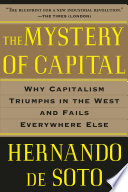
In *The Mystery of Capital*, Hernando De Soto explores the relationship between legal insecurity and poverty and underdevelopment. Legal insecurity refers to the lack of property rights and the inability to use assets as collateral for credit. It is the inability of individuals and businesses to access and enforce property and contractual rights. Legal insecurity, according to De Soto, is a fundamental barrier that prevents individuals and businesses from participating in the formal economy and accessing its benefits.
Legal insecurity has far-reaching implications, particularly in developing countries, where a significant portion of the population and businesses operate in the informal sector. Here, we explore some examples and applications of legal insecurity, illustrating its practical implications for college students.
[](https://www.worldbank.org/content/dam/photos/780x439/2021/nov-1/social-protection-for-the-informal-economy-operational-lessons-for-developing-countries-in-africa-and-beyond-780x439.jpg)
*Informal sector in developing countries*
## Extracting Value from Assets
One of the core concepts of *The Mystery of Capital* is the idea that the majority of assets in developing countries are not adequately documented or recognized by the legal system. This results in an inability for individuals and businesses to extract the full value of their assets. For instance, a farmer in a developing country might own a substantial piece of land, yet if their property rights are not recognized and documented, they cannot extract the full value of their land by leveraging it as collateral for a loan.
As a result, the farmer might not have the means to invest in better farming equipment, expand their land, or adapt to new farming methods, ultimately limiting their potential for growth and wealth creation. The same situation applies to businesses, where the lack of collateral makes it difficult for them to access credit and grow. By failing to address legal insecurity and recognize and document property rights, developing countries deprive their citizens and businesses of the opportunity to create wealth and prosperity.
## Accessing the Formal Economy
Legal insecurity prevents individuals and businesses from accessing the benefits of the formal economy. Without legal protection, it becomes challenging for individuals and businesses to enter into contracts, participate in the legal system, and operate in a stable and predictable environment. As a result, people and businesses are forced to operate in the informal sector, where the risks are higher and the potential for growth and prosperity is much lower.
For instance, in many developing countries, the majority of the workforce operates in the informal sector, where they have limited access to formal financial services, have no recourse to legal protection in cases of contract disputes, and often cannot access social protection mechanisms. This places a significant limitation on the potential for growth and wealth creation, as the informal sector is characterized by low productivity and limited access to resources.
## Legal Insecurity and Inequality
Another critical aspect of legal insecurity is its contribution to social and economic inequality. In developing countries, legal insecurity exacerbates existing inequalities by denying marginalized groups the same opportunities as the more privileged. Without the ability to access and enforce property rights, marginalized groups are prevented from accessing the same opportunities for wealth creation and growth as the more affluent.
As a result, the majority of the world's wealth remains in the hands of the few, while the majority of the population is excluded from the formal economy, with limited opportunities for growth and wealth creation. Legal insecurity further perpetuates this cycle of inequality, as it creates a barrier to entry for marginalized groups, preventing them from accessing the same opportunities and resources as the more privileged.
## Mitigating Legal Insecurity
Addressing legal insecurity requires significant efforts to document and recognize property rights, as well as a commitment to building the necessary legal and judicial infrastructure to enforce them. Developing countries can mitigate legal insecurity by:
[](https://lookaside.fbsbx.com/lookaside/crawler/media/?media_id=100067904192256)
*Land registry system*
1. Establishing a comprehensive and accessible land registry: A centralized and accessible land registry system would enable individuals and businesses to document and protect their property rights, providing a foundation for growth and wealth creation.
2. Streamlining the legal process: Legal processes should be simplified and made more accessible to individuals and businesses. This would reduce the burden on individuals and businesses and enable them to access the formal economy more easily.
3. Strengthening the judicial system: A strong and independent judicial system is crucial for protecting and enforcing property rights. Strengthening the judiciary would increase legal security and provide a more stable and predictable environment for individuals and businesses.
## Conclusion
Legal insecurity is a fundamental barrier to the growth and prosperity of individuals, businesses, and developing countries. By failing to address legal insecurity, developing countries deny their citizens and businesses the opportunity to create wealth and prosperity, exacerbate inequality, and perpetuate a cycle of poverty and underdevelopment. Mitigating legal insecurity requires significant efforts to document and recognize property rights, strengthen the legal system, and streamline legal processes. By addressing legal insecurity, developing countries can unleash the full potential of their citizens and businesses, promoting growth, wealth creation, and prosperity.
For further exploration of the topic, students can research land registry systems, the role of the judiciary in property rights, and the impact of legal insecurity on poverty and underdevelopment. Additionally, students can examine case studies from countries that have successfully addressed legal insecurity and the lessons learned from their experiences.
Last updated: 2024-06-23
Related Books
Related Knowledges