# Investor's Edge Rare: The Power of Understanding Compounding and Patience in Wealth Creation
*Compounding is the greatest mathematical discovery of all time.* — Albert Einstein
## Introduction
Throughout Morgan Housel's *The Psychology of Money*, he introduces several essential concepts that can help reframe the way we approach wealth creation. One such concept is the 'Investor's Edge Rare,' which the author introduces in Chapter 5 (*Luck & Risk*), exploring the interconnectedness of compounding and patience.
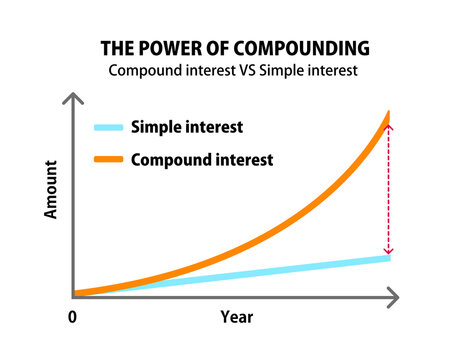
The core of the 'Investor's Edge Rare' lies in the understanding of compounding interest: the process through which the interest earned on an investment generates additional interest over time. This idea may seem rudimentary at first glance, but the real edge comes from internalizing the *enormous* potential of compounding over long periods and how it can change your financial life.
[](https://t4.ftcdn.net/jpg/04/17/33/93/360_F_417339335_U8agOm425cpEcnNylJ5YAdWePmM1O8Qi.jpg)
*Illustration of compounding interest over time*
Relevance
----
In a world that continuously shifts its attention to quick gratification and instant results, patience and foresight often take a backseat. The power of compounding is particularly relevant for young college students who are just embarking on their financial and investment journey. It is crucial to emphasize the massive wealth disparities that patience and compounding can create compared to a strategy centered around instant gratification, impulsive financial decisions, and chasing after short-term trends.
## Compounding: The Key to Wealth Creation
To truly grasp the 'Investor's Edge Rare,' we should examine the power of compounding and how it can significantly benefit long-term investors.
Example 1: The Story of Two Percentages
-------------------------------------
Assume you have $1,000 and the option to invest in two different scenarios:
A. A 20% annual return for five years
B. A 10% annual return for ten years
It's easy to see that the 20% annual return in option A is significantly higher than the 10% return in option B, making the former the more attractive option at first glance. However, let's analyze the final result after each respective period:
- **Option A:** $1,000 \* 1.2 \*\* 5 = $2,488.32
- **Option B:** $1,000 \* 1.1 \*\* 10 = $2,593.74
While the annual return of option B is considerably lower, the final payoff is higher due to the advantages of compounding interest over a decade.
[](https://previews.123rf.com/images/blankstock/blankstock1905/blankstock190500463/121801681-analytics-graph-medal-and-investment-icons-simple-set-comparison-table-new-mail-sign-growth-report.jpg)
*Comparison of investment growth over different time frames*
Example 2: Investment Time vs. Annual Return
----------------------------------------
In this scenario, we'll explore how the duration of an investment can outweigh the annual return:
A. A 15% annual return for 15 years
B. A 25% annual return for 5 years
Let's calculate the final investment value in each scenario:
- **Option A:** $1,000 \* 1.15 \*\* 15 = $5,574.54
- **Option B:** $1,000 \* 1.25 \*\* 5 = $2,441.41
In this second example, a lower but consistent annual return, coupled with a more extended investment period, creates a higher return than a short-term, higher-risk investment.
## Turning Patience into an Investor's Edge
The 'Investor's Edge Rare' concept teaches us that patience, when combined with an understanding of compounding interest, creates an immense edge for long-term investors.
To illustrate this, let's look at a historical case study:
Example 3: Warren Buffett's Berkshire Hathaway
--------------------------------------------
Warren Buffett is famous for his long-term investment strategy and staying power. For instance, Berkshire Hathaway stock (BRK.A) has increased by over 2,805,456% from its initial closing price of $14.86 on May 27, 1965. This translates to a 19.2% CAGR (compounded annual growth rate) over 56 years.
[](https://img.capital.com/imgs/articles/750xx/BRK.B-1-MCT-7545-EN.png)
*Warren Buffett's Berkshire Hathaway stock growth over time*
In 1965, buying just one share of Berkshire Hathaway would have cost you a mere $14.86, but as of June 30, 2021, that same share stands at approximately $431,186.
While it might not be reasonable to expect such extraordinary returns in the future, the lesson remains the same: patience and time work in conjunction with compounding interest to create extraordinary results.
## Conclusion
In conclusion, the 'Investor's Edge Rare' surfaces from the interaction of two fundamental ideas in finance: patience and compound interest. Understanding and diligently applying the principles underlying these concepts can greatly enhance your investment outcomes.
To further your knowledge, consider:
- Exploring various compounding investment cases and timeframes;
- Investigating other real-life examples of patient investors who reaped the benefits of compounding;
- Examining psychology-related topics, including the marshmallow test and self-control, to deepen your comprehension of long-term decision-making.
Ultimately, applying the 'Investor's Edge Rare' concepts can help transform the way you think about wealth creation and inspire a more sustainable future financial strategy.
Last updated: 2024-04-14
Related Books
Related Knowledges