# The Power of Loss Aversion: Understanding Risk and Reward through Morgan Housel's "The Psychology of Money"
## Introduction
Morgan Housel's *The Psychology of Money* highlights various aspects of human nature that surface when we deal with finances, especially our decision-making regarding money. One of the most potent ideas put forward by Housel is the concept of **loss aversion**. Loss aversion refers to the tendency of people to have a stronger preference to avoid losses over acquiring equivalent gains. Losing $50 would make most individuals feel worse than the pleasure they get from gaining $50. This principle, which stems from prospect theory, coined by Daniel Kahneman and Amos Tversky, significantly impacts financial decision-making.
[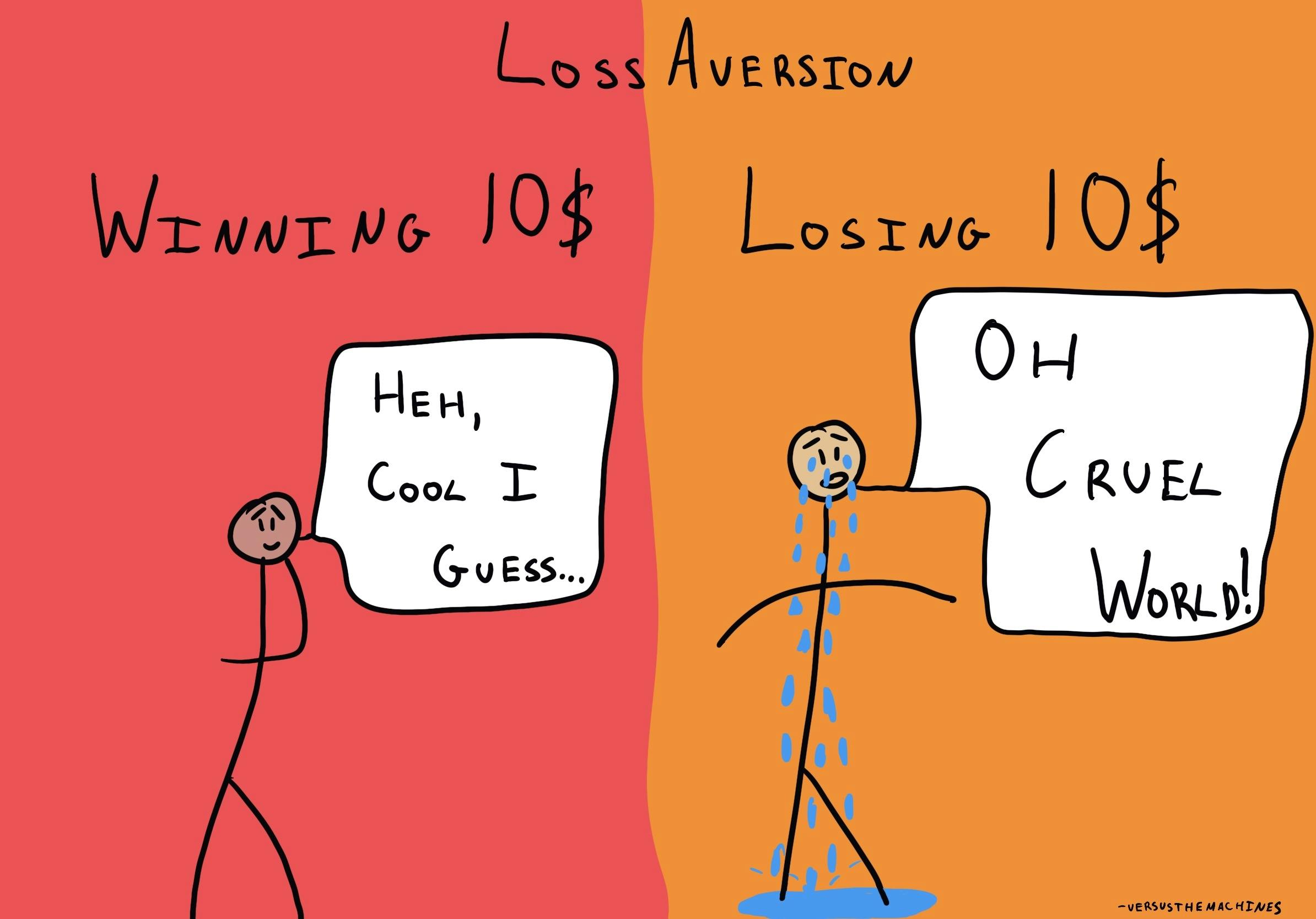](https://images.prismic.io/thedecisionlab/2c63f6f8-d7e5-4dbd-bb4c-86006085482c_Loss-Aversion.jpg?auto=compress,format)
*Illustration of Loss Aversion in financial decision-making.*
## Loss Aversion in Real Life
In the world of investing, loss aversion impacts the choices many people make. Investors typically experience the pain of a loss twice as much as the pleasure of a gain, a finding also supported by researchers like Paul Slovic. In this sector, the notion of loss aversion is often conceptualized as the 'disposition effect.' Below are a few examples and applications to illustrate the idea and its practical implications.
### Example 1: The Disposition Effect
Consider an investor who purchases a stock at $100 per share. When the stock price rises to $150, the investor hasn't sold it and believes the stock will keep increasing in value. Yet, when the stock price then dips back down to $100, the same investor is more inclined to sell it because it has returned to its original price rather than holding onto it for further growth. This behavior is known as the disposition effect, and it reflects the investor's sensitivity to locking in a loss (returning to the original purchase price) compared to realizing a profit.
[](https://research.macrosynergy.com/wp-content/uploads/2021/02/Disposition_01.png)
*Example of the Disposition Effect in stock trading.*
### Example 2: Risk Averse vs. Risk Seeking
Suppose we present another investor with two scenarios. In the first scenario, the investor has a 50% probability of a $10,000 gain and a 50% probability of no change in their investment. In the second scenario, the investor has a 50% probability of losing $10,000 and a 50% probability of no change. Although these situations mathematically have the same result – an expected value of zero – the majority of people would prefer the first scenario because it does not pose an explicit loss. This reaction is rooted in loss aversion: people would prefer avoiding losses over acquiring equivalent gains, making them risk-averse in the face of loss possibilities.
[](https://www.investopedia.com/thmb/cIvO9ab9fOtYZFOPdjMlDTPF2Jk=/1500x0/filters:no_upscale%28%29:max_bytes%28150000%29:strip_icc%28%29/Riskaverse_final_rev_02-aeaf9c912e1d4b9dab3481f76f514839.png)
*Risk Averse vs. Risk Seeking decision scenarios in investing.*
## Key Insights
Loss aversion can affect how one perceives and acts upon risk and reward. It can cause investors to miss out on opportunities or lock in losses prematurely, and it often manifests in the form of the disposition effect. The following are key insights to remember when it comes to loss aversion:
1. Loss aversion influences investors' decision-making and biases their judgment regarding investments.
2. Loss aversion can cause individuals to miss opportunities by being overly cautious or even reacting negatively to perceived losses.
3. Understanding and acknowledging one's susceptibility to loss aversion can serve as a catalyst to making more rational and well-informed decisions.
## Conclusion and Further Exploration
As discussed, loss aversion is an essential concept in understanding financial decision-making. Acknowledging the role of negative emotions and biases on investments and recognizing that most investors often feel losses more intensely than gains can help people create a counteracting strategy.
To further explore the concept of loss aversion, consider the following ideas and readings:
1. Daniel Kahneman and Amos Tversky's **prospect theory**. Delve deeper and learn about the origins of loss aversion and prospect theory in behavioral economics.
2. **Behavioral finance workshops or courses**. Participate in workshops or courses designed to teach individuals how to recognize biases influencing financial choices and develop a system to make unbiased decisions.
3. **The disposition effect and investor behavior**. Research further into the relationship between loss aversion and the disposition effect and the steps traders can take to minimize the negative effects of this phenomenon.
By understanding the implications of loss aversion, college students can move towards more logical and reasoned financial decision-making. It is important to be aware of the biases that exist in our own minds and develop the skills necessary to minimize errors in judgment when managing personal finances or making investment decisions.
Last updated: 2024-04-29
Related Books
Related Knowledges