# Risk and Return: The Inextricable Link
_"The most important lesson about investing is the one that is rarely taught: The ultimate goal of investing is to be wealthy enough to live life on your terms. Anything else is just a road to frustration." - The Psychology of Money, Morgan Housel_
In finance and investing, the concepts of risk and return are fundamental pillars that influence the decision-making process. In Morgan Housel's best-selling book, _The Psychology of Money_, the author illustrates the intricate relationship between risk and return, showcasing its significance and impact on long-term financial success.
## Risk and Return: Concepts and Relevance
In essence, risk and return are two sides of the same coin in the financial world. _Risk_ can be described as a deviation from expected outcomes, often measured in the form of volatility and uncertainty that can negatively affect investments or portfolios. Meanwhile, _return_ represents the financial benefit or profit earned from an investment over a specified period, predominantly expressed as a percentage of the original investment.
The relationship between risk and return is forged on the principle that investors expect higher returns as compensation for assuming higher risks. This concept is crystallized by the _risk-reward tradeoff_ - the idea that investors cannot reap the rewards without taking on the associated risks. This principle influences the investment choices of individuals and institutions, portraying a clear connection between the potential for loss and the likelihood of higher gains.
[](https://blogger.googleusercontent.com/img/b/R29vZ2xl/AVvXsEi1lz1dhciDm5utDapwg_DYtnDvA5t4x7z7qSoiD48NIdavRRCdhvgsBMS1GxApa-EtY7I5KOGtb1RPA2DR_asz5D8ivhB3QunWh27NoMhCTQbpn9siwxJDmvSAJW3rp2T1qJBJ5bZZ4qBL/s640/risk-versus-return.JPG)
*The principle of risk and return in finance*
## Practical Implications: Diverse Examples and Applications
To elucidate the concept of risk and return, let us examine a few practical examples and examine their implications.
### Example 1: Stocks vs. Bonds
Stocks and bonds are classic examples of investments with varying levels of risk and return. Generally, stocks offer higher returns than bonds; however, they are accompanied by greater risk due to their susceptibility to market volatility. On the contrary, bonds are considered more stable and less risky; nevertheless, the returns they yield are notably lower than those offered by stocks.
[](https://www.raymondjames.com/-/media/rj/advisor-sites/sites/m/i/mickgraham/images/blog/apr-10-risk-vs-return.jpg)
*Comparing stocks and bonds*
Imagine an investor deliberating between a stock market index fund and a government bond portfolio. The former, while offering the potential for higher returns, is coupled with higher market risk, implying a higher likelihood of losses in a down market. Conversely, the bond portfolio assures a lower, yet more predictable, return, making for a more conservative investment option. Based on their risk tolerance, financial objectives, and time horizon, the investor must weigh the pros and cons and choose the investment option that aligns with their individual financial goals.
### Example 2: Real Estate
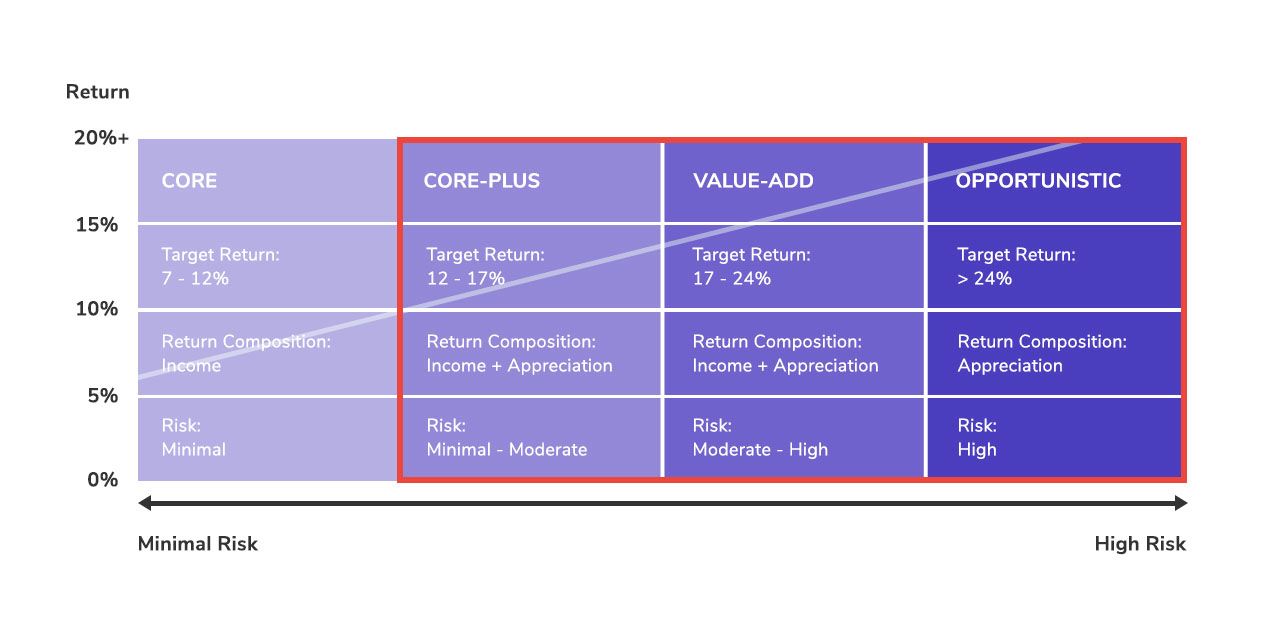
Real estate investment, both residential and commercial, represents a valuable asset class that illustrates the risk-return link. Properties such as apartments, commercial spaces, and vacation homes, can offer substantial returns as a result of rental income and potential appreciation (price increase) over time. However, real estate investment also exposes buyers to factors that introduce risk, including illiquidity, market fluctuations, and property management dilemmas.
Consider an investor who considers purchasing a beachfront rental property in a popular tourist destination. Albeit the investment bears the potential for sizable returns on rental revenue and capital appreciation, it also comes with the risks of seasonal fluctuations in demand, property damage due to natural disasters, and unforeseen regulatory changes. In this instance, the investor must balance the allure of potentially high returns against the inherent hazards of real estate investment before committing their resources.
[](https://www.realvantage.co/insights/content/images/2020/08/real-estate-risk-spectrum-table.jpg)
*Real estate investment risk and return*
## Key Insights and Further Exploration
Upon examination, the relationship between risk and return is undeniable. It underscores the significance of understanding one's risk tolerance and aligning it with financial goals to ensure investment success. Experienced investors comprehend that it is not possible to 100% eliminate risk altogether, but prudent management of risk can contribute to a fruitful financial journey.
In exploring the topic of risk and return further, we urge you to:
1. _Assess your personal risk tolerance:_ Understanding your capacity for risk exposure is a critical step in forging a strong investment strategy. Utilize quizzes, worksheets, and financial resources to assess your risk preferences accurately.
2. _Diversify your investment portfolio:_ Adopting a well-diversified portfolio is a time-tested strategy to balance risk and return. Amalgamating investments with varying risk profiles can help mitigate volatility and safeguard long-term gains.
3. _Understand your time horizon:_ Consider the time horizon while plotting an investment strategy. A longer time horizon allows you to absorb potential market fluctuations and enables your investments to prosper.
4. _Leverage the risk-reward tradeoff:_ Embrace the risk-reward tradeoff by recognizing that the potential for higher gains is often accompanied by a higher risk. Understanding this linkage allows investors to seize worthwhile investment opportunities while prudently overseeing risk exposure.
By acknowledging and embracing the risk and return relationship, investors can work diligently to craft solutions that cater to individual financial goals, risk tolerance, and time horizons. This balanced approach, characterized by careful analysis and strategic decision-making, can position investors for success as they traverse the ever-evolving financial landscape.
Last updated: 2024-05-16
Related Books
Related Knowledges