Compounding Power: The Surprising Force Behind Wealth Accumulation 🌳
==============================================================
_"Compounding isn't about money. It's about knowledge, learning, and growing._" - Morgan Housel, The Psychology of Money
When people think about wealth and financial success, they often focus on making high returns or landing a lucrative salary. While these factors are important, there is another crucial ingredient that deserves far more attention: compounding. Compounding, the process in which returns build upon one another over time, is the engine that powers wealth accumulation.
[](https://www.investopedia.com/thmb/nkwVV6fOnaOF5fY7k6lnPz2fVTY=/1500x0/filters:no_upscale%28%29:max_bytes%28150000%29:strip_icc%28%29/compounding.asp-final-11c1b77f605d4ed0a317f0cf32c73b3f.png)
*Compounding Interest Illustration*
Morgan Housel's _The Psychology of Money_ highlights the impact of compounding, emphasizing how patience and a long-term perspective can create substantial wealth over time. This concept is crucial for college students who are just beginning their financial journey, as understanding and harnessing the power of compounding will provide a solid foundation for future financial stability.
Let's explore the concept of compounding in more depth and discuss its implications for college students.
**Compounding in Action**
------------------------
Suppose you invest $1,000 today in an account that earns an average annual return of 8%. After the first year, your $1,000 becomes $1,080. However, the power of compounding truly becomes evident when you track the progress over time:
| Year | Principal Amount | Earnings | Total |
| --- | --- | --- | --- |
| 1 | $1,000.00 | $80.00 | $1,080.00 |
| 2 | $1,080.00 | $86.40 | $1,166.40 |
| 3 | $1,166.40 | $93.31 | $1,259.71 |
| 4 | $1,259.71 | $100.78 | $1,360.49 |
| 5 | $1,360.49 | $108.84 | $1,469.33 |
| 10 | $2,158.93 | $172.64 | $2,331.57 |
| 20 | $4,660.97 | $372.88 | $5,033.85 |
| 30 | $10,062.66 | $804.21 | $10,866.87 |
This table reveals how compound interest accelerates wealth accumulation over time. After 10 years, your investment would have grown to over double its original value, thanks to compounding. Fast-forward to 30 years, and your investment grows to over ten times its initial amount. This illustrative example demonstrates why college students especially should prioritize long-term investments, even if the returns appear modest in the beginning.
**Invest Early and Often**
---------------------------
[](https://cdnlearnblog.etmoney.com/wp-content/uploads/2023/09/Compounding-Infographic-1.jpg)
*Invest Early Example*
The power of compounding is more pronounced when college students start investing early. Consider a hypothetical scenario where three students, Alice, Bob, and Carol, begin investing immediately after high school, reaching the age of 18. Alice, Bob, and Carol each invest $2,000 annually, with an average annual return of 8%. The only variable among them is the age they stop investing:
* Alice stops investing at age 25, having invested for just 7 years.
* Bob stops at age 35, having invested for 17 years.
* Carol stops at age 45, having invested for 27 years.
Despite their different investing horizons, all three will have significant, yet varying sums of money at age 65:
* Alice's total investment value at age 65: $535,990.
* Bob's total investment value at age 65: $1,137,644 (Almost double Alice's)
* Carol's total investment value at age 65: $3,155,213 (Over five times Alice's)
While Bob and Carol accumulate substantially more wealth than Alice, it's important to note that Alice invests for just seven years, reinforcing how much impact even a brief investment period has on an individual's long-term financial well-being.
**Compounding's Role in Growing a Business**
------------------------------------------
The concept of compounding isn't limited to finance or investing; it applies to growing a business as well. As you accumulate skills, knowledge, and connections, your ability to generate and seize opportunities improves. Thus, building a strong foundation for lifelong learning and network development in college provides the groundwork for future success.
By continuously cultivating skills and cultivating relationships with colleagues and mentors, young professionals will enjoy exponentially more opportunities and substantial growth in their careers. For instance, writing and publishing articles, presenting at conferences, and creating YouTube tutorials in niche areas of expertise grant professionals access to new communities and job openings.
**Applying Compounding Power in Life**
-------------------------------------
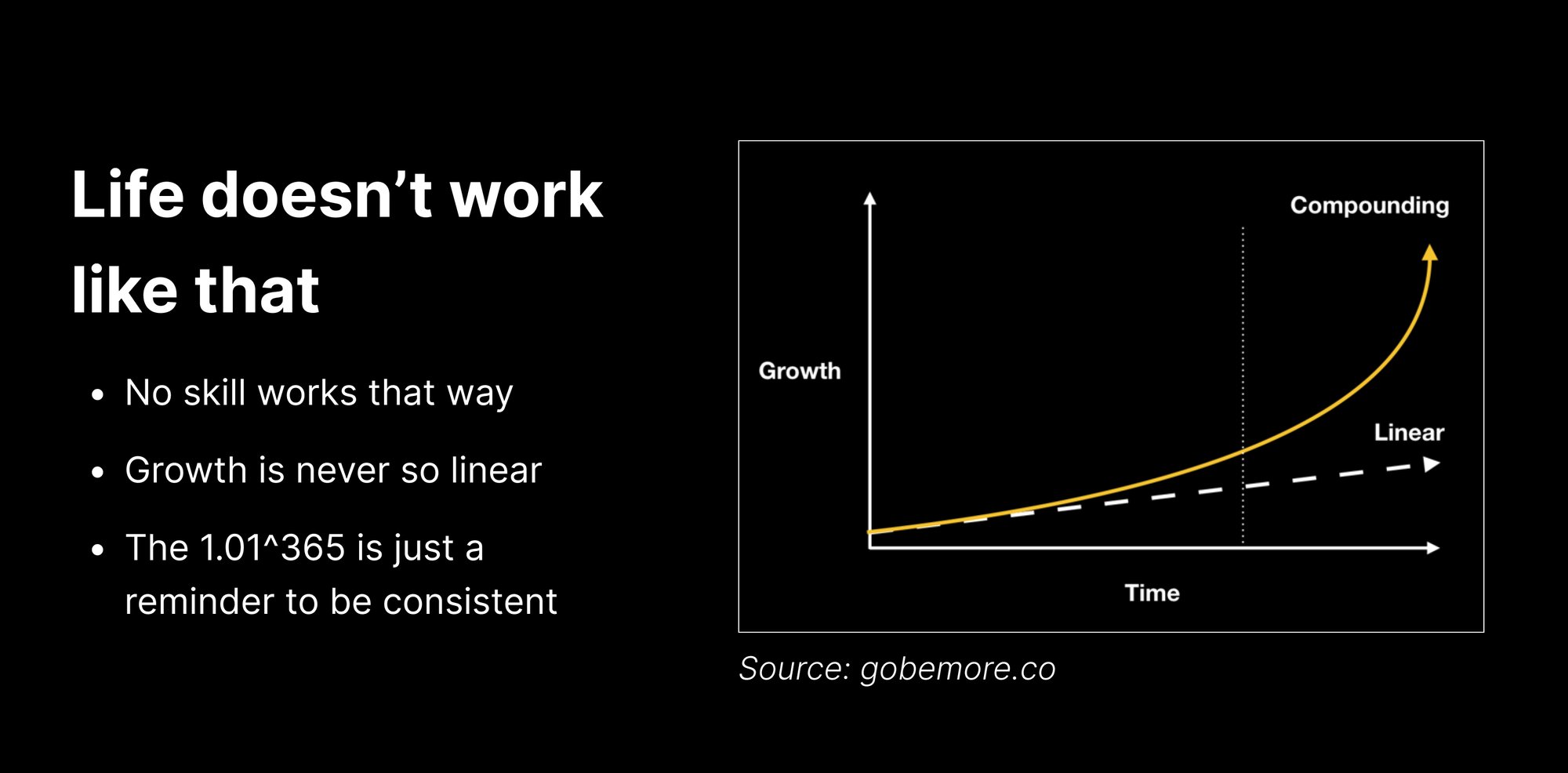
Beyond finance and careers, compounding applies to improving personal skills and abilities. When people spend time acquiring new skills, the results might seem minor initially. However, every additional hour of practice accelerates the learning process.
[](https://pbs.twimg.com/media/GDfb3bDW0AAdBh9.jpg:large)
*Skill Development Over Time*
For example, learning new hobbies, such as digital art or coding, may appear insignificant at first, but continuous skill building leads to breakthroughs and mastery over time. In the end, committing to small but consistent efforts pays off handsomely.
In essence, compounding emphasizes the importance of patience and long-term thinking over short-term gratification. By embracing the principles of compounding, college students can develop a solid foundation for future financial, professional, and personal growth.
**Key Takeaways**
----------------
* Compounding, or returns building upon one another over time, is the fundamental driver of financial success.
* Small, consistent investments grow significantly more valuable thanks to compounding over extended time frames.
* Early investment and long-term thinking compound efforts and lead to substantial wealth creation and career development.
* Compounding applies to education, career development, and skill development, not just finance.
**Explore Further**
------------------
To better understand and explore the concept of compounding, consider researching the following:
* [Albert Einstein's quote on compounding interest](https://www.investopedia.com/terms/c/compoundinterest.asp#:~:text=Einstein%20once%20reportedly%20referred%20to,interest%20earned%20on%20previously%20earned%20interest.)
* [Several compounding examples and situations from Investopedia](https://www.investopedia.com/terms/c/compoundinterest.asp)
* [How Compound Interest Works from NerdWallet](https://www.nerdwallet.com/blog/investing/compound-interest-explained/#:~:text=Compound%20interest%20is%20interest%20calculated,smaller%20the%20compounding%20period.)
By understanding compounding, college students may lay the groundwork for a solid and prosperous financial future.
Last updated: 2024-04-11
Related Books
Related Knowledges