### **Hindsight Bias Distorts: Understanding the Psychology of Hindsight and its Impact on Financial Decision-Making**
[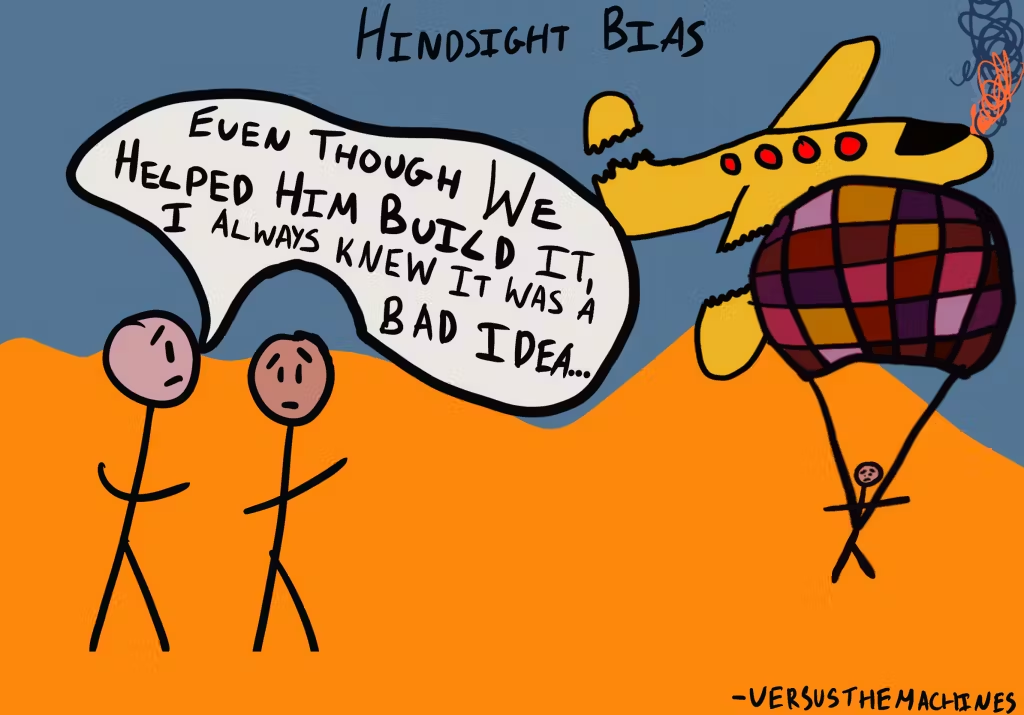](https://images.prismic.io/thedecisionlab/6723422d-41c0-4f02-836e-43d94a9b1f98_Untitled_Artwork-1024x715.png?auto=compress,format)
*Hindsight Bias in Financial Decision-Making*
When it comes to understanding the intricacies of financial decision-making, delving into the psychology behind our behaviors can provide us with valuable insights. One such concept is hindsight bias, a phenomenon that can significantly influence our judgment and decision-making abilities, particularly in the realm of finance and investments. Morgan Housel's book, "The Psychology of Money," highlights the importance of understanding hindsight bias and its effects on our lives.
#### **Introduction to Hindsight Bias**
[](https://images.prismic.io/thedecisionlab/6723422d-41c0-4f02-836e-43d94a9b1f98_Untitled_Artwork-1024x715.png?auto=compress,format)
*Introduction to Hindsight Bias*
Hindsight bias, also known as the "I-knew-it-all-along" effect, refers to the tendency for individuals to perceive past events as being more predictable than they actually were at the time. Simply put, hindsight bias causes us to believe, in retrospect, that we "knew it all along," when in reality, we may have been uncertain or even surprised by the outcome of an event.
In the context of finance and investing, hindsight bias can contribute to irrational decision-making, overconfidence, and an inflated sense of one's ability to predict market trends. This, in turn, can have significant ramifications on our financial well-being and long-term financial goals.
#### **Examples and Applications of Hindsight Bias**
To better understand the practical implications of hindsight bias, let's explore a few examples and applications:
1. **Investing in the Dot-Com Bubble:**
During the late 1990s, the dot-com bubble led to a massive surge in technology stock prices, fueled by unprecedented optimism and speculation. As the bubble eventually burst in the early 2000s, many investors suffered significant losses. However, in retrospect, it's easy to look back and identify the irrational exuberance, excessive speculation, and lack of fundamentals that drove the bubble. Hindsight bias causes us to believe that we "knew it was a bubble all along," when in reality, it was challenging to predict the exact timing and magnitude of the collapse.
2. **The 2008 Financial Crisis:**
The 2008 financial crisis was the result of a complex interplay of factors, including lax financial regulations, excessively risky lending practices, and the proliferation of toxic assets. While the signs of a potential crisis were present for those who looked closely enough, the sheer scale and impact of the crisis caught many by surprise. Nonetheless, in retrospect, it's common to hear individuals claim that they "knew the financial system was on shaky ground" or "saw the crisis coming." This represents a clear instance of hindsight bias.
3. **The Rise of Cryptocurrency:**
The rapid ascent of cryptocurrencies, particularly Bitcoin, has been marked by extreme volatility and speculation. While the long-term potential of cryptocurrencies remains uncertain, many investors have experienced significant gains or losses in a short period. However, looking back, it's easy to identify the factors that have contributed to the rise and fall of cryptocurrencies. This hindsight bias can lead to either overconfidence or fear, affecting future investment decisions.
#### **Overcoming Hindsight Bias**
[](https://fastercapital.com/i/Critical-thinking--Developing-a-Skeptical-Mindset-towards-Hindsight-Bias--Strategies-for-Overcoming-Hindsight-Bias.webp)
*Overcoming Hindsight Bias*
While it's challenging to entirely eliminate hindsight bias, there are strategies that investors can employ to mitigate its effects.
1. **Documenting Decisions:**
By maintaining a record of their financial decisions, investors can revisit their thought processes and assumptions at the time of a decision. This can serve as a helpful reminder that past events were not as predictable as they may appear in hindsight, providing a more realistic perspective.
2. **Engaging in Counterfactual Thinking:**
Counterfactual thinking involves considering alternative scenarios or outcomes to a past event. By imagining different outcomes, individuals can challenge their assumptions and develop a more nuanced understanding of the complexities and uncertainties surrounding financial decision-making.
3. **Practicing Humility and Open-Mindedness:**
By acknowledging the inherent unpredictability of financial markets and the limits of one's own knowledge, investors can cultivate a greater sense of humility and open-mindedness. Adopting this mindset can help individuals resist the allure of hindsight bias and make more informed financial decisions.
#### **Conclusion and Further Exploration**
Understanding the impact of hindsight bias on our financial decision-making is a crucial first step in overcoming this phenomenon. By recognizing and addressing the effects of hindsight bias, investors can make more informed and rational choices, ultimately leading to better financial outcomes.
To further explore the topic, consider the following avenues of study:
1. **Additional Books and Resources:**
In addition to "The Psychology of Money," several other resources delve into the psychological aspects of financial decision-making. Consider exploring books such as "Thinking, Fast and Slow" by Daniel Kahneman, "Misbehaving: The Making of Behavioral Economics" by Richard Thaler, and "Your Money and Your Brain" by Jason Zweig.
2. **Academic Research:**
Numerous academic studies address the role of hindsight bias in financial decision-making. Conducting a literature review can provide valuable insights into the various aspects of hindsight bias and its impact on investor behavior.
3. **Online Courses and Workshops:**
Engaging in online learning platforms, such as Coursera, Udemy, or LinkedIn Learning, can provide access to courses and workshops that focus on the psychology of money, financial decision-making, and behavioral finance.
By deepening your understanding of the psychological factors that influence financial decision-making, you can become a more informed, thoughtful, and effective investor. Through the exploration of hindsight bias and its impact on financial behavior, you've taken an essential step in cultivating the knowledge and skills required to make sound financial decisions.
Last updated: 2024-06-25
Related Books
Related Knowledges