### The Lender of Last Resort: Pivotal Role in Financial Crisis Management
[](https://www.ft.com/__origami/service/image/v2/images/raw/ftcms%3A99ec562d-006d-418e-ae37-bf8b1f45b780?source=next-article&fit=scale-down&quality=highest&width=1440&dpr=1)
*Central bank acting as a lender of last resort during a financial crisis*
During financial crises, a "lender of last resort" (LOLR) refers to a financial institution that extends credit under extraordinary circumstances to prevent a bank or other financial institution from collapsing. The expression came into common use in the 19th century when central banks first assumed this responsibility. The role of the LOLR has evolved over time, with three primary rationales for its existence:
1. **Preventing Panics:** LOLR intervention helps curtail bank panics and runs by providing necessary liquidity.
2. **Maintaining Financial Stability:** LOLR actions contribute to financial stability and overall economic well-being.
3. **Preserving the Monetary Policy Role:** By serving as the LOLR, a central bank can preserve its ability to implement monetary policy.
The importance of the LOLR during financial crises came to the forefront of global attention during the 2008 financial crisis. In the aptly titled books, *Firefighting* by Ben S. Bernanke, Timothy F. Geithner, and Henry M. Paulson, Jr., the authors delve deep into their experiences during the crisis. In this piece, we will discuss the concept of the LOLR and its practical implications by analyzing examples from the aforementioned books.
#### Preventing Panics and Restoring Confidence
Ben Bernanke exemplified the LOLR role during his tenure as the Federal Reserve (FED) chairman during the 2008 financial crisis. In *Firefighting*, Bernanke detailed the intricacies of providing assistance to flailing financial institutions in order to avert complete collapse.
A significant example was the bailout of Bear Stearns in March 2008. The investment bank faced an imminent liquidity crisis due to its massive exposure to mortgage-backed securities. In response, the FED, along with JPMorgan Chase, orchestrated a deal where JPMorgan would acquire Bear Stearns in a firesale. Additionally, the FED facilitated a $30 billion credit line to JPMorgan that effectively served as a backstop for any potential losses arising from Bear Stearns' mortgage-related assets. The result of this intervention was the prevention of a chain reaction of failures of global financial institutions.
[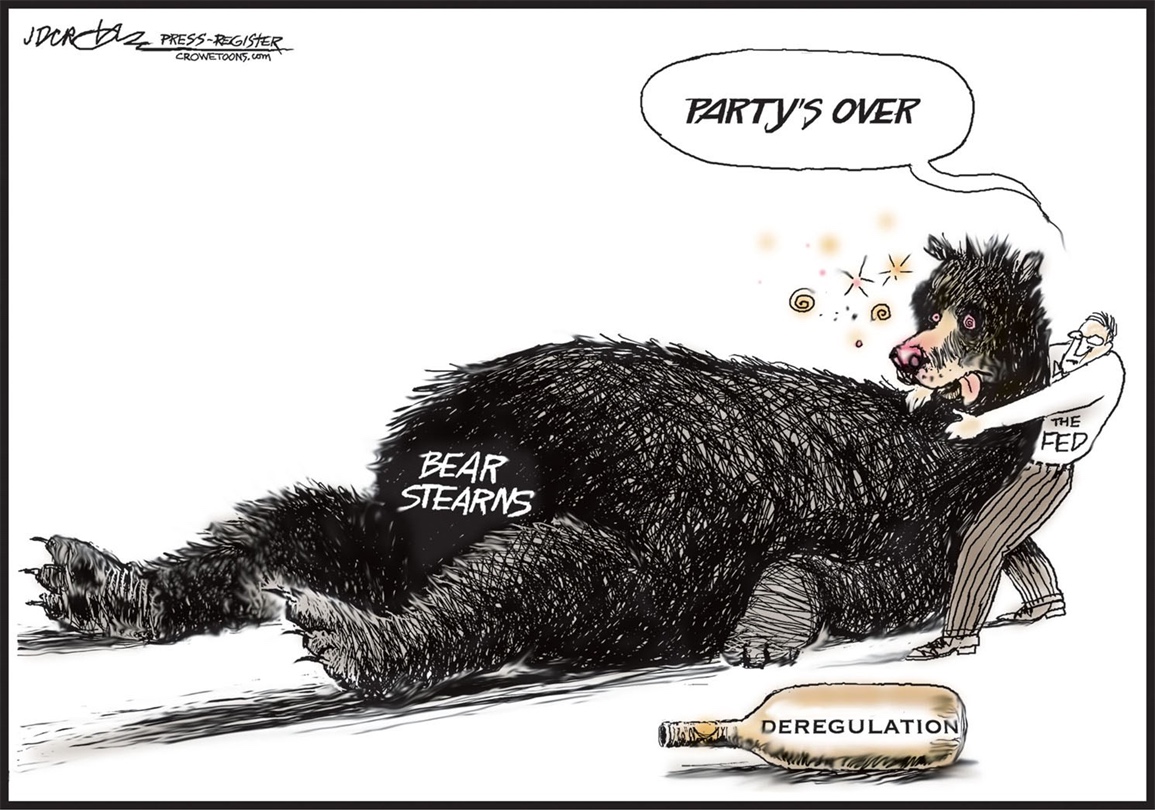](http://www.ineteconomics.org/uploads/featured/bear-stearns.jpg)
*Bear Stearns bailout example of lender of last resort action*
#### Maintaining Financial Stability
The second rationale for an LOLR is to maintain financial stability by guarding against the interconnectedness of the financial system. A key instance of this imperative came to light during the collapse of Lehman Brothers.
By September 2008, Lehman Brothers had amassed overwhelming debts and was unable to source sufficient liquidity. Despite the hesitation of then-Treasury Secretary Hank Paulson and FED Chairman Bernanke to intervene, Lehman's failure would threaten the stability of the entire financial system. The interconnections between Lehman and other significant global banks would eventually lead to an intensified credit crunch and deepening global recession.
[](https://cdn.britannica.com/70/254770-050-707D3E1F/Two-employees-of-Christies-auction-house-maneuver-the-collapsed-investment-bank-Lehman-Brothers.jpg)
*Impact of Lehman Brothers collapse on global financial stability*
In this context, the lack of adequate LOLR intervention led to severe consequences. As discussed in *Firefighting*, the fallout from Lehman Brothers resulted in an extensive ripple effect, impacting financial institutions and markets worldwide. As a result, the role of the LOLR in maintaining financial stability remains paramount.
#### Preserving Monetary Policy and Price Stability
The FED's role as lender of last resort extends beyond shoring up individual financial institutions or preventing panics; it also serves to uphold the FED's mandate of maintaining price stability and implementing monetary policy. In particular, the LOLR functions as a policy tool that central banks can employ without undermining their ability to influence interest rates.
A classic example comes from the Bank of England during the 1866 Overend-Gurney crisis. Throughout the 19th century, central banks used the LOLR function to counteract liquidity squeezes without adding to the money supply. As banks made use of the LOLR, their liabilities increased — offsetting the central bank's creation of high-powered money when extending credit.
[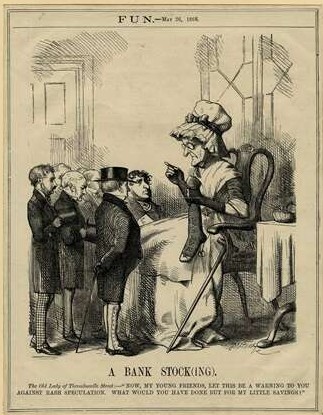](https://upload.wikimedia.org/wikipedia/commons/8/81/Political_cartoon_from_Fun_magazine_about_Overend_Gurney.jpg)
*Bank of England 1866 Overend-Gurney crisis*
In essence, the LOLR provides a means of preventing financial collapses without impeding overall monetary policy or causing potential inflation.
### Conclusion
The LOLR serves as a critical function in financial systems and has demonstrated its relevance in various historical and contemporary scenarios. By preventing panics, maintaining financial stability, and preserving monetary policy and price stability, the LOLR helps ensure the functioning of the financial system and supports overall economic growth. Delving deeper into the LOLR, students can further explore:
- Additional LOLR examples and implications
- The LOLR's influence on different financial systems, such as wholesale versus retail markets
- The implications of LOLR actions on economic inequality and social welfare
- Comparative analyses of central banks' approaches as LOLRs
By understanding the LOLR's concept and implications, college students will be better prepared to analyze and respond to future financial crises.
Last updated: 2025-04-27
Related Books
Related Knowledges