### Government Intervention: A Key Player in Financial Crises
In the world of economics and finance, government intervention is often a controversial topic. While some argue that the government should stay out of the market and let it operate freely, others believe that government intervention is necessary to ensure the stability and efficiency of the financial system. The books "Firefighting" by Ben S. Bernanke, Timothy F. Geithner, and Henry M. Paulson Jr. provide a unique perspective on this topic, highlighting the critical role of government intervention during financial crises. In this piece, we will delve into the core concepts of government intervention, its relevance in financial crises, and practical examples of its applications.
[](https://i.ytimg.com/vi/xlitBwWTp2g/maxresdefault.jpg)
*Examples of Government Intervention*
#### Core Concepts of Government Intervention
Government intervention refers to the actions taken by government authorities to influence or regulate the economy and financial systems. These actions can take various forms, such as monetary policy, fiscal policy, regulation, and bailouts. Governments may intervene in the market for several reasons, such as addressing market failures, promoting social welfare, and maintaining financial stability.
[](https://www.blacksacademy.net/images/0000072%20Deadweight%20loss.JPG)
*Market Failures and Government Intervention*
The decision to intervene often depends on the type of market failure and the severity of its consequences. Market failures occur when the free market fails to allocate resources efficiently, leading to inefficiencies, inequities, and instability. Financial crises are prime examples of market failures, where the government may need to intervene to prevent or mitigate their adverse effects.
#### Relevance of Government Intervention in Financial Crises
Financial crises often result from the interplay of various factors, such as excessive risk-taking, inadequate regulation, and macroeconomic shocks. These crises can have severe consequences, such as bank failures, widespread unemployment, and economic recessions. Given the potential for significant social and economic costs, the government has a crucial role to play in managing financial crises.
During financial crises, government intervention can help stabilize financial institutions, prevent contagion, and support economic recovery. It can achieve these goals through various tools, such as liquidity provisions, capital injections, and guarantees. By intervening, the government can help restore confidence in the financial system and prevent a complete collapse of the economy.
[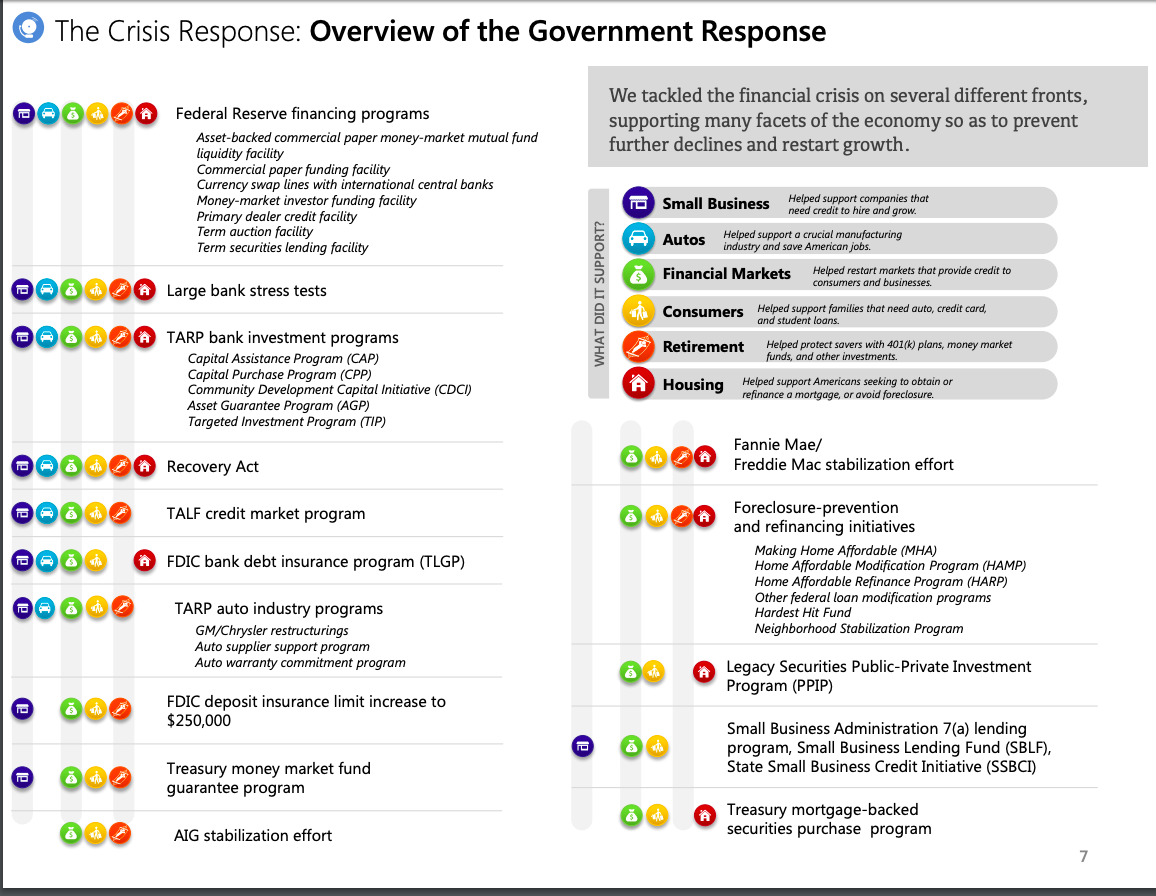](https://ypfs.som.yale.edu/sites/default/files/inline-images/Chart1_US%20Gov%20Response.png)
*Financial Crisis Stabilization*
#### Practical Implications: Examples of Government Intervention in Financial Crises
Throughout history, governments have intervened in various financial crises to mitigate their consequences. Here, we will explore two notable examples from the 2008 global financial crisis and the 2020 COVID-19 pandemic.
1. **2008 Global Financial Crisis**
The 2008 global financial crisis was triggered by the bursting of the United States housing bubble, leading to massive losses for financial institutions exposed to mortgage-backed securities. In response, the U.S. government implemented several measures to stabilize the financial system and prevent a complete economic collapse. Key interventions include:
[](https://www.investopedia.com/thmb/Gv4kHFZbBkKXYJ2SO7Q-NtzFBDE=/1500x0/filters:no_upscale%28%29:max_bytes%28150000%29:strip_icc%28%29/HenryPaulson_final-fc607bc124ca46b489afbca1c3b567b3.png)
*2008 Financial Crisis Intervention*
- **Troubled Asset Relief Program (TARP):** A $700 billion program established by the U.S. Treasury to purchase troubled assets and recapitalize financial institutions. TARP aimed to restore confidence in the financial system, prevent additional bank failures, and maintain the flow of credit to households and businesses.
- **Federal Reserve's Emergency Lending Facilities:** The Federal Reserve created several emergency lending facilities to provide liquidity to various segments of the financial market, including commercial paper, money market funds, and primary dealers. These facilities aimed to prevent a complete seizing up of the financial markets and maintain the flow of credit.
2. **2020 COVID-19 Pandemic**
The COVID-19 pandemic had a profound impact on the global economy, leading to a sharp contraction in economic activity and unprecedented unemployment levels. In response, governments worldwide implemented various fiscal and monetary measures to support individuals, businesses, and financial institutions. Key interventions include:
[](https://media.licdn.com/dms/image/C4E22AQHOSyyM0d3dmQ/feedshare-shrink_800/0/1675273988905?e=2147483647&v=beta&t=Rm_dRhbisFxdCdKFET1LZewMwMHjeS2ykyqe0NVQiFI)
*COVID-19 Pandemic Economic Support*
- **Fiscal Stimulus Packages:** Governments around the world implemented large-scale fiscal stimulus packages to support households and businesses affected by the pandemic. These packages included measures such as income support, business loans, and grants to prevent mass layoffs and bankruptcies.
- **Monetary Policy Actions:** Central banks around the world implemented various monetary policy actions to support the economy, including lowering interest rates, purchasing government bonds and corporate debt, and providing loans to financial institutions. These measures aimed to maintain the flow of credit and prevent a financial crisis.
#### Key Insights and Further Exploration
Government intervention plays a vital role in managing financial crises and promoting financial stability. Whether through monetary policy, fiscal policy, or direct interventions, the government can help mitigate the consequences of market failures and prevent a complete collapse of the financial system.
To further explore the topic of government intervention, consider the following:
- Analyze the trade-offs between government intervention and free-market principles in the context of financial crises.
- Investigate the role of international cooperation and coordination in managing global financial crises.
- Examine the potential moral hazards and unintended consequences of government interventions in financial markets.
- Compare and contrast the effectiveness of different intervention strategies across various financial crises throughout history.
Last updated: 2024-04-09
Related Books

Related Knowledges