# The Central Bank's Role: Pillar of Financial Stability
In the modern financial landscape, the role of central banks has never been more crucial. As lenders of last resort, responsible for ensuring financial stability, and tasked with managing a nation's monetary policy, central banks are vital institutions for economic health and development. In this exploration of the central bank's role, we refer to Andrew Ross Sorkin's "Too Big to Fail" and various other relevant sources to understand the indispensable functions of central banks.
## Lender of Last Resort
Central banks serve as the lender of last resort, providing liquidity to the financial system during times of stress or crisis. This role helps maintain financial stability and prevent the collapse of the entire financial system. During the 2008 financial crisis, the Federal Reserve (Fed) acted as the lender of last resort to various financial institutions to stabilize the tumultuous financial markets. For instance, the Fed offered substantial loans and financial support to Bear Stearns, JPMorgan Chase, American International Group (AIG), and others in critical situations (Sorkin, 2010). These actions prevented the potential breakdown of the financial system, safeguarding the global economy's stability.
[](https://images.wsj.net/im-937026?width=700&height=466)
*Central banks as lenders of last resort*
## Monetary Policy Management
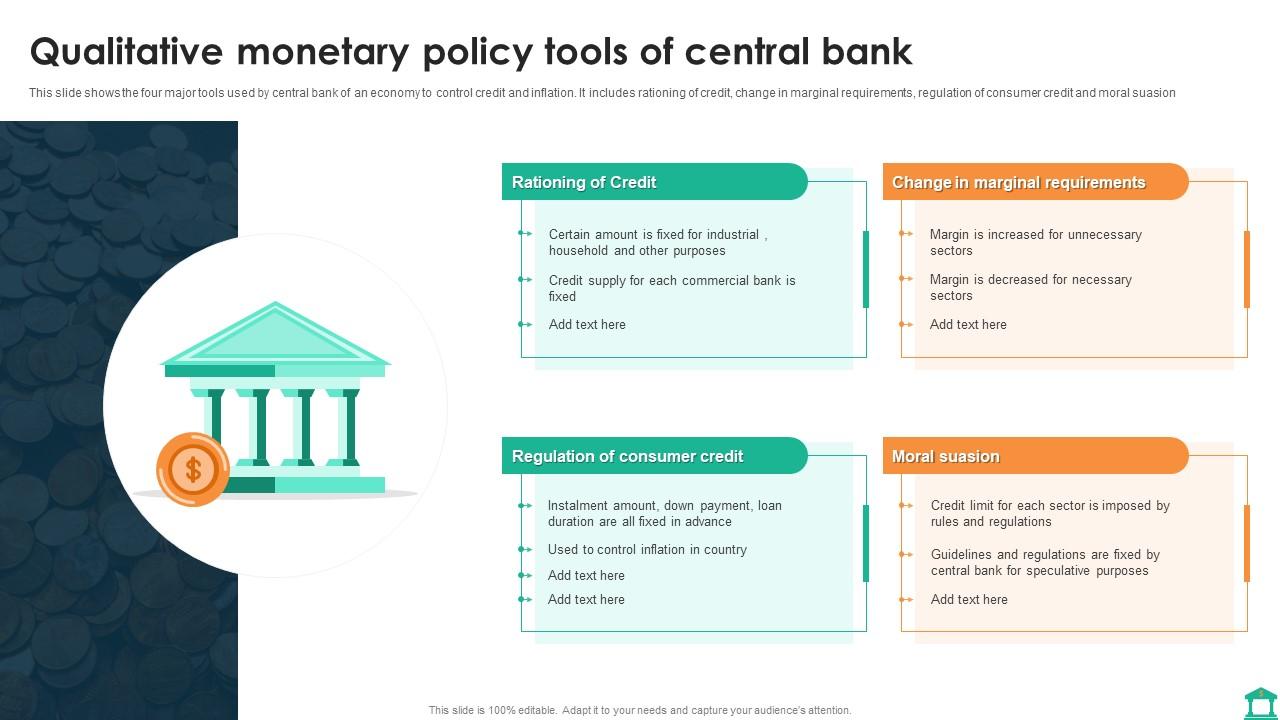
Central banks play a significant role in managing monetary policy, influencing a nation's money supply, interest rates, and credit conditions. Monetary policy tools include open market operations, reserve requirements, and discount rates. By adjusting these instruments, central banks aim to control inflation, stabilize prices, foster economic growth, and maintain full employment. For example, after the 2008 financial crisis, the Fed adopted an expansionary monetary policy by lowering interest rates to historically low levels and implementing quantitative easing, stimulating economic recovery (Bernanke, 2012).
[](https://www.slideteam.net/media/catalog/product/cache/1280x720/q/u/qualitative_monetary_policy_tools_of_central_bank_slide01.jpg)
*Monetary policy instruments*
## Promoting Financial Stability
Central banks are responsible for ensuring financial stability, overseeing the financial system's safety and soundness, and addressing potential risks. They must identify and mitigate systemic risks in the financial sector, such as those posed by large, interconnected financial institutions considered "too big to fail." Central banks regulate and supervise these institutions, ensuring adherence to capital adequacy, liquidity, and risk management standards. For instance, the Dodd-Frank Wall Street Reform and Consumer Protection Act of 2010 gave the Federal Reserve enhanced authority to regulate and supervise large, complex financial institutions to prevent financial crises (Dodd-Frank Act, 2010).
[](https://fastercapital.com/i/Central-banks--TSLF-and-Their-Role-in-Ensuring-Financial-Stability--Introduction-to-Central-Banks-and-Financial-Stability.webp)
*Central banks promoting financial stability*
## Price Stability and Inflation Targeting
Central banks aim for price stability to foster economic growth, maintain full employment, and enhance the purchasing power of a country's currency. By focusing on inflation targeting, central banks can establish credibility and confidence in their monetary policy actions. For example, the Bank of England has pursued a 2% inflation target since 1992, anchoring long-term inflation expectations and promoting economic stability (Bank of England, n.d.).
[](https://graphics.reuters.com/GLOBAL-CENBANKS/INFLATION/lbvggoqwgvq/chart.png)
*Inflation targeting for economic stability*
## Case Study: European Central Bank and the Eurozone Debt Crisis
The European Central Bank (ECB) played a pivotal role during the Eurozone debt crisis, when countries like Greece, Portugal, Ireland, and Spain faced severe financial difficulties. The ECB acted as the lender of last resort by providing emergency liquidity assistance to several European banks and purchasing government bonds to alleviate sovereign debt pressures. Moreover, the ECB engaged in various unconventional monetary policies, such as long-term refinancing operations and negative interest rates, to stabilize the European financial system (European Central Bank, n.d.).
The case study of the ECB's actions demonstrates the central bank's role in preserving financial stability and preventing contagion in times of turmoil. By providing crucial support to ailing economies, the ECB contributed to the Eurozone's survival and helped maintain the integrity of the European project.
[](https://i.guim.co.uk/img/static/sys-images/Guardian/Pix/cartoons/2011/9/26/1317067424399/European-Central-Bank-ECB-014.jpg?width=465&dpr=1&s=none)
*ECB Eurozone debt crisis support*
## Conclusion
Central banks are critical institutions tasked with ensuring financial stability, managing monetary policy, and maintaining price stability. Through their roles as lenders of last resort, regulators, and stewards of the financial system, central banks can significantly impact economic development. College students interested in deepening their understanding of the central bank's role can explore the following avenues:
1. Delve into the history of central banking and its evolution.
2. Examine various central bank governance structures and policy frameworks.
3. Investigate how central banks coordinate and cooperate with international organizations such as the International Monetary Fund and the Bank for International Settlements.
By examining the essential functions and key insights of central banks, college students can develop a nuanced understanding of these vital institutions and their crucial role in shaping the global economy.
## References
- Bank of England. (n.d.). Inflation targeting. Retrieved from
- Bernanke, B. (2012, November 2). The Federal Reserve's response to the financial crisis. Speech delivered at the National Economists Club 31st Annual Membership Meeting and Dinner, Washington, D.C. Retrieved from
- Dodd-Frank Act (Pub. L. No. 111-203, 124 Stat. 1376).
- European Central Bank. (n.d.). Crisis management. Retrieved from
- Sorkin, A. R. (2010). Too Big to Fail: The Inside Story of How Wall Street and Washington Fought to Save the Financial System—and Themselves. Penguin Group.
Last updated: 2024-06-24
Related Books

Related Knowledges