Regulatory Failure: Understanding its Core Concepts, Relevance, and Practical Implications
=====================================================================================
In the realm of economics and finance, understanding the concept of regulatory failure is crucial in analyzing the intricate relationship between government regulation and the performance of financial institutions. In "Too Big to Fail" by Andrew Ross Sorkin, the author provides a detailed account of the 2008 financial crisis, which was partly caused by regulatory failures that allowed systemically important financial institutions to engage in excessive risk-taking.
At its core, regulatory failure refers to the inability or inefficiency of regulatory measures and institutions to prevent or mitigate undesirable outcomes in the financial sector. These outcomes include financial crises, systemic risks, and moral hazards. Regulatory failure can manifest in various ways, such as insufficient regulation, inadequate enforcement, and poorly designed regulations.
Relevance of Regulatory Failure
-------------------------------
The concept of regulatory failure is highly relevant in today's financial landscape for several reasons. Firstly, the ever-increasing complexity of financial products and services demands more effective regulatory oversight. Secondly, the interconnectedness of financial institutions and markets necessitates robust regulations to prevent or mitigate systemic risks. Lastly, the constant endeavor to maintain a balance between financial innovation and financial stability hinges on a thorough understanding of regulatory failure.
Diverse Examples and Applications
---------------------------------
### 1. The 2008 Financial Crisis and Subprime Mortgage Lending
The 2008 financial crisis provides a compelling illustration of regulatory failure. In the years leading up to the crisis, lax regulation of financial institutions allowed them to engage in subprime mortgage lending with inadequate risk assessment. This led to a significant increase in the issuance of mortgage-backed securities, many of which contained toxic assets.
[](https://www.investopedia.com/thmb/HMCFEBHaSf1a-Zyc82DhzyAhT44=/1500x0/filters:no_upscale%28%29:max_bytes%28150000%29:strip_icc%28%29/dotdash_INV-final-Stock-Market-Crash-July-2021-01-88a96c7bec2846dd9986a5777c089417.jpg)
*2008 Financial Crisis timeline*
Financial institutions and rating agencies failed to recognize the risks associated with these instruments, leading to a housing bubble and, ultimately, a financial crash. Regulatory agencies, such as the Securities and Exchange Commission, failed to enforce adequate risk management practices within financial institutions. As a result, the financial sector experienced significant losses, and the global economy plunged into a deep recession.
### 2. The Dot-Com Bubble and the Failure of Self-Regulation
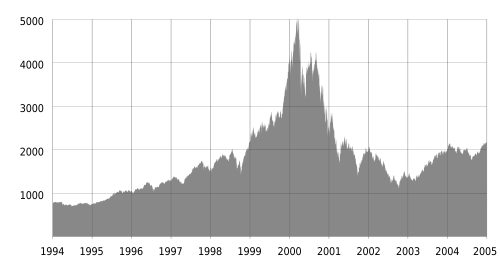
Another example of regulatory failure is the dot-com bubble of the late 1990s. During this period, the technology sector witnessed rapid growth, and many startups experienced soaring stock prices despite posting significant losses. The financial sector, driven by a belief in the exponential growth potential of technology companies, failed to exercise proper risk management.
In this case, regulatory agencies adopted a self-regulatory approach, allowing the industry to oversee itself. This approach proved insufficient in preventing the irrational exuberance that characterized the dot-com bubble. Consequently, when the technology bubble burst in 2000, many technology firms collapsed, resulting in substantial losses for investors.
[](https://upload.wikimedia.org/wikipedia/commons/8/84/Nasdaq_Composite_dot-com_bubble.svg)
*Dot-Com Bubble timeline*
Key Insights and Further Exploration
-----------------------------------
Understanding the concept of regulatory failure provides valuable insights into the limitations and challenges associated with financial regulation. By recognizing the shortcomings of current regulatory frameworks, scholars and policymakers can develop more effective strategies to mitigate the risks inherent in the financial sector.
Further exploration of regulatory failure can include researching its impact on financial innovation, investigating alternative regulatory approaches, and analyzing the role of political influences in regulatory decision-making. Ultimately, a comprehensive understanding of regulatory failure is critical in shaping future policies and regulations that balance financial stability, innovation, and economic growth.
To delve deeper into the topic of regulatory failure and its implications, consider the following resources:
* "The Failure of Regulation: What Went Wrong and Why" by Robert E. Litan and Wallace T. Bennett
* "Regulating Wall Street: The Dodd-Frank Act and the New Architecture of Global Finance" by Jeffrey N. Gordon and Randall S. Thomas
* "Moral Hazard and the Financial System" by Franklin Allen and Douglas Gale
Last updated: 2024-04-06
Related Books

Related Knowledges