# Randomness: Embracing Uncertainty and Antifragility
[](https://upload.wikimedia.org/wikipedia/commons/9/9b/Taleb_mug.JPG)
*Nassim Nicholas Taleb, author of Antifragile*
*Antifragile: Things That Gain from Disorder* is a book written by Nassim Nicholas Taleb, which introduces the concept of antifragility – the idea that some systems actually benefit from volatility, chaos, and uncertainty. Randomness is an essential element of antifragility, playing a crucial role in understanding and harnessing the power of unpredictability. In this lesson, we will explore the concept of randomness in Taleb's work and its practical implications in various aspects of life.
## What is Randomness?
Randomness can be defined as the lack of pattern or predictability in events. In *Antifragile*, Taleb distinguishes three types of randomness:
1. **Simple randomness**: Events occur regardless of each other, exhibiting no correlation or pattern.
2. **Complex randomness**: Events appear unpredictable but display certain statistical properties or fractal patterns.
3. **Non-randomness**: Events follow a specific pattern or cause-and-effect relationship.
[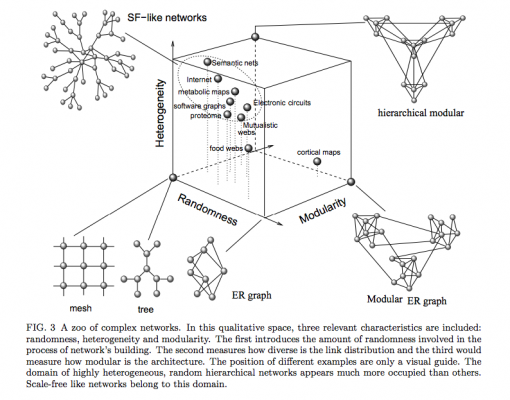](https://noduslabs.com/wp-content/uploads/2012/04/Screen-Shot-2012-04-05-at-19.26.38-510x400.png)
*Types of Randomness: Simple, Complex, and Non-random*
Understanding the distinction between these categories helps us appreciate the complex nature of randomness and its significance in various systems.
## How Does Randomness Relate to Antifragility?
Randomness is essential to antifragility because it enables systems to learn, adapt, and strengthen under volatility. Antifragile systems gain from exposure to stress, uncertainty, and randomness, leading to growth, resilience, and improved performance.
[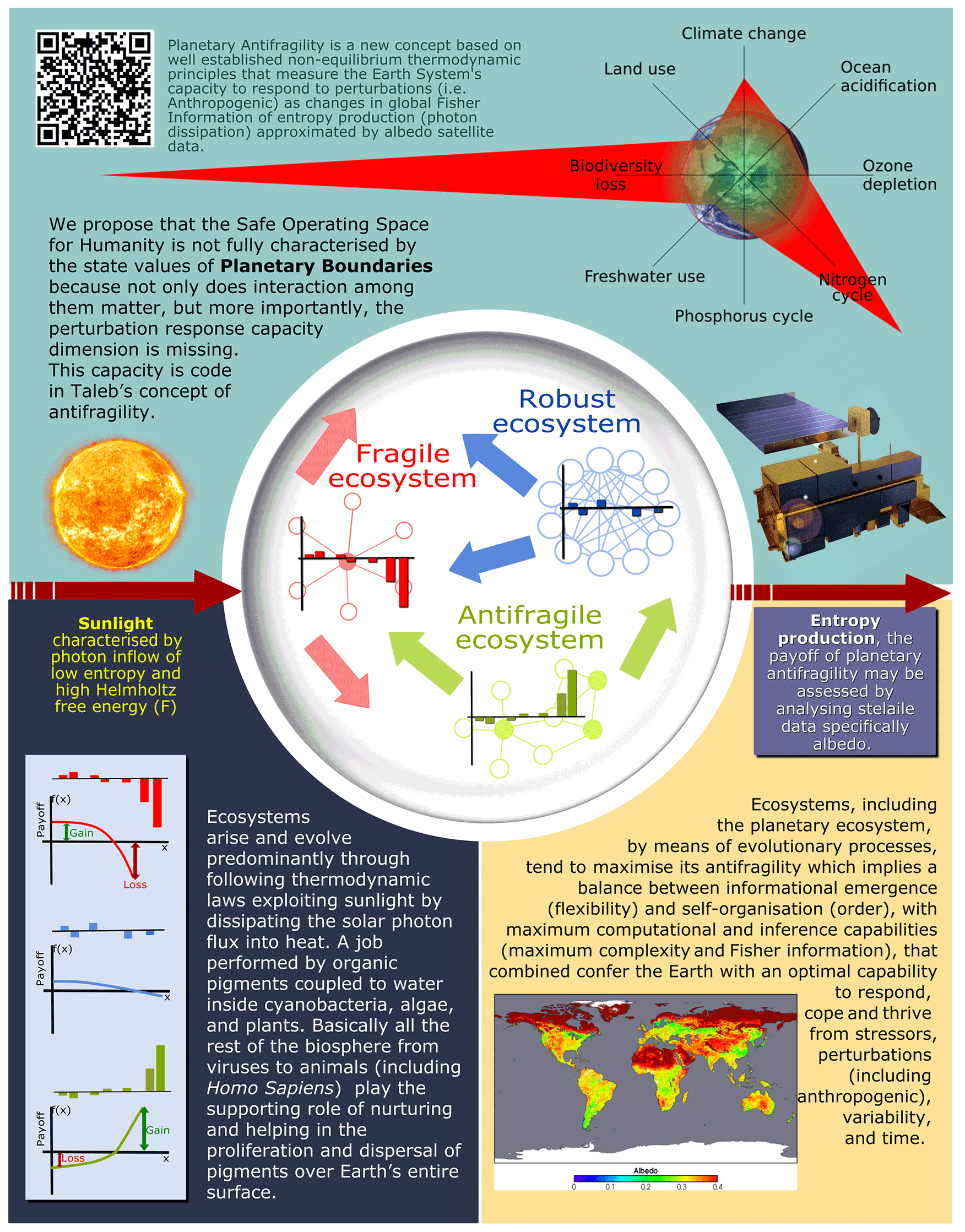](https://esd.copernicus.org/articles/13/1145/2022/esd-13-1145-2022-f03-web.png)
*Antifragility Concept in Systems*
Taleb introduces several examples in *Antifragile* to clarify the concepts of randomness and antifragility:
1. **Financial Markets**: Traditional financial models assume that market fluctuations follow fixed statistical patterns. However, Taleb contends that financial markets often experience extreme, unpredictable events – so-called Black Swans – that render these assumptions void. By acknowledging the randomness and inherent volatility in financial markets, investors can construct antifragile portfolios that benefit from increased uncertainty.
[](https://www.investopedia.com/thmb/FTs7Cs_80lJHY8kNyU3fe3VGYBI=/1500x0/filters:no_upscale%28%29:max_bytes%28150000%29:strip_icc%28%29/Blackswan-f5daa1c10708423bbb218f9db5452eb0.jpg)
*Black Swan Event in Financial Markets*
For instance, an option trader may profit from selling out-of-the-money put options on stocks they consider undervalued. By selling these options, the trader receives a premium that can be reinvested. If the stock price remains above the strike price at expiration, the trader keeps the premium, while the buyer of the option suffers a loss. In case of a significant market downturn – a Black Swan event – the option will most likely be exercised, resulting in substantial losses for the buyer. The trader's strategy, meanwhile, benefits from increased volatility.
2. **Innovation and Creative Destruction**: Industry and technological development often involve creative destruction, which drives innovation, improves processes, and replaces outdated methods. Chaos, turbulence, and unforeseen change contribute to a dynamic environment where innovators thrive. The randomness inherent in the process allows for new ideas to surface and emerge.
[](https://media.licdn.com/dms/image/v2/C4E12AQGgdCKFpeWmGQ/article-cover_image-shrink_720_1280/article-cover_image-shrink_720_1280/0/1520926497691?e=2147483647&v=beta&t=kwOm6rZDEXG8NkeKhqiRgNRtt_RMaS13enhrdzdnns4)
*Innovation Through Creative Destruction*
For example, the invention of the Internet randomized communication channels, leading to unforeseen applications and innovations. E-commerce platforms such as Amazon emerged from the newfound potential of the Internet, profoundly disrupting traditional retail businesses. Embracing the uncertainty and randomness provided by the Web enabled the development and growth of e-commerce, fueling the evolution of efficient supply chains and logistics networks.
## Further Exploration
Understanding randomness and antifragility has practical implications for decision-making and risk management in various disciplines, including finance, engineering, information technology, and urban planning. Here are some suggestions for further exploration of the topic:
- Learn more about Taleb's Incerto series, where he delves further into the subjects of randomness and antifragility. The series includes *Fooled by Randomness*, *The Black Swan*, *Antifragile*, and the forthcoming *Skin in the Game*.
- Review prominent mathematical models of randomness, including the Gaussian (normal) distribution, power-law distributions, and Pareto distributions, to recognize different patterns of randomness.
- Research statistical methods for complex data, such as wavelet transformations or chaos theory, which help identify underlying patterns in seemingly random phenomena.
- Explore the links between randomness and entrepreneurship, innovation, and decision-making under uncertainty.
## Conclusion
Embracing randomness and understanding its implications for antifragility is crucial in navigating today's complex and rapidly-changing world. By acknowledging the role of randomness in various systems, individuals and organizations can appreciate the potential benefits of unpredictability and harness its power to learn, adapt, and grow. Understanding and applying the principles laid out by Nassim Nicholas Taleb in *Antifragile* can improve decision-making and risk management in diverse disciplines, enabling individuals and organizations to thrive under conditions of uncertainty and volatility.
**Key Insights**
- Randomness is the absence of a discernible pattern or predictability in events.
- Taleb distinguishes three types of randomness: simple, complex, and non-random.
- Antifragile systems grow, adapt, and improve from exposure to stress, uncertainty, and volatility.
- Understanding randomness and antifragility can enhance decision-making and risk management in various disciplines.
- Further exploration includes mathematical models of randomness, statistical methods, and applying principles to entrepreneurship and innovation.
Last updated: 2025-03-30
Related Books

Related Knowledges