# Mandelbrotian Variability: Embracing Uncertainty and Complexity
In *Antifragile: Things That Gain from Disorder*, Nassim Nicholas Taleb introduces the concept of Mandelbrotian variability, drawing from the work of mathematician Benoit Mandelbrot. This concept challenges traditional Gaussian (normal) approaches to understanding variability and risk, instead emphasizing the importance of extreme events and power-law distributions.

*Benoit Mandelbrot, mathematician behind Mandelbrotian variability*
## Introduction: From Gaussian to Mandelbrotian Thinking
Gaussian thinking, based on the bell curve, assumes that variability is predictable and that extreme events are rare. In contrast, Mandelbrotian thinking acknowledges that variability is often unpredictable and characterized by extreme events. This shift in perspective has significant implications for various fields, including finance, engineering, and social sciences.
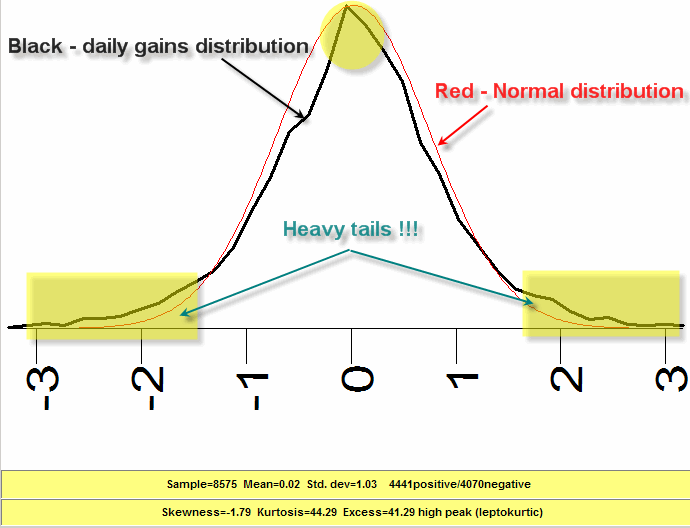
*Comparison of Gaussian and Mandelbrotian distributions*
## Mandelbrotian Variability in Finance
In finance, Gaussian thinking has historically dominated risk management and portfolio theory. However, the 2008 financial crisis exposed the limitations of this approach. Mandelbrotian variability, on the other hand, accounts for the "fat tails" or extreme events that are more common than Gaussian models suggest.

*Illustration of financial market 'fat tails'*
### Example 1: Black Swan Events
Taleb's concept of the "Black Swan" highlights the importance of Mandelbrotian variability. Black Swan events, characterized by their rarity, extreme impact, and retrospective predictability, are more accurately captured by Mandelbrotian thinking. By accounting for these extreme events, financial institutions can better prepare for and respond to unforeseen market disruptions.

*Black Swan event concept*
## Mandelbrotian Variability in Engineering
Engineering, particularly in the design of complex systems, has traditionally relied on Gaussian thinking. However, Mandelbrotian variability offers a more robust framework for understanding and managing risk in these systems.
### Example 2: The Three Mile Island Accident
The Three Mile Island accident in 1979 demonstrated the limitations of Gaussian thinking in engineering. The accident, classified as a "low-probability, high-consequence" event, was not adequately accounted for in the design and operation of the nuclear power plant. Mandelbrotian thinking, with its emphasis on extreme events, could have provided a more comprehensive approach to risk management.

*Three Mile Island nuclear accident*
## Mandelbrotian Variability in Social Sciences
In social sciences, Mandelbrotian variability offers a valuable framework for understanding complex phenomena and their underlying mechanisms.
### Example 3: The Spread of Social Movements
The spread of social movements, such as the Arab Spring, often follows a power-law distribution rather than a Gaussian one. Mandelbrotian variability can help social scientists better understand and predict the dynamics of these movements, enabling more effective policy interventions.
*Power-law distribution in social movements*
## Conclusion
Mandelbrotian variability, as introduced in Taleb's *Antifragile*, offers a powerful alternative to Gaussian thinking. By embracing the complexity and uncertainty of real-world systems, Mandelbrotian thinking provides a more robust framework for understanding risk and managing extreme events.
For further exploration, consider the following avenues:
* Investigate the applications of Mandelbrotian variability in other fields, such as biology, ecology, and climate science.
* Compare and contrast Mandelbrotian variability with other risk management frameworks, such as expected utility theory and prospect theory.
* Examine the policy implications of Mandelbrotian thinking for risk regulation and crisis management.
By delving deeper into Mandelbrotian variability, college students can develop a more nuanced understanding of uncertainty and complexity, equipping them with the tools to navigate an increasingly volatile and unpredictable world.
Last updated: 2024-03-20
Related Books

Related Knowledges