Nonlinear Response: A Key Concept in Antifragile Systems
=====================================================

*Nassim Nicholas Taleb, author of Antifragile*
In his book *Antifragile: Things That Gain from Disorder*, Nassim Nicholas Taleb introduces the concept of nonlinear response, which plays a crucial role in understanding the behavior of antifragile systems. At its core, nonlinear response refers to the phenomenon where a system's output or reaction is not proportional to the input or stress applied. Instead, the system's response can be disproportionately large or small, leading to unexpected and counterintuitive outcomes.

*Illustration of Nonlinear Response*
Nonlinear response is a fundamental concept in various disciplines, including mathematics, physics, engineering, economics, and biology. In the context of antifragile systems, nonlinear response helps explain how these systems not only withstand shocks and volatility but also thrive and become stronger as a result.
Examples of Nonlinear Response
----------------------------
### 1. Hormesis in Biology
Hormesis is a biological phenomenon where low levels of stress or toxins can have a beneficial effect on an organism, while higher levels can be harmful or even lethal. This behavior can be observed in various biological systems, such as the effect of radiation on cells or the impact of exercise on muscle growth.
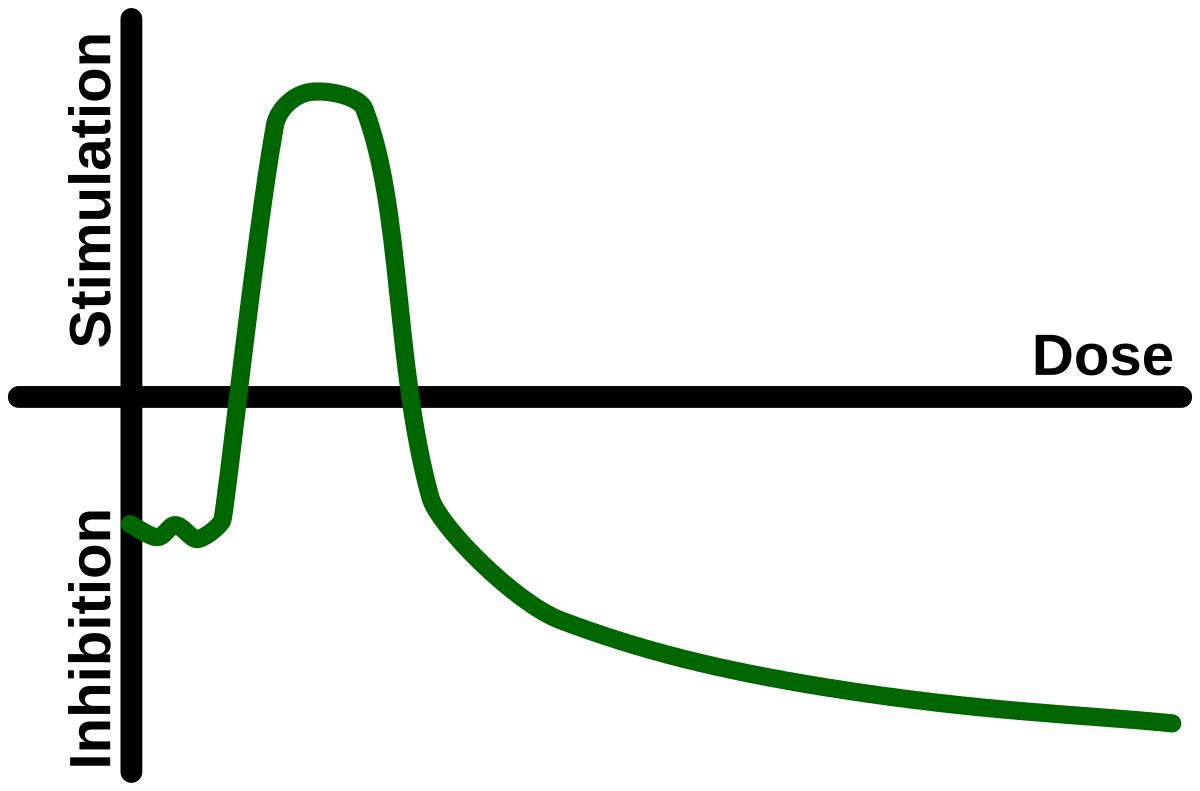
*Hormesis in Biology*
For instance, exposure to low levels of radiation can stimulate DNA repair mechanisms and increase the resistance of cells to further damage. However, higher levels of radiation can cause severe DNA damage, leading to mutations and even cancer. Similarly, moderate exercise can promote muscle growth and overall health, while excessive exercise can result in injuries and decreased performance.
### 2. Phase Transitions in Physics
Phase transitions, such as the transition from a liquid to a gas or from a ferromagnetic to a paramagnetic state, are characterized by nonlinear responses. These transitions occur abruptly, with a small change in a control parameter (e.g., temperature or pressure) leading to a drastic change in the system's properties.
For example, consider the phase transition of water at 100°C under standard atmospheric pressure. Below this temperature, water exists as a liquid, while above it, water transforms into a gas (steam). The response of water to temperature changes is nonlinear, as a slight increase in temperature above 100°C results in a significant change in the system's state.

*Phase Transition of Water*
Nonlinear Response and Antifragile Systems
---------------------------------------
Nonlinear response is a key characteristic of antifragile systems, which thrive on disorder, stress, and volatility. By understanding nonlinear response, we can better appreciate how antifragile systems can harness the energy and information from shocks and unpredictability to become stronger and more resilient.
Antifragile systems often exhibit convex responses to stress, meaning that their performance or output increases with an increase in the magnitude of the stressor, up to a certain point. This behavior contrasts with fragile systems, which display concave responses, where performance or output decreases with an increase in stress, and robust systems, which show linear or flat responses, where performance or output remains relatively constant despite stress.
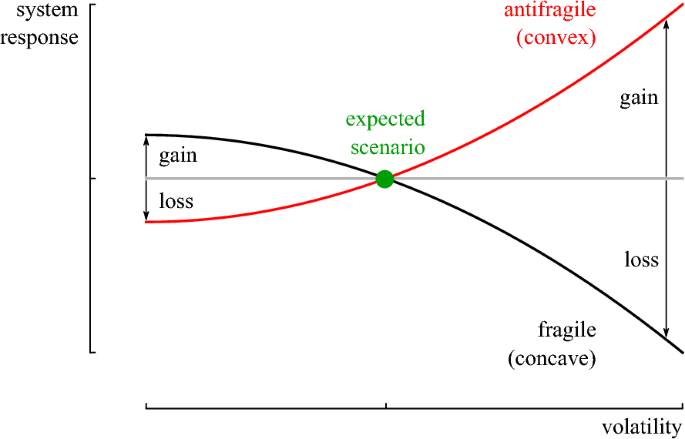
*Antifragile Systems Response*
Key Insights and Further Exploration
----------------------------------
Nonlinear response is a powerful concept that sheds light on the behavior of complex systems, particularly those that exhibit antifragility. By understanding nonlinear response, we can better appreciate the counterintuitive nature of these systems and develop strategies to harness their potential for growth and adaptation.
To further explore the topic of nonlinear response and its implications for antifragile systems, consider the following avenues:
1. Delve deeper into the mathematics of nonlinear systems, exploring concepts such as chaos theory, bifurcations, and catastrophe theory.
2. Investigate the role of nonlinear response in various disciplines, such as finance, economics, and social systems, and consider how these insights can inform policy-making and risk management.
3. Examine the relationship between nonlinear response and other key concepts in Taleb's work, such as the Lindy effect, via negativa, and the barbell strategy.
4. Explore the implications of nonlinear response for artificial intelligence and machine learning, particularly in the context of model uncertainty, overfitting, and adaptive algorithms.
By engaging with these topics, you will not only deepen your understanding of nonlinear response and antifragile systems but also develop a richer appreciation for the complex and interconnected nature of the world around us.
Last updated: 2024-03-20
Related Books

Related Knowledges