### The Anatomy of Export-Driven Economies: A Deep Dive into Asian Godfathers
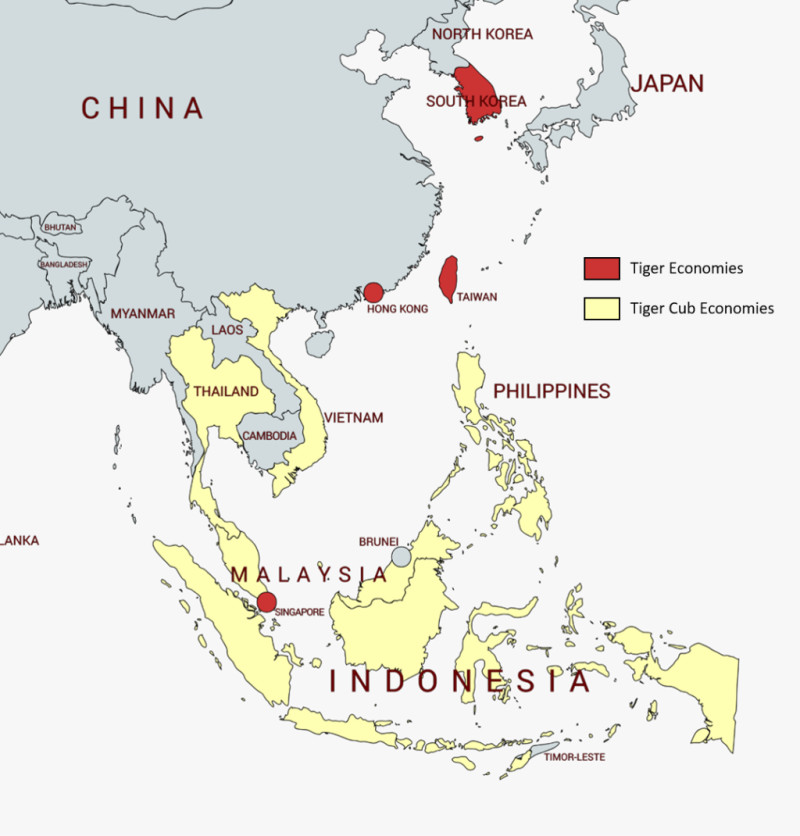
Establishing successful export-driven economies has been a primary driver of Asian economic "miracles" over the last five decades. In his seminal work, *Asian Godfathers*, journalist and researcher Joe Studwell provide a detailed analysis of how resource-scarce economies like Hong Kong, Singapore, Taiwan, and South Korea strategically harnessed the power of export-led growth to transform themselves into industrial powerhouses. This essay unravels the essence and the practical implications of export-driven economies, as detailed in Studwell's work.
[](https://assets.spe.org/dims4/default/63c16f7/2147483647/strip/true/crop/1024x1070+0+0/resize/800x836!/quality/90/?url=http%3A%2F%2Fspe-brightspot.s3.us-east-2.amazonaws.com%2Fe3%2Fb3%2F769447b0acbb2cb947d5c79ff8c8%2Ftwa-2018-08-tigercub-southeast-asia-map.png)
*The four Asian Tigers*
#### What are Export-Driven Economies?
An export-driven economy is a nation that proactively promotes and facilitates the export of goods and services to boost its economic growth and development. In the case of Asian economies discussed in *Asian Godfathers*, the process began with governments purposefully nurturing select industries to become globally competitive—often in labor-intensive manufacturing sectors—and providing them with incentives to expand their operations and capture foreign markets.
[](https://media.hinrichfoundation.com/media/n53h0ylo/paterson-china-consumption-slump-infographic-web.jpg)
*Export-driven economy diagram*
#### Key Elements and Relevance
Three major elements contribute to successful export-driven economies according to Studwell's analysis. First, a strong and efficient government plays a crucial role in crafting policies to create a conducive business environment that enables firms to flourish and compete internationally. Second, a disciplined and strategic allocation of resources focusing on strategic industries helps cultivate globally competitive enterprises. Third, the relentless pursuit of technological advancements and innovation propels these economies into higher value-added production stages.
Understanding the making of export-driven economies bears a multitude of implications for college students willing to explore developmental economics or undertake a career concerning international business or public policy. It unveils the deliberate, strategic efforts required to turn around an economy. Moreover, it provides insights into industries and regions likely to witness growth and investment opportunities.
#### Case Study: Hong Kong – From a Barren Rock to a World City
Hong Kong, a British colony until 1997, is a prominent instance of a successful export-driven economy. Post-WWII, Hong Kong drew upon its core strengths of geographical proximity to mainland China, an enterprising populace, and a laissez-faire economic system backed by robust property rights protection. In particular, it targeted several labor-intensive industries such as textile, electronics, and toys, and soon climbed the ranks in global export shares.
Later, the Hong Kong government strategically capitalized on its growing manufacturing base and transitioned towards services by advocating the expansion of its financial and logistics sectors. As a result, the city-state transformed into a leading global financial hub and a critical gateway for foreign investments into mainland China.
[](https://cdn.i-scmp.com/sites/default/files/d8/images/canvas/2024/03/08/2e0c9793-9c10-494d-861d-e8ca9b89d22e_e89e7a52.jpg)
*Hong Kong skyline showcasing economic growth*
#### Case Study: South Korea's Chaebols – State-guided Capitalism
Another stellar example is South Korea's transformation from a war-torn nation to the world's 12th largest economy. The South Korean government was instrumental in fostering select industries by supporting the growth of powerful conglomerates known as chaebols (e.g., Samsung, Hyundai, and LG). Similar to Hong Kong, South Korea too identified strategic sectors for development, primarily focusing on heavy and chemical industries in the 1970s and later ventured into information technology and electronics.
A key distinction of South Korea's export-driven model was active government steering via policy interventions, subsidies, protectionism, and credit allocation to the chaebols. By investing heavily in research and development, South Korea rapidly ascended the value chain and entered capital and technology-intensive markets, becoming a global leader in several sectors like shipbuilding, electronics, and automobiles.
[](https://www.nber.org/sites/default/files/inline-images/w29252.jpg)
*South Korea's industrial growth*
#### Implications and Further Exploration
Studwell's in-depth analysis of Asian Godfathers underscores the significance of savvy, proactive, and purposeful governance to translate resource scarcity into a competitive advantage. Furthermore, it highlights the necessity of strategic resource allocation, the value of entrepreneurship, and the potential of innovation-driven growth.
To further explore the intricacies of export-driven economies, one could study other emerging economies, like Taiwan, Malaysia, or Vietnam, and analyze their distinct strategies and milestones. Additionally, investigating the role of multinational corporations in facilitating or hindering such growth models presents another valuable avenue for further inquiry.
Last updated: 2024-05-29
Related Books
Related Knowledges