Human Fallibility: Understanding Our Limits and Embracing Rational Discussion
==============================================================================
_"Less perfection, more discussion"_
In the realm of philosophy and social sciences, the concept of human fallibility assumes paramount significance. Delving deep into the depths of human erring and fallibility, esteemed philosopher and intellectual titan Karl Popper, in his seminal work, *The Open Society and Its Enemies*, sheds light on the inherent limitations of human knowledge and understanding. Popper's exploration of human fallibility underscores the importance of being cognizant of our innate imperfections, fostering a culture of humility, and embracing rational discussion as a cornerstone of our pursuit of truth. Let us embark on a journey to illuminate the essence of human fallibility, drawing insights from the rich tapestry of philosophical thought and practical implications for our daily lives.
[](https://cdn.britannica.com/69/199769-050-CC9752D7/Karl-Popper-1991.jpg)
*Karl Popper*
Understanding Human Fallibility
------------------------------
At its core, human fallibility bespeaks the inherent limitations and weaknesses in human judgment, comprehension, and knowledge acquisition. Engaging in the process of self-reflection, one may uncover the manifold aspects of human fallibility, such as cognitive biases, bounded rationality, and the predisposition to commit errors. By understanding and acknowledging these shortcomings, we can strive towards enhancing our intellectual rigor, fostering a sense of epistemic humility, and forging meaningful connections with fellow inquirers on the path to truth.
In the words of Karl Popper, "the capacity to recognize one's errors—that is, to be capable of criticism—is the mark of the educated man." As such, embracing human fallibility, rather than being daunted by it, provides the foundation for intellectual growth and development, fueling an insatiable appetite for knowledge and understanding.
### Cognitive Biases and Bounded Rationality
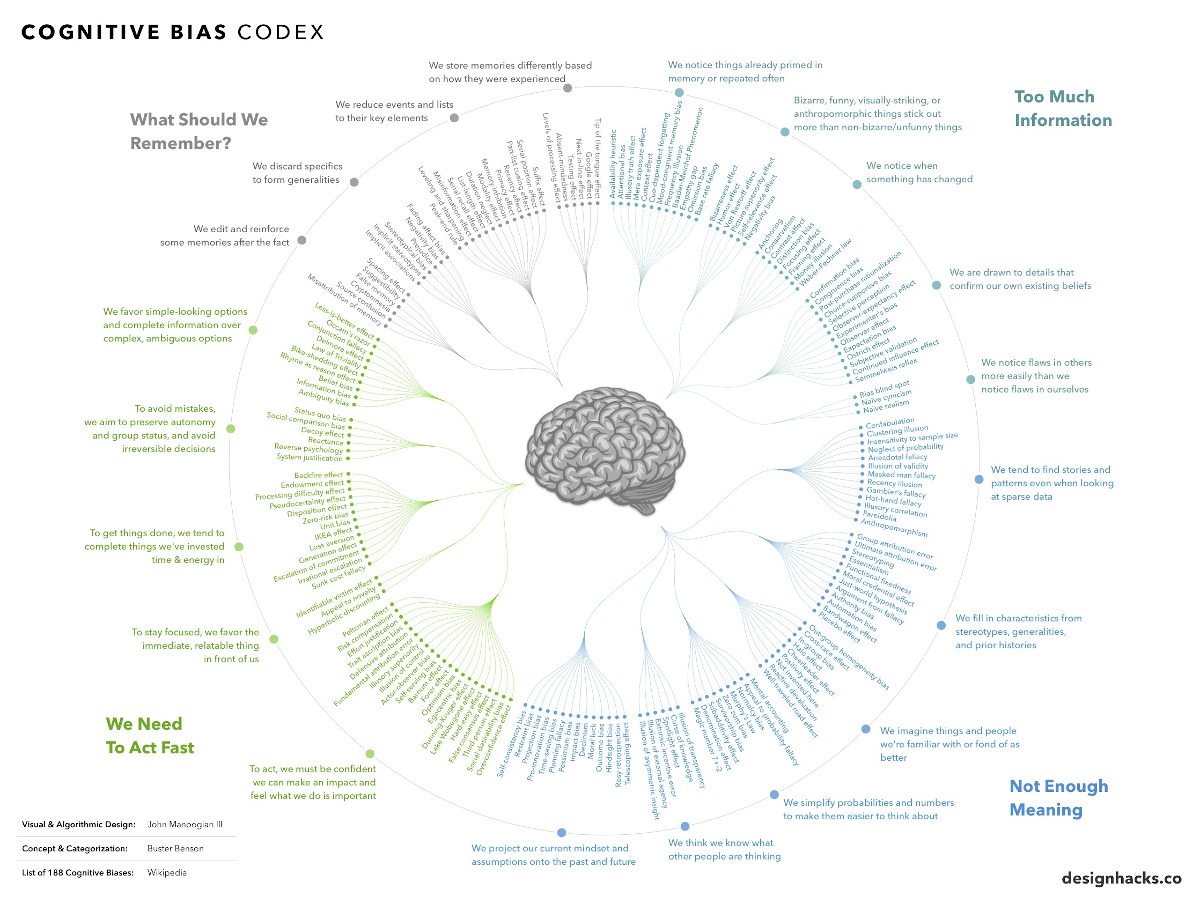
At the intersection of psychology and economics, cognitive biases and bounded rationality emerge as salient features of human fallibility. Cognitive biases allude to systematic deviations from rationality, decision-making, and problem-solving, often stemming from mental shortcuts and heuristics. Examples of these biases encompass, but are not limited to, confirmation bias, availability bias, overconfidence bias, and anchoring bias. These biases, whether manifesting individually or collectively, exert a profound influence on our thinking processes, judgment, and decision-making, rendering us susceptible to committing errors and succumbing to misconceptions.
[](https://www.visualcapitalist.com/wp-content/uploads/2017/09/cognitive-biases-1200.jpg)
*Cognitive biases chart*
In addition to cognitive biases, bounded rationality, a concept introduced by Herbert A. Simon, sheds light on the inherent limitations of human decision-making in light of cognitive constraints and informational asymmetry in the real world. Recognizing the implications of cognitive biases and bounded rationality, one can develop an awareness of the potential pitfalls that might obfuscate the pursuit of truth and optimal decision-making.
[](https://www.wallstreetmojo.com/wp-content/uploads/2022/08/Bounded-Rationality.jpg)
*Bounded Rationality diagram*
### Epistemic Humility and Intellectual Rigor
In the face of human fallibility, the cultivation of epistemic humility emerges as a crucial attribute for intellectual growth and development. Epistemic humility entails an awareness of the expansive domains of ignorance and a profound appreciation for the fallibility of our knowledge and understanding. Embodying epistemic humility paves the way for the forging of connections with fellow truth-seekers, fostering an environment conducive to learning and open dialogues.
Concomitant with epistemic humility lies intellectual rigor—a steadfast commitment to upholding academic integrity, engaging in critical thinking, and adopting a meticulous approach towards the evaluation of claims and arguments. Intellectual rigor demands an unwavering dedication to the principles of objectivity, honesty, and fair-mindedness, ensuring that our inquiry and inquest remain grounded in sound reasoning and solid evidence.
## Practical Implications and Applications
Human fallibility transcends the boundaries of abstract philosophical thought and finds its footing in the realm of practical applications and implications. By internalizing and incorporating an understanding of human fallibility into our daily lives, we can cultivate the habits and practices that promote intellectual curiosity, foster meaningful dialogue, and uphold the values of objectivity, fair-mindedness, and truth-seeking. In the sections that follow, we shall explore practical applications of human fallibility in the form of decision-making, dialogue and communication, and intellectual honesty.
### Thoughtful Decision-Making
Acknowledging the implications of human fallibility can lead to an augmented decision-making process, one that is marked by mindfulness, deliberation, and an unwavering commitment to truth-seeking. By remaining vigilant of the pitfalls of cognitive biases and bounded rationality, decision-makers can minimize the potential for errors, ensure that critical information is not overlooked, and strive to optimize the outcome of decisions.
To this end, one may incorporate strategies such as conducting thorough research, seeking diverse perspectives, and engaging in iterative processes, wherein decisions are continuously evaluated, refined, and recalibrated in light of newly acquired information and evolving circumstances.
[](https://bonnieterrylearning.com/wp-content/uploads/teaching-kids-decision-making.png)
*Decision Making Process*
### Dialogue and Communication
In the context of human fallibility, effective dialogue and communication serve as essential components for fostering open, respectful, and engaging discourse. By prioritizing the values of epistemic humility, active listening, and intellectual rigor, dialogue participants can establish a safe, inclusive, and nurturing environment that upholds the principles of objectivity, fair-mindedness, and truth-seeking.
In engaging in constructive dialogue, participants should prioritize the following practices—seeking first to understand, acknowledging the limitations of one's knowledge, and resisting the urge to resort to dogmatism or close-mindedness. These practices promote an atmosphere of intellectual camaraderie, forging a collective commitment to the pursuit of truth and understanding.
[](https://nbs.net/wp-content/uploads/2022/02/How-to-communicate-successfully-within-dialogue.png)
*Dialogue and Communication*
### Intellectual Honesty and Academic Integrity
At the nexus of human fallibility and academic integrity lies intellectual honesty—a steadfast adherence to the principles of truth-seeking, objectivity, and credibility. Intellectual honesty calls for a rigorous evaluation of claims, evidence, and arguments, ensuring that our beliefs, attitudes, and actions align with the facts and evidence at hand.
In embodying intellectual honesty, one may adopt the practices of maintaining transparency, acknowledging the limitations of one's knowledge and understanding, and fostering a commitment to the continuous improvement of one's knowledge and skills. By upholding the values of intellectual honesty, we not only fortify the integrity of our inquiry but also contribute to the collective advancement of knowledge and understanding.
[](https://cdn.sketchbubble.com/pub/media/catalog/product/optimized1/9/8/9892ca4ee7dd15d62f852b4db26fbb67c607799cc5ff1bcc926567424cb98b4a/intellectual-honesty-slide1.png)
*Intellectual Honesty*
## Conclusion
Karl Popper's exploration of human fallibility provides a framework for understanding our inherent limitations, weaknesses, and potential for error in the pursuit of truth and knowledge. By cultivating the habits and practices that foster epistemic humility, intellectual rigor, and truth-seeking, we can establish a strong foundation for intellectual growth and development.
In practical applications, human fallibility serves as a guiding light for effective decision-making, dialogue and communication, and intellectual honesty. By embracing the tenets of human fallibility, individuals and communities alike can nurture a culture that champions openness, inclusivity, and collective learning, ultimately paving the way for the betterment of the human condition.
As a final thought, we invite you to consider the following questions for further reflection and discussion:
* How can one cultivate and refine the habits and practices that promote epistemic humility and intellectual rigor?
* In what ways can human fallibility be integrated into educational curricula and pedagogical practices to foster critical thinking and intellectual curiosity?
* How might the principles of human fallibility be applied in the context of addressing societal challenges and global issues, such as climate change, social inequality, and political polarization?
Last updated: 2024-04-05
Related Books

Related Knowledges