# The Fallacy of 'Sure Things': Embracing Uncertainty and Improving Decision Making
## Introduction
In her insightful book, *Thinking in Bets: Making Smarter Decisions When You Don't Have All the Facts*, renowned author and professional poker player Annie Duke* introduces a powerful concept: the fallacy of 'sure things'. At its core, this idea challenges our innate tendency to believe that we can predict outcomes with certainty. By understanding and embracing the inherent uncertainty in life, we can significantly improve our decision-making capabilities.
[](https://www.annieduke.com/site/uploads/fs-annie-duke-final-mp3-image.jpg)
*Annie Duke, author of Thinking in Bets*
This knowledge point is essential for college students as it encourages critical thinking and fosters intellectual humility. It teaches us that decision making is not merely a matter of being right or wrong, but rather a continuous process of refining and adjusting our beliefs based on new information and experiences.
## The Fallacy of 'Sure Things'
The fallacy of 'sure things' refers to our often irrational belief that we can accurately predict outcomes and that some events are guaranteed to transpire. This belief can manifest in various aspects of our lives, from professional and academic pursuits to personal relationships and financial decisions.
Duke argues that this fallacy is dangerous because it obscures our ability to rationally evaluate probabilities and make informed decisions. Instead, it fosters overconfidence, leading to poor judgment and ultimately suboptimal outcomes.
[](https://corporate-assets.lucid.co/chart/5eaf9c22-de8b-4c68-8770-6fffce781591.png)
*Decision making process diagram*
## Practical Implications with Illustrative Examples
### 1. Predicting Academic Performance
Suppose a college student named Jane is convinced that she will receive an A in her upcoming statistics final because she has consistently achieved high grades in previous classes. Despite her strong track record, Jane may be falling victim to the fallacy of 'sure things'.
To combat this, Jane should acknowledge that while her past performance is a positive indicator, it does not guarantee a similar outcome in the future due to the myriad factors that can influence her performance (e.g., test format, instructor's grading style, etc.). By estimating the true probability of earning an A, Jane can temper her expectations, develop a more realistic study plan, and make better use of her time and resources.
### 2. Job Offer Decisions
Consider a recent college graduate, John, who receives a job offer from a reputable company in his field. Although the offer appears promising, John is hesitant because he has interviewed with another company that he perceives as a 'sure thing'.
Here, the fallacy of 'sure things' can lead John to overlook potential benefits and drawbacks of each opportunity. Instead of treating either decision as absolute, John should weigh the pros and cons of each option and assign probabilities to the potential outcomes. This method allows him to make a more informed decision by objectively comparing the opportunities based on their merits.
[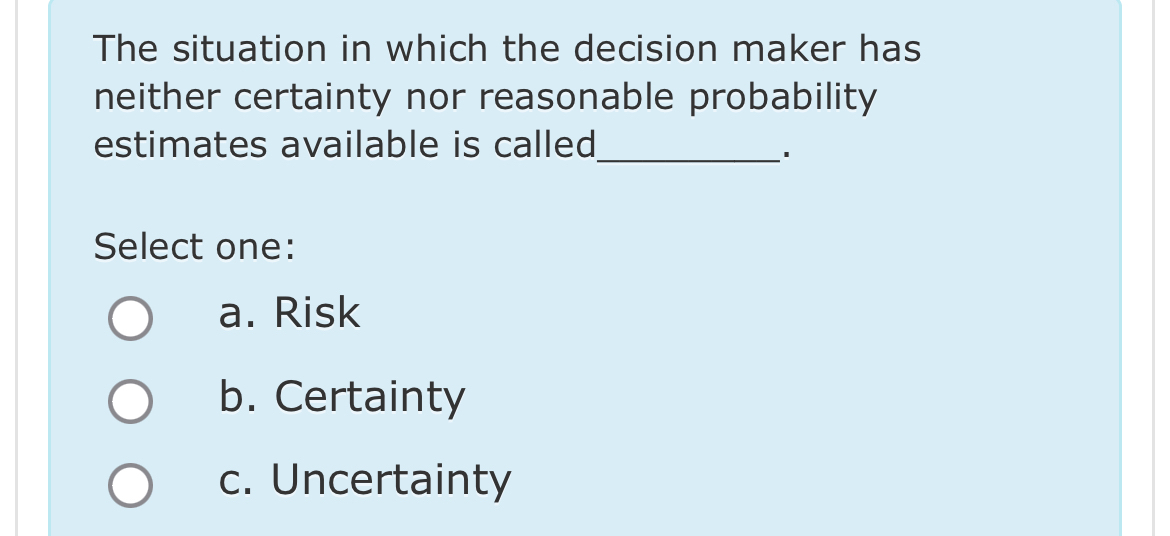](https://media.cheggcdn.com/study/81e/81ed03e7-f0d0-4ddc-96a3-32b8c956e0ca/image)
*Probability estimation in decision making*
## Conclusion
Embracing uncertainty and acknowledging the fallacy of 'sure things' can significantly enhance our decision-making capabilities, both in academic and professional settings. By recognizing the inherent unpredictability of life, we can become more judicious in our assessments, more adaptable in our approaches, and ultimately more successful in our pursuits.
For further exploration of this concept, consider reading *Thinking, Fast and Slow* by Daniel Kahneman, which delves deeper into cognitive biases and their influence on decision making. Additionally, engage in discussions and debates with peers on this topic, drawing on real-life examples to test your understanding and strengthen your critical thinking skills.
### References
- Duke, Annie. *Thinking in Bets: Making Smarter Decisions When You Don't Have All the Facts*. Penguin Random House, 2018.
- Kahneman, Daniel. *Thinking, Fast and Slow*. Farrar, Straus and Giroux, 2011.
Last updated: 2024-05-31
Related Books
Related Knowledges