# The Role of Emotions in Decision-Making: A Deep Dive into Annie Duke's Thinking in Bets
## Introduction
[](https://upload.wikimedia.org/wikipedia/commons/3/31/Annie_Duke_jgphoto_002.jpg)
*Annie Duke, author of Thinking in Bets*
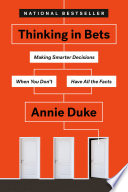
Emotions play a crucial role in our everyday decision-making processes. However, understanding the intricate relationship between our emotions and the choices we make can often be challenging. In her book, *Thinking in Bets: Making Smarter Decisions When You Don't Have All the Facts*, former professional poker player Annie Duke delves into the ways that emotions can impact our decision-making abilities, offering valuable insights into the importance of considering our emotional states when trying to make informed and well-thought-out choices.
Duke emphasizes the value of understanding that decision-making is not a discrete event but rather a continuous process that unfolds over time. This perspective allows us to view our decisions as a series of bets – or educated guesses based on the information available to us at any given moment – that can help us better understand the role of emotions in our decision-making processes.
In this deep dive into Thinking in Bets, we will explore the following aspects of the role of emotions in decision-making:
1. The impact of cognitive biases on our decision-making and the role of emotions in perpetuating these biases.
2. The value of separating the decision from the outcome, focusing on the process instead of the emotional attachment to a specific result.
3. Strategies for cultivating a growth mindset and embracing uncertainty when facing high-stakes decisions.
## Emotions, Cognitive Biases, and Decision-Making
[](https://media.licdn.com/dms/image/D5612AQHu4e40_2Vquw/article-cover_image-shrink_720_1280/0/1689702603714?e=2147483647&v=beta&t=46I5Z5dPI2LeQieFj96gtmwTWZVHOTQgB36kV48bMxE)
*Cognitive Biases in Decision Making*
Cognitive biases often stem from our emotional responses, heavily influencing the choices we make. These inherent biases can lead to poor decision-making, as we might not fully consider the available information and may instead rely on our past experiences or emotional triggers.
Consider the following example from Thinking in Bets: imagine you are a sports fan and your favorite team has just won a game after an impressive comeback. In this situation, you might attribute the win to the team's resilience and skill, while attributing any losses to factors like bad refereeing or poor weather conditions. This phenomenon, known as the *outcome bias*, arises from our desire to find a clear explanation for the result, often leading us to overlook the complexity of the situation and the role of chance. In this example, our emotional attachment to the team can impair our ability to objectively analyze the factors that contributed to the win or loss.
To counteract the impact of cognitive biases in our decision-making process, it is crucial to cultivate a more nuanced understanding of the role of emotions and to develop strategies that help minimize the influence of these biases. In the next section, we will examine one such strategy: separating the decision from the outcome.
## The Importance of Separating the Decision from the Outcome
By focusing on the decision rather than the emotional attachment to a specific outcome, we can better evaluate our decision-making process and learn from our mistakes. This approach encourages us to view decisions as a series of experiments that enable us to expand our knowledge rather than as definitive events that we must either "win" or "lose."
Duke provides the example of a medical intern faced with the decision of whether to operate on a patient suffering from abdominal pain. Despite following the best course of action based on the information available – including the patient's symptoms, diagnostic tests, and medical history – the intern ultimately discovers that the patient had a rare form of appendicitis that was not initially detected. In this situation, the intern's decision to operate was correct based on the available information, but the outcome was still unfavorable due to the unforeseen circumstances.
By separating the decision from the outcome in this scenario, the intern can recognize the quality of the decision-making process while acknowledging the inherent uncertainty in the situation. This mindset allows the intern to learn from the experience and apply the insights gained to future decisions, fostering continuous growth and development.
Another strategy for minimizing the impact of emotions on decision-making is to embrace uncertainty, particularly when facing high-stakes situations. In the following section, we will discuss the importance of cultivating a growth mindset and willingly embracing the unknown when striving to make informed choices.
## Cultivating a Growth Mindset and Embracing Uncertainty
[](https://www.success.com/wp-content/uploads/2022/06/A-New-Book-Explores-How-Uncertainty-Can-Be-Your-Greatest-Gift-1024x682.jpg)
*Embracing Uncertainty*
One of the most effective ways to counteract the impact of emotions on decision-making is to develop a growth mindset and embrace uncertainty when navigating high-stakes scenarios. By viewing decision-making as a continuous process that allows for learning and adaptation, we can minimize our emotional attachment to specific outcomes and instead focus on refining our decision-making skills over time.
To illustrate this concept, consider the story of a business owner weighing the decision to expand their operations by opening a new location. Despite extensive market research and a well-crafted business plan, the owner discovers that the new location is not as successful as anticipated in its first year of operation. However, rather than viewing this outcome as a failure, the owner adopts a growth mindset, recognizing that the decision to expand was rooted in the best information available and acknowledging that the unfavorable outcome does not define their abilities as a business owner.
Armed with this newfound understanding, the business owner can use the first year's data to refine their decision-making process and make adjustments for the future, ultimately leading to a more informed and well-thought-out decision the next time around.
## Conclusion
By examining the role of emotions in decision-making through the lens of Annie Duke's Thinking in Bets, we can better understand the ways that our emotions can influence the choices we make. By exploring the impact of cognitive biases, separating the decision from the outcome, and cultivating a growth mindset, we can develop strategies that help minimize the influence of emotions on our decision-making processes and, in turn, make smarter and more informed choices.
For further exploration of this topic, consider the following questions:
1. In what ways do emotions play a role in your personal and professional decision-making processes?
2. How can understanding the concept of separating the decision from the outcome be applied to other aspects of life?
3. What are some additional strategies for minimizing the impact of cognitive biases on decision-making?
By continuing to examine the role of emotions in decision-making, we can refine our understanding of the complex interplay between our emotional states, our biases, and the choices we make, ultimately leading to increasingly effective and well-informed decision-making strategies.
Last updated: 2024-05-31
Related Books
Related Knowledges