# Using Scenarios and Stress-Testing: Sharpening Decision-Making Skills
In her insightful book, *Thinking in Bets: Making Smarter Decisions When You Don't Have All the Facts*, Annie Duke emphasizes the importance of using scenarios and stress-testing to enhance decision-making skills. By exploring various possibilities, estimating probabilities, and rehearsing reactions, we can better prepare ourselves for the uncertainties of real-world situations. This approach encourages critical thinking and adaptability, fostering a growth mindset and reducing the likelihood of cognitive biases. In this piece, we will delve into detailed examples and applications to illustrate the practical implications of using scenarios and stress-testing.
[](https://www.annieduke.com/site/uploads/fs-annie-duke-final-mp3-image.jpg)
*Annie Duke, author of Thinking in Bets*
## Core Concepts and Relevance
At the heart of using scenarios and stress-testing is the understanding that we rarely have complete information when making decisions. Therefore, it is crucial to assess various possibilities and their potential outcomes. By simulating different scenarios and stress-testing our strategies, we can:
1. Identify our assumptions and test their validity.
2. Evaluate the robustness of our decisions under various conditions.
3. Reflect on potential cognitive biases and prevent them from skewing our decision-making.
[](https://www.venasolutions.com/hubfs/03%20Blog%20Files/Blog%20Images/Blog%20Articles/Why%20What-If%20Scenario%20Analysis%20Is%20Critical%20for%20Driving%20Decision%20Making/vena-blog_%20Why%20What-If%20Scenario%20Analysis%20Is%20Critical%20for%20Driving%20Decision%20Makings.jpg)
*Scenario analysis in decision making*
Applying scenarios and stress-testing to real-world situations can be valuable in several contexts, such as business strategy, investment, and project management.
## Practical Examples and Applications
### Business Strategy: Market Entry
Consider a company, Alpha Tech, contemplating entering a new market. By examining various scenarios and stress-testing their strategies, Alpha Tech can better understand the risks and potential rewards associated with this decision.
#### Scenarios
1. **Market Growth:** The new market experiences rapid growth, and Alpha Tech captures a significant share.
2. **Market Stagnation:** The market remains stagnant, and Alpha Tech struggles to gain traction due to intense competition.
3. **Market Decline:** A downturn in the market negatively impacts Alpha Tech's performance, leading to significant losses.
#### Stress-Testing
Alpha Tech's management team can stress-test their strategies by estimating the likelihood of each scenario and analyzing the potential financial and reputational impacts. For instance, if the probability of **Market Decline** is deemed high due to economic factors, Alpha Tech can:
- Develop contingency plans, such as diversifying product offerings or reallocating resources.
- Assess their risk tolerance and evaluate potential partnerships or acquisitions to mitigate losses.
- Re-examine their entry strategy, timeline, and budget, making adjustments as necessary.
By stress-testing their decision, Alpha Tech's management team fosters a proactive, adaptive mindset that prepares the company for various outcomes.
[](https://www.mckinsey.com/~/media/mckinsey/business%20functions/strategy%20and%20corporate%20finance/our%20insights/stress%20testing%20for%20nonfinancial%20companies/svg_stress_testing_for_nonfinancial_companies_ex1.svgz?cq=50&cpy=Center)
*Stress-testing in business strategy*
### Investment: Stock Portfolio Management
Investors can benefit from using scenarios and stress-testing to manage their stock portfolios. By evaluating potential market conditions and their impact on individual holdings, investors can optimize their portfolios and minimize risks.
#### Scenarios
1. **Bull Market:** Stocks generally experience strong growth, leading to higher portfolio values.
2. **Bear Market:** Stocks decline, resulting in reduced portfolio values.
3. **Volatile Market:** Stocks exhibit significant fluctuations, leading to uncertainty and potential losses.
#### Stress-Testing
Investors can stress-test their portfolios by assessing the performance of individual holdings under each scenario. For example, if a **Bear Market** is likely due to economic uncertainty, an investor can consider the following actions:
- Reallocating assets to more defensive sectors or instruments, such as bonds or cash.
- Diversifying the portfolio by adding uncorrelated assets to minimize overall risk.
- Implementing a stop-loss strategy to limit potential losses.
By stress-testing their portfolio, investors make data-driven decisions that equip them for various market conditions.
[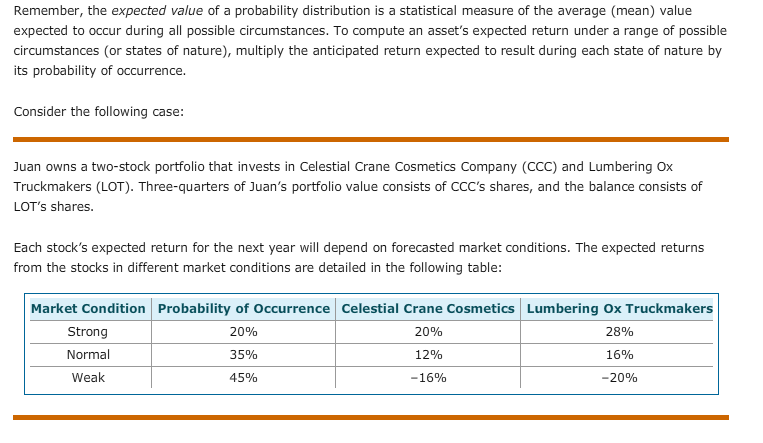](https://media.cheggcdn.com/media/129/129ae551-e9c8-4490-a250-9d798f4894d5/phpzITw11.png)
*Investment portfolio management under different market conditions*
## Key Insights and Further Exploration
By using scenarios and stress-testing, we can:
- Estimate probabilities of various outcomes and make informed decisions.
- Prepare ourselves for unforeseen circumstances and develop adaptive mindsets.
- Limit the impact of cognitive biases on our decision-making.
Further exploration of this topic can include strategies for identifying and addressing cognitive biases, applying scenarios and stress-testing in personal decision-making, and analyzing case studies of successful stress-testing implementations.
Using scenarios and stress-testing allows us to approach decision-making with a proactive, calculated mindset that fosters growth and resilience. By applying these concepts, we can significantly enhance our ability to navigate the uncertainties of life with confidence and competence.
Last updated: 2024-06-04
Related Books

Related Knowledges