Collaborative Decision-making: Lessons from Annie Duke's "Thinking in Bets"
=============================================================================
[](https://images.blinkist.io/images/books/5bf0b5a66cee0700076f059d/1_1/470.jpg)
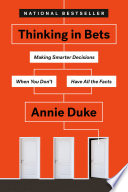
*Cover of 'Thinking in Bets' by Annie Duke*
Introduction
------------
[](https://www.insperity.com/wp-content/uploads/5-smart-strategies-for-balancing-collaboration-and-decision-making-1-1200x630.png)
*Illustration of collaborative decision-making*
Collaborative decision-making is a powerful tool for modern organizations, allowing them to harness the collective wisdom of their members for improved outcomes. In her book "Thinking in Bets," Annie Duke provides us with a wealth of insights on decision-making, emphasizing the importance of approaching it as a process of probability and risk management. Here, we explore Duke's lessons on collaborative decision-making and its practical implications in various contexts.
Core Concepts
-------------
* ### Decision-making as a process
[](https://corporate-assets.lucid.co/chart/5eaf9c22-de8b-4c68-8770-6fffce781591.png)
*Diagram of the decision-making process*
Decision-making is not a one-time event; rather, it is a continuous process that demands reflection and adaptation. This perspective encourages sharing, learning, and growth among team members.
* ### The role of uncertainty
[](https://executiveeducation.wharton.upenn.edu/wp-content/uploads/2021/08/2108-decision-making-under-uncertainty-600.jpg)
*Visualizing uncertainty in decision-making*
By accepting the inherent uncertainty in decision-making, teams can build a more robust and adaptive decision-making culture. Duke encourages decision-makers to be open about what they know and don't know, facilitating more effective collaboration in mitigating risks and managing outcomes.
* ### Outcome vs. Process Learning
[](http://mikecardus.com/app/uploads/2014/06/Process-and-Results-for-team-building-and-leadership-development_thumb.jpg)
*Outcome vs. Process Learning visualization*
Instead of solely focusing on the outcome of a decision, Duke emphasizes the importance of evaluating the decision-making process. This approach encourages learning, growth, and adaptation, making the process the essential factor for successful decision-making.
Applications and Examples
-------------------------
### Case Study: The Silicon Valley Tech Company
A tech company in Silicon Valley consistently faces challenging, high-stakes decisions due to the rapid pace of innovation. By shifting towards a collaborative and reflective decision-making culture, they can harness the insights of their diverse workforce to navigate uncertainty better. Duke's book can help the company accomplish the following:
[](https://dupont.scene7.com/is/image/Dupont/Website%20banner%20V2?fmt=png-alpha)
*Collaboration in a Silicon Valley tech company*
* Encouraging the sharing of ideas and perspectives among different departments and disciplines
* Building a learning culture that emphasizes evaluation of the decision-making process instead of solely outcomes
* Fostering a growth mindset that embraces failure as a potential source of learning
* Enhancing the ability of the workforce to manage risk and ambiguity using data-driven analysis
### Case Study: The Non-Profit Humanitarian Organization
[](https://taroworks.org/wp-content/uploads/2024/04/Enterprise-Grant-Web-Banner-Mobile-version-1024x699.jpg)
*Collaborative effort in a non-profit humanitarian organization*
A non-profit humanitarian organization aims to address pressing social issues and allocate resources efficiently. Adopting Duke's principles can improve the following:
* Fostering transparent and inclusive collaboration to harness the insights of diverse stakeholders and improve resource allocation
* Balancing the need for action with careful consideration, minimizing the risk of unintended consequences
* Encouraging fact-based decision-making through collective fact-finding efforts
* Establishing a robust feedback loop that facilitates learning, iteration, and adaptation
Key Insights and Further Exploration
------------------------------------
[](https://m.media-amazon.com/images/I/51qtdxclBAL._AC_UF1000,1000_QL80_.jpg)
*Examples of collaborative decision-making in action*
Collaborative decision-making is a powerful tool for improving organizational outcomes in the face of uncertainty and complexity. Annie Duke's insights in "Thinking in Bets" offer practical strategies for colleges students and professionals alike.
Here are some insights and discussion prompts for further exploration:
* How do ethical considerations influence collaborative decision-making processes, especially in high-stakes scenarios?
* In what ways can technology facilitate and optimize collaborative decision-making among distributed teams?
* How might cognitive biases impact the collaboration and decision-making processes, and what strategies can be used to minimize their influence?
In conclusion, collaborative decision-making, when informed by Duke's framework, enables organizations and individuals to manage risks, adapt to uncertainty, and effectively navigate complex situations. By integrating the core concepts from "Thinking in Bets," college students and professionals can hone their critical thinking, communication, and adaptability skills necessary to tackle the challenges of the modern world.
Last updated: 2024-05-31
Related Books
Related Knowledges