# Old Major's Vision: A Critique of Class Struggle and Oppression in George Orwell's Animal Farm
## Introduction
[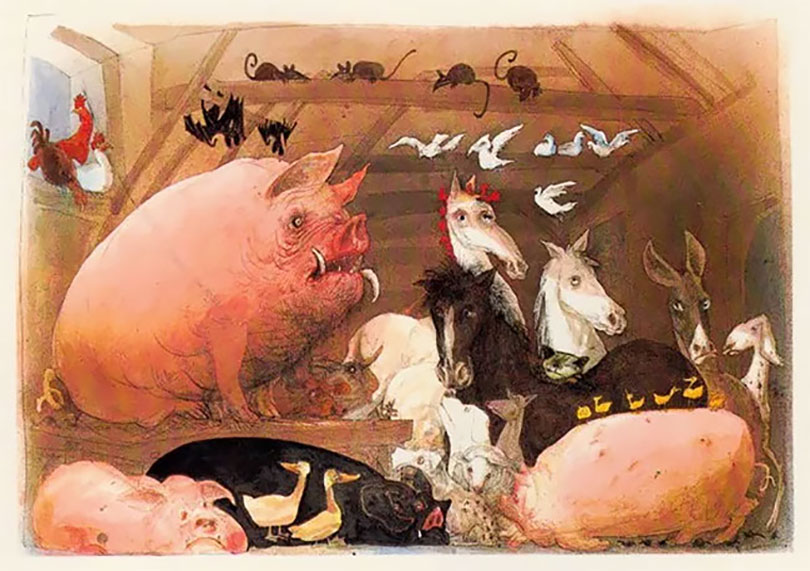](https://cdn8.openculture.com/2017/08/15235012/orwellanimalfarm1.jpg)
*George Orwell's Animal Farm*
In George Orwell's renowned novella, *Animal Farm*, Old Major's vision of a socialist society serves as a foundational premise for the plot's development. As a Marxist critique of the Russian Revolution, Old Major's teachings represent both a call for the animals' emancipation and a stark warning against the corruption of revolutionary ideals. This essay delves into the core concepts of Old Major's vision: the inherent flaws in the capitalist system, the necessity of a revolution, and the dangers of a power-driven elite. Through engaging examples and practical implications, we will not only explore Old Major's vision in greater depth but also highlight its enduring relevance for today's college students.
## Inherent Flaws in the Capitalist System
Central to Old Major's vision is his critique of the capitalist system and its exploitative nature. Orwell illustrates this concept through the relationship between Mr. Jones and his animals. According to Old Major,
[](https://c8.alamy.com/comp/D9CHR6/paris-france-detail-poster-of-capitalist-exploitation-at-demonstration-D9CHR6.jpg)
*The Capitalist System and Exploitation*
> Man is the only real enemy we have. Remove Man from the scene, and the root cause of hunger and overwork is abolished for ever. (Orwell 13)
Orwell emphasizes that the ruling class (humans) benefit from the labor of the working class (animals), who suffer wage theft, poor conditions, and overwork. This critique resonates with the historical and contemporary class struggle in marxist theory. Today's students may draw parallels between Old Major's criticism and ongoing issues in our society, such as income inequality, labor exploitation, and corporate greed.
## Necessity of a Revolution
The imperative of revolution lies at the heart of Old Major's vision. He persuades the animals that the existing social order must be abolished and replaced by a socialist system founded on 'animalism.' Old Major outlines the principles of animalism as follows:
[](https://media.newyorker.com/photos/59096d6c2179605b11ad723e/master/pass/101004_r20052_p886.jpg)
*Revolution and Social Change*
> All animals are equal. But some animals are more equal than others. (Orwell 18)
While the initial statement embodies a fundamental precept of socialism, the latter addition foreshadows the imminent corruption and self-serving interests that lead to the pigs' consolidation of power and the reinstatement of inequality.
The necessity of a revolution and the dilemma of power management is a recurrent theme in history. Students today should reflect on the critical role of the leader(s) during a revolution. As seen in Animal Farm, once the ruling party seizes power, the potential for corruption and exploitation threatens the very principles of the revolution itself. Students can analyze how power structures have evolved in contemporary society, examining how political and social revolutions have led to positive change or uncovered the dangers of consolidated power.
## Dangers of a Power-driven Elite
[](https://insight.kellogg.northwestern.edu/imager/clientcontent/7913/does_power_corrupt_art_265dcf20bf86bc91590c49e978b05b5a.jpeg)
*Power Dynamics and Corruption*
Orwell issues a stern warning against the dangers of a power-hungry elite by depicting the devolution of the revolution. While the initial intention of 'animalism' was to promote equality among animals, the pigs' usurpation of resources and manipulation of ideology result in an arguably worse situation than before the revolution.
The transformation of the seven commandments provides a striking example of the pigs' misuse of power. The initial commandment – "*No animal shall kill any other animal*" – is eventually amended to "*No animal shall kill any other animal without cause*" (Orwell 51-52). These amendments illustrate the danger of a ruling elite, as shown in the gradual regression towards the original system of haves and have-nots.
Students can consider parallels in historical revolutions and the consequences of power consolidation. Studying power dynamics in society and politics encourages students to reflect on the checks and balances required for sustainable and just governance.
## Conclusion
Old Major's vision of socialist reshuffling in Animal Farm offers a rich avenue for college students to analyze, discuss, and draw parallels to contemporary issues and historical precedents. Through understanding the inherent flaws of the capitalist system, the necessity of a revolution, and the dangers of a power-driven elite, students can apply these critical insights to ongoing dialogues in society, political theories, and real-world issues.
As students delve deeper into 'Old Major's vision,' they can explore topics such as:
- The role of revolutionary leadership
- Devolution and regression in historical revolutions
- Power dynamics and consolidation of authority in politics and corporations
- Comparative studies of Marxist theory and capitalist systems
- Power and ethical implications in socialist thought
Last updated: 2024-06-23
Related Books
Related Knowledges