# End of Ignorance: Debiasing Our Perspective
## Introduction
In the realm of decision-making, we often struggle with a pervasive issue: our cognitive biases. Nassim Nicholas Taleb, in his book "Fooled by Randomness," emphasizes the importance of understanding the role of randomness and luck in shaping our lives and decisions. By acknowledging and addressing these cognitive biases and the role of randomness, Taleb argues that we can reach the 'End of Ignorance' -- a state of heightened awareness and understanding. In this discourse, we will explore the core concepts of Taleb's ideas and provide real-world examples to illustrate the practical implications of embracing the 'End of Ignorance'.
## Cognitive Biases & Randomness
[](https://www.visualcapitalist.com/wp-content/uploads/2017/09/cognitive-biases-1200.jpg)
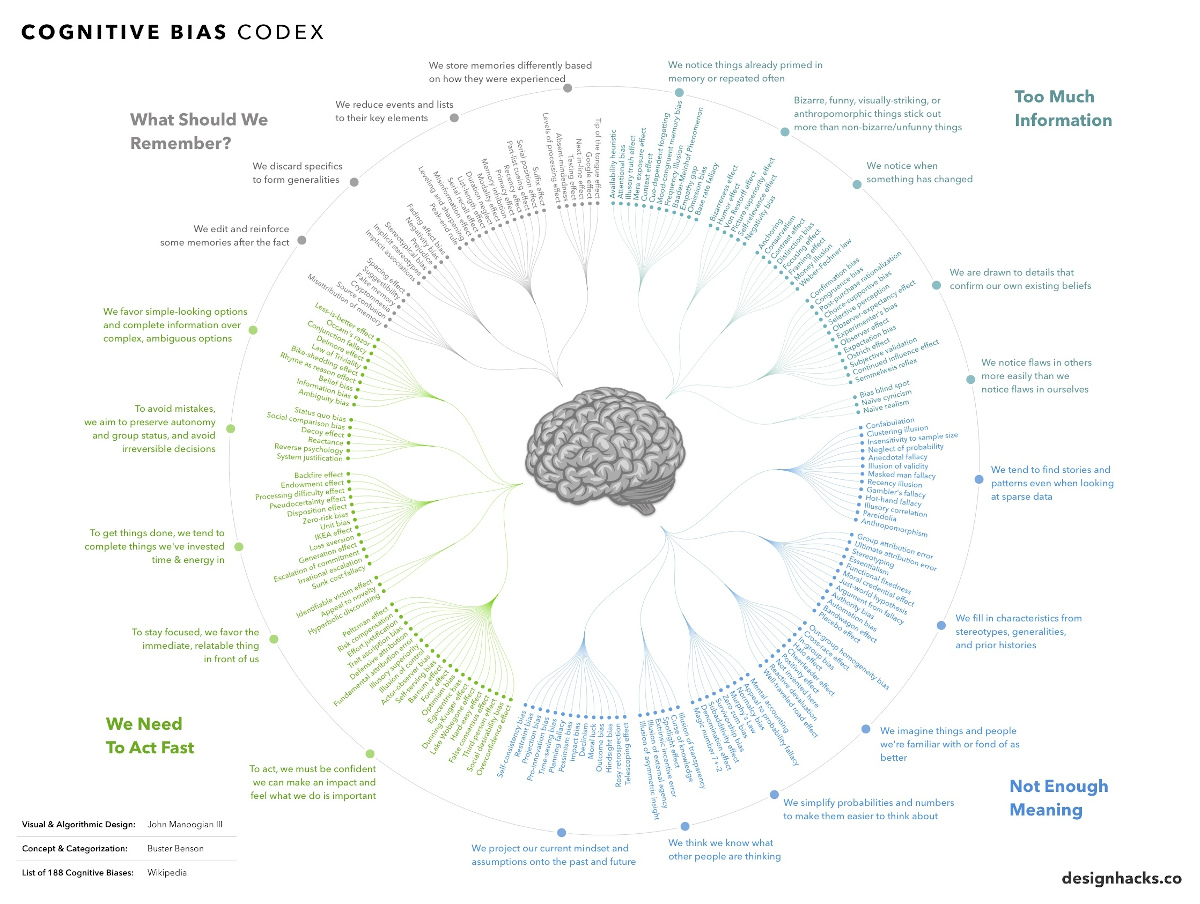
*Understanding Cognitive Biases*
At the heart of Taleb's message is the significance of understanding cognitive biases--predictable patterns of deviation from rational judgment--and how they affect our decision-making process. Taleb argues that humans are prone to overestimating the importance of skill and underestimating the role of chance. As a result, we attribute success to personal abilities and failures to external factors, creating a skewed perspective.
Additionally, humans often conflate correlation with causation, leading to flawed decision-making. Taleb asserts that by understanding and acknowledging these pitfalls, we can strive for the 'End of Ignorance': a more nuanced, comprehensive understanding of the world that accounts for randomness and uncertainty.
## Debiasing Our Perspective
Embracing the 'End of Ignorance' involves actively confronting and mitigating the effects of cognitive biases. This process begins with raising awareness of our propensity to fall prey to these biases. By acknowledging our limitations, we can begin to implement strategies that promote more balanced decision-making.
[](https://assets-global.website-files.com/5f46d1d4a0d948ce3438f8d0/62d6feff28e71188d6563998_async%20protocol.png)
*Checklists and Protocols for Decision-Making*
A powerful method for debiasing our perspective is the systematic use of checklists and protocols. These tools can help decision-makers avoid common pitfalls by providing a clear and concise framework for addressing problems. Furthermore, employing the practice of 'pre-mortem analysis' can uncover potential weaknesses in our decision-making process by examining the possible reasons for a project's failure before it even begins.
## Practical Implications
### Example 1 - Investing
The world of finance is replete with examples of the dangers of ignoring cognitive biases and randomness. Consider the phenomenon of 'narrative fallacy,' where we construct plausible stories to explain historical returns. By attributing these returns to skill rather than chance, investors may overestimate their abilities and take on excessive risk.
[](https://www.investopedia.com/thmb/I-hYXo69QJpeiCVFyWEmsfGKQiM=/1500x0/filters:no_upscale%28%29:max_bytes%28150000%29:strip_icc%28%29/terms_r_randomwalktheory_FINAL-29f2ea494d0f4809836a1e16fb174eaf.jpg)
*The Role of Randomness in Finance*
In contrast, recognizing the role of randomness in investment performance can help mitigate this bias. By adopting a long-term, value-oriented approach centered on diversification and risk management, investors can strive for more consistent returns and resist the allure of short-term performance chasing.
### Example 2 - Personnel Management
The 'End of Ignorance' also carries significant implications for personnel management. Managers frequently encounter difficulties in distinguishing between employee performance and luck. Overemphasizing short-term results can lead to the promotion of less competent individuals--a phenomenon known as the 'Peter Principle.'
[](https://www.aihr.com/wp-content/uploads/strategic-human-resource-management.png)
*Effective Personnel Management Strategies*
To counteract this issue, organizations can implement objective performance evaluation methods, accounting for fluctuations due to randomness. Additionally, focusing on long-term employee development through training and mentorship can foster an environment conducive to growth and continued success.
## Conclusion
To summarize, the 'End of Ignorance' represents a critical step towards more informed, comprehensive decision-making. By acknowledging the presence and impact of cognitive biases and randomness in our lives, we can implement strategies to mitigate these effects. Ultimately, the 'End of Ignorance' encourages a mindset that embraces uncertainty and fosters the pursuit of knowledge, enabling us to become more effective decision-makers and better equipped to navigate the complexities of our world.
For further exploration, interested readers might consider expanding their understanding of cognitive biases by studying the work of Nobel laureates Daniel Kahneman and Amos Tversky. Additionally, integrating the principles of formal logic and critical thinking can provide a robust foundation for debiasing decision-making processes. Indeed, the pursuit of wisdom is an ongoing journey, and the 'End of Ignorance' serves as a vital milestone towards that end.
Last updated: 2024-06-05
Related Books

Related Knowledges